

Welcome to Polymathic Being, a place to explore counterintuitive insights across multiple domains. These essays explore common topics from different perspectives and disciplines to uncover unique insights and solutions.
Today’s topic examines the secrets Army Rangers use to succeed. It’s an insight that offers a slightly different view on discipline and shows how many benefits in work and life are right at your fingertips.
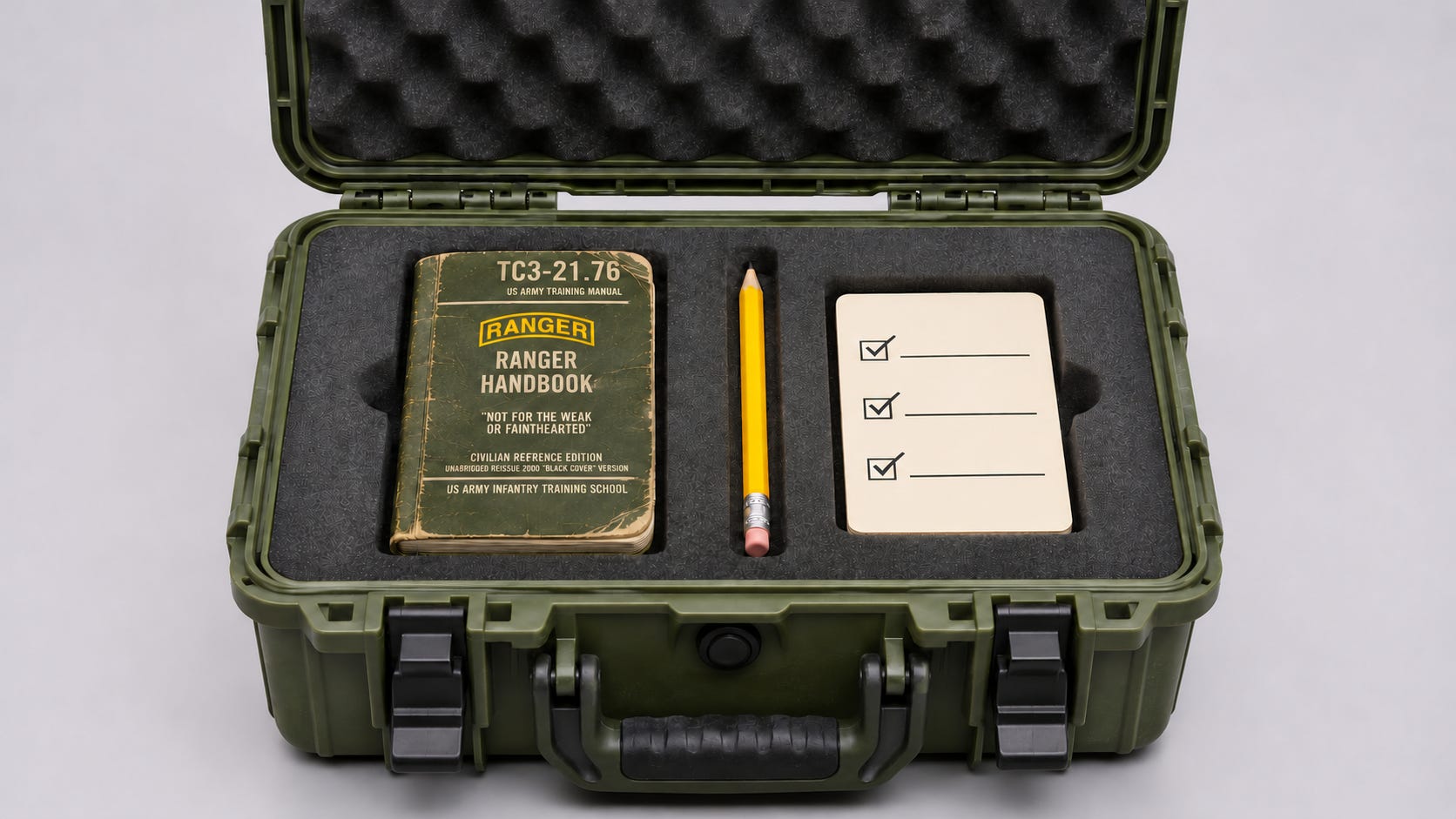
In a work meeting the other day, we were talking about capturing our best practices in program management, systems integration, and mission engineering into a playbook of sorts to help program teams get up to speed faster. It’s the classic paradigm of great work being done on programs but not always transferring over. But then it hit me: it had nothing to do with a lack of documentation, quick guides, or playbooks. It really was just one little secret I learned in Ranger School:
Just do the Things.
Now, the Rangers didn’t say it like that; for that, I credit Joshua Deiches who, while getting back in shape, kept asking for little shortcuts or tips, and it always ended up being the same: cut calories, lift heavy weights, use good form, focus on the whole body, sleep well… You know, the “Things” that are so blindingly obvious that we can’t imagine they’re so simple.
Back to the Rangers: they’ve got a special Ranger Handbook that you get on your first day of Ranger School that contains all the secrets of success in squad and platoon leadership and tactics. It’s the book that the Ranger Instructors (RIs) exclusively grade you on. It’s the holy grail of knowledge for passing the hardest leadership school on the planet to earn the coveted Ranger tab.
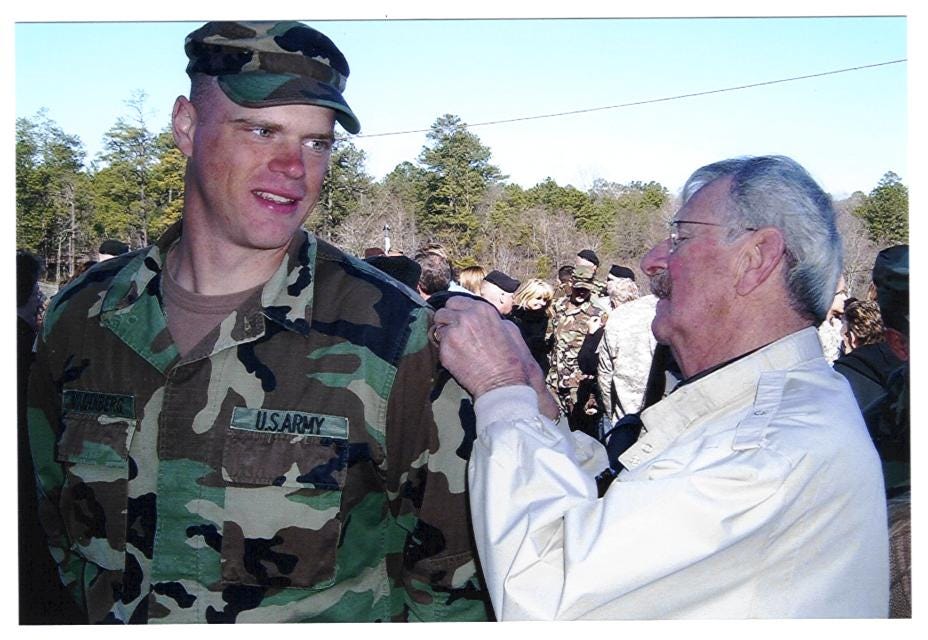
The Ranger Handbook is also just a distillation of the Army’s Field Manual FM 3-21.8, and you can read it by clicking the hyperlink! It’s world-class knowledge in Squad and Platoon tactics and leadership right at your fingertips. The manual breaks down everything from battle drills to troop-leading procedures, medevac processes, calling in airstrikes, and tactics, techniques, and procedures. All the Things needed for successful warfare.
You just have to do the Things.
During that work conversation, I described that the only difference between the Special Forces and standard line units fundamentally boiled down to discipline. They did the Things, they trained the Things, they drilled and drilled the Things. Because it wasn’t about the mission (they’re all different) or the equipment (it changes) or the people (they come and go); it came down to the discipline of actually doing the Things exceptionally well.
In Ranger School, those who failed didn’t do the Things. Worse, the things they did focus on were more checklist compliance than true internalization of the important Things. They made Ranger School more complicated while failing to realize it was about discipline, focus, and adaptability under stress while doing the Things.
At work, those who fail also don’t do the Things.
Because the reality is, we don’t lack knowledge of how successful programs, systems integrations, and mission decomposition happen. We have guides and best practices and templates, and documents, and technical artifacts, that describe ALL the Things.
We have the Program Management Body of Knowledge (PMBoK), which contains everything you need for project planning, work breakdown structures, stakeholder management plans, earned value management, and other fundamentals of successful program management.
There’s also the Systems Engineering Body of Knowledge (SEBok), which shows everyone how to do systems integration starting from good requirements definition, decomposition, and deconfliction. It walks you through how to manage verification and validation in your design phases so integration is continuous and adaptable.
We have the Mission Engineering Guide (MEG 2.0), which, step by step, gives you a framework for decomposing complex missions and defining Measures of Success, Measures of Effectiveness, and Measures of Performance. It’s also built on the Joint Mission Essential Task List (JMETL), Unified Joint Task List (UJTL), and Joint Common System Function List (JCSFL). Simply put, it covers the fundamentals that ensure rigorous mission decomposition.
We just don’t do those Things.
Part of this is because we love to convince ourselves that this project, integration, or mission is special, unique, or somehow different. We looked at Unicorn Projects before and showed how, for as unique as everyone thinks they are, they all end up failing for exactly the same reasons, whether it’s petroleum turnarounds, advanced space systems, factory management, blockchain startups, autonomous systems, or AI architectures. No one is truly a unicorn, and that mindset overlooks the vast amount of knowledge lost in ignoring the simple Things.
A great example from the Military was one we introduced in The Enemy’s Gate Is Down - Counterintuitive Insights from the War on Terror, where the military treated Improved Explosive Devices (IEDs) as something new instead of recognizing that it was just part of a classic ambush for which we have battle drills addressing how to react. We turned a tactics problem into a technical problem and drove thousands of soldiers to their deaths in textbook ambushes.
Another element is that we fall victim to three leadership fallacies: 1. believing the people doing the work know what they need to be successful, 2. that people naturally gravitate toward higher levels of performance, and 3. that there’s inherent accountability. These are fallacies because reality demands we provide Direction, Energy, and Proactive Accountability. Ignoring that simple reality is a common failure.

A third element is that we just assume someone else will do the Things. This was a real-life behavior I experienced while running a program office where the lead absolved themselves of the Things by regularly stating: “Not my circus, not my monkeys.” But the Things are, in fact, your circus, and if you don’t manage those monkeys, they create chaos.
A fourth, but not final element (there are always excuses for not doing the Things) is that we think our merit is based on how much effort we put in and, counterintuitively, those who actually do the Things make complex programs look ‘easy,’ but this is like a Special Operator moving onto an objective or an expert skier on a black diamond versus watching a noob, who doesn’t even know the Things, yard-sale down the bunny hill. We explored this concept in more detail in Lazy Leadership (which is actually not a bad thing), where, in short, doing the Things with discipline makes the task look ‘easy.’ Not understanding or doing the basics looks harder than it is.

Which brings us to the secret: Army Rangers don’t have a special magic. Neither do the Navy SEALs. Neither do successful program managers, systems integrators, or mission engineers. They just do the Things, and they do them well.
Just Do The Things!
It doesn’t matter whether you’re trying to survive work or life, the Things are out there and known. Back to Joshua: he did the Things and dramatically improved his physical fitness. The phrase emerged because whenever he’d expect something special, it was always just the basics or, as he called them, the Things.
Similarly, my eldest daughter, facing a tough mountain biking competition, asked me, “Dad, how do I get faster?” My non-sarcastic response: “Pedal faster and work on skills.” We added simple sprint intervals to her workout regimen and focused on some critical skills. We did the Things, and she tied for first in the league. This past weekend, she then became the 8th-grade State Champion for Arizona, beating a dozen girls who were previously faster. It was hard, but she did it.

It’s also important to remind you that the failures I see in my career are never from something unique and unexpected. They’re always from something obvious and common, yet even then, we still try to justify why this failure, like the same one elsewhere, was different. To avoid this, you have to do the things. It’s hard, but it works.
James Horton, PhD. adds a useful insight in On Capacity where he shares that knowing what to do doesn’t mean you’ve developed the capacity to sustain it. His approach is to establish a small, repeatable minimum, then add effort as your capacity allows. This fits nicely with “Do the Things.” Identify the fundamentals, practice them at a manageable level, and build your ability to do more. The discipline is in consistently returning to the work, while the training develops your capacity to do it well. In Ranger School, this was known as Crawl, Walk, Run, where each step builds on the previous and requires increasing discipline.
And that last part is the most important in understanding why we don’t do the Things: It’s hard. Back to that reminder of providing Direction, ENERGY, and proactive accountability, I need to append that Entropy is Easy! It’s easy to sit on the couch; it’s easy to push all your monkeys away; it’s easy to make justifications; and it’s easy to pretend what you’re doing is unique and different.
One other point before we conclude is that even if leadership doesn’t think the discipline is necessary and/or isn’t interested in the formalized documents, it’s still essential to create and execute the Things even if they aren’t openly published. It’s the art of covert vs. overt establishment of discipline.1
A great example was the program in My Circus, My Monkeys, where leadership didn’t want all the ‘process’ and started off eschewing the Things. But instead of ripping right along with them, we created the Program Management Plan, the Systems Engineering Management Plan, and other artifacts and procedures that captured the critical Things and just kept them ‘under the table’ while still executing them. When improved performance was noted, and leadership asked how we were doing it, we pulled the documents out from under the table and gained support to officially publish them. The success was that we did the Things even when others avoided them.
Summary
One of the most important lessons I took from Ranger School was how much depends on doing the basics well, especially when you’re tired, stressed, and tempted to skip them. That ability takes training. You practice, get feedback, correct mistakes, and build the capacity to keep doing the Things when they get hard.
The same applies at work and at home. Identify the fundamentals. Make room to practice them. Hold yourself accountable for returning to them, and build from there. There’s often far less mystery to success than we’d like to imagine, but there’s still work to do.
What separates Army Rangers from other Soldiers isn’t a secret. It’s that they Do the Hard Things because they embrace greater discipline. Counterintuitively, those hard things are also the basics, done right. Which means there’s no secret knowledge out there that separates you from success. You have access to what you need; you just have to add discipline.
Just Do the Things.
What’s something you’ve done that was just a simple thing, done with discipline, that helped you succeed?
Further reading:


Did you enjoy this post? If so, please hit the ❤️ button above or below. This will help more people discover Substacks like this one, which is great. Also, please share here or in your network to help us grow.
Polymathic Being is a reader-supported publication. Becoming a paid member keeps these essays open for everyone. Hurry and grab 20% off an annual subscription. That’s $24 a year or $2 a month. It’s just 50¢ an essay and makes a big difference.
Further Reading from Authors I Appreciate
I highly recommend the following Substacks for their great content and complementary explorations of topics that Polymathic Being shares.
Goatfury Writes All-around great daily essays
Cyborgs Writing Highly useful insights into using AI for writing
Educating AI Integrating AI into education
Mostly Harmless Ideas Computer Science for Everyone
The Shepard Scale - Kit Perez - Counter Intelligence Insights
My 2 Cents - Karina Schneidman MBA, MS-MFT
This deserves a little more nuance that I didn’t want to bog down the essay with. So many times, in my career, I’ve heard people say they don’t want the burden of hefty processes and, to be fair, not every program or design needs the same degree of control. A three-month project doesn’t need the same program management plan as a three-year project. But that doesn’t mean the same foundational elements don’t matter.
For example, the Ranger Handbook, used for a specific purpose and place, is a distillation of the much larger FM 3-21.8, which, itself, is a subset of many other FMs at the Company, Battalion, and Brigade levels, as well as parallel ones for Armor, Engineering, Field Artillery, etc. Put another way, the Handbook works great for Ranger School, but that’s not how you’d fight a war. Conversely, you don’t need the layers of control for fighting a war to succeed at Ranger School.
What I see is that people have difficulty discerning that nuance and say, because we aren’t fighting a war, we don’t need any Things when the right answer is to just hand them the Ranger Handbook.
Another consideration is that sometimes the Things exist under different names. While teaching Engineering classes, I had a student say they’d never seen a Systems Engineering Management Plan, BUT they followed a process in the Advanced Product Quality Planning (APQP), which is a structured framework used in the automotive industry to design, develop, and validate products before mass production starts. Simply put, it’s an overarching SEMP used across thousands of designs, whereas the program office I mentioned needed its own tailored SEMP.
And tailoring is the final key to remember. Sometimes the right answer is to strip off process because, in its burden, you lose discipline and the ability to execute. However, as you remove the process, you have to ensure the discipline is maintained so you maintain execution consistency. It’s not an all-or-nothing approach, and that’s the critical nuance.
Crawl, Walk, Run. Just do the things. And thanks a lot…