


Welcome to Polymathic Being, a place to explore counterintuitive insights across multiple domains. These essays explore common topics from different perspectives and disciplines to uncover unique insights and solutions.
Today’s topic builds on the previous Keys to Innovation series and focuses on a real-world example where the avoidance of complexity, pushing the easy button, and not understanding the whole system can have catastrophic consequences. Thankfully, there are well-known solutions that we can apply to any technology or organization.

I’ve recently been working to help stand up a new program office for our customer. It’s an incredible opportunity in both technology, non-traditional development, and systems integration. Both the timeline and the requirements are intense, the technological constraints are high, and the complex physics is, well… it hasn’t ever been done. Simply put, it’s a great challenge.
That’s why it’s been interesting to see them fall for all of the common missteps like treating projects as if they were unique unicorns, or the misunderstanding of how essential it is to provide direction, energy, and proactive accountability, to even the overlooked opportunity to design like a sailor. Compounding all this is the even more incredulous behavior of ignoring common lessons learned from rapid development. With all this chaos, the icing on the cake was one phrase applied to a new situation where a customer lead loved saying:
“Not my circus, not my monkeys.”
It goes hand in hand with a few other silly Silicon Valley mantras like “Fail early, fail often.” “Building the airplane while flying it.” “Ship it, fix it, ship it again.” While those mantras are cute and make a well-intended attempt to overcome analysis paralysis and death by perfection, “Not my circus, not my monkeys” takes it to a whole new level because it wraps them all together and leads to some serious technology and organizational challenges.

That’s because those monkeys you pushed away will gravitate to the seams between programs and technology elements, and they turn into chaos monkeys, wreaking havoc and foiling any attempts at integration. The truth is, those are your monkeys and, yes, this is your circus. You just need to learn how to be a Ringmaster.
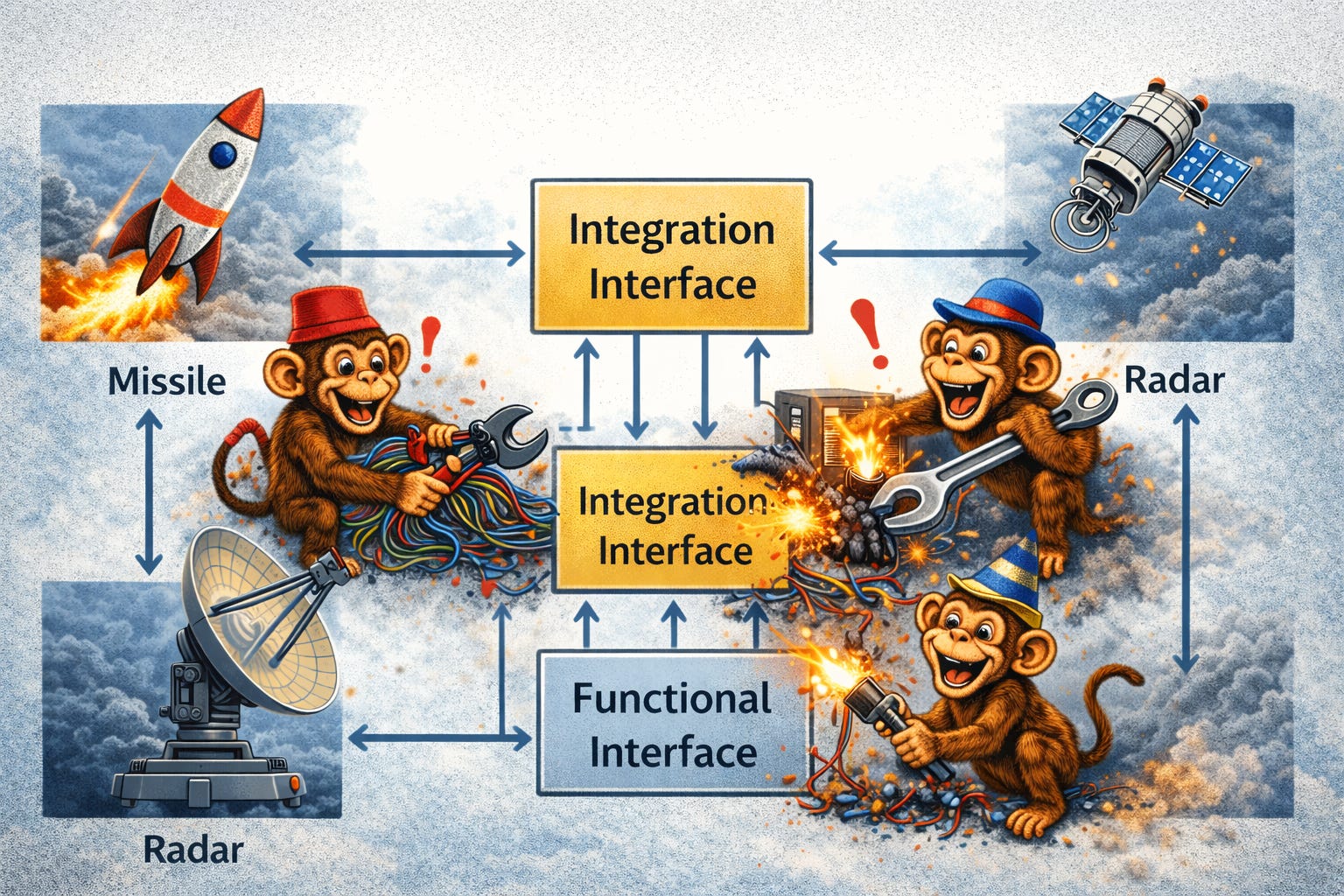
Mastering the Chaos
When you’re dealing with complex systems, the trite platitudes never make things better. This is why I spend so much time talking about Systems Thinking and desperately trying to get people to appreciate complexity while recognizing that many of these problems aren’t unique. Even better, dozens of solutions already exist across domains and disciplines. The counterintuitive element here is that discounting complex systems and trying to simplify them adds significantly more complexity.
Here’s where we have to grapple with the balancing act. We’re talking about bracketing complexity through usable frameworks. At the one extreme, “Not my circus, not my monkeys” dismisses complexity and tries to pretend it doesn’t exist or, at least, that you’re not responsible for it.
On the other hand, we also need to make sure we don’t get completely lost in the complexity by believing everything is unprecedented, unknowable, or unmanageable. So, before you lose yourself and before you dismiss the monkeys and claim it’s not your circus, I recommend following a simple mantra that we distilled from Systems Thinking:
Yes, Let’s acknowledge that what you are focusing on needs to be addressed.
And… We need to step back to ensure we consider critical elements in the larger system, focusing on the physical, logical, and persona implications at a minimum, without getting lost in the mess.
So! With this larger context, what new designs, risks, ethical considerations, and strategies have emerged that help achieve the outcomes you want? More importantly, where are those chaos monkeys you need to keep an eye on, that can be turned into a brilliant circus act?

Following this process, you also have to be critical because you might find out that some of those monkeys actually weren’t yours and need to be handled by a different person or organization. That’s a nuance explored in “That’s Not My Job:
Lean Six Sigma has a phrase for this: “Don’t steal the monkey.” This means if a problem or roadblock emerges, don’t just step in and do it yourself. Sometimes it’s not your job. Instead, step back and figure out who should be doing it, why it’s not working, and get to the root cause of the problem.
If we build this analogy, finding those monkeys doesn’t mean you have to own all of them; it means you have to hand them to the right ringmaster who is operating in an adjacent system. This will help identify how many leaders around you are pushing their monkeys to the seams and ignoring them, too.

You’ll also learn that there are a lot of critical elements, interfaces, handoffs, stakeholders, and dependencies that were likely overlooked in the original problem definition and requirements planning. These are great additions to your program and engineering plans, as well as adding to your oversight of risk and opportunity management processes.
As a fun addition, there’s an actual discipline called Chaos Engineering that takes those chaos monkeys and, instead of caging them or pretending they don’t exist, puts them to use injecting intentional trauma into your designs with the goal of creating resilient and antifragile systems. That’s where you’ll find yourself at the most advanced level, having matured from “Not my monkeys,” to “OK, those are mine, and I’ll work with them,” to a Ringmaster incorporating those monkeys into advantages that wow the world.
Even cooler, almost all of my inventions over the years, whether in cybersecurity, measuring business capture, or space debris mitigation, all occurred in those very seams that the monkeys love to play in. The more I focused on where the monkeys went, the more I found overlooked and ignored opportunities for innovation. Doing so, I won three trade secrets, six innovation awards, published dozens of whitepapers, and helped mentor two different invention generation programs focused on making employee ideas a reality.
Getting there starts with Yes, And… So! and then understanding how to Lead Complex Systems, where we dug deeper into the specifics of:
Stop relying on hyper-structured processes that don’t allow flexibility
Execute with discipline while intentionally looking for problems
Do many things well, don’t niche down too fast. Embrace the system
Step back and ensure you are appreciating all of the complexity. Don’t get lost in it, and don’t pretend it doesn’t exist. Embrace and own it.
The program in question is currently beginning to face some of the chaos emerging from those monkeys, and our team is working to help them embrace these ideas. Time will tell how it goes, but thankfully, we have a group of systems thinkers working through these ideas, willing to challenge the simplistic mantra and grapple with the complexity. Even just recognizing the problem has allowed us to reduce the consequences that have emerged.

Summary
This Key to Innovation fuses a lot of ideas we’ve played with before and opens a more complicated lock. While the other ideas were more focused, this one requires the fusion and confluence of ideas. It’s also incredibly hard to do. What I hope you might do is go back to the other Keys to Innovation and see how you can start applying them individually now that you can see how they work together.
Because it is “My Circus, My Monkeys,” and we can be the Ringmasters who intentionally manage it. In doing so, our purview is broadened, we can explore the interfaces critically, and we’ll often find extremely valuable innovation hiding right where the monkeys love to play.
The best part about these concepts is that the parallels exist in our personal lives. Whether those monkeys are your agency, your identity, your validation, your values, or your media consumption, if you aren’t paying attention to your monkeys, they’ll cause chaos.
It’s also interesting to note that many of the innovation challenges we face aren’t actually technological problems; they’re organizational and human problems. Sure, the technology is tough, but those monkeys, that circus… It’s mostly human-caused.

Did you enjoy this post? If so, please hit the ❤️ button above or below. This will help more people discover Substacks like this one, which is great. Also, please share here or in your network to help us grow.
Polymathic Being is a reader-supported publication. Becoming a paid member keeps these essays open for everyone. Hurry and grab 20% off an annual subscription. That’s $24 a year or $2 a month. It’s just 50¢ an essay and makes a big difference.
Further Reading from Authors I Appreciate
I highly recommend the following Substacks for their great content and complementary explorations of topics that Polymathic Being shares.
Goatfury Writes All-around great daily essays
Never Stop Learning Insightful Life Tips and Tricks
Cyborgs Writing Highly useful insights into using AI for writing
Educating AI Integrating AI into education
Socratic State of Mind Powerful insights into the philosophy of agency
I decided to listen to your post today. The aaaaaaaand got me. Great piece!
When you finish building this program, can I bring you to NAVAIR? I can think of many areas that would benefit from this approach and it’d be fun to work with you. Haha so good man