


Welcome to Polymathic Being, a place to explore counterintuitive insights across multiple domains. These essays explore common topics from different perspectives and disciplines to uncover unique insights and solutions.
Today’s topic explores the male loneliness epidemic from the angle of the loss of masculine physical touch. We’ll uncover two surprising drivers and wrangle with the implications while we search for a way to reconnect the men for an improved society.
It doesn’t take much digging to find articles discussing the male loneliness epidemic. Men are reporting fewer close friends, less time spent with those friends, more time spent online, and, often, more time spent with pornography. Mental health in men is dropping, and suicide is up. Simply put, the men aren’t doing OK.
The U.S. Surgeon General declared a national “epidemic of loneliness and isolation,” noting that one‑in‑two adults experiences measurable loneliness and that social disconnection raises the risk of cardiovascular disease, dementia, stroke, and premature death to levels similar to smoking fifteen cigarettes a day.
Surveys show a decline in male friendships where, in 1990, 55% of men reported having at least six close friends, but by 2021, only 27% did. Incredibly, Pew Research and the Survey Center on American Life found that 20 % of men report having no close friends and that men’s friendship groups have shrunk more than women’s.
I think a lot of this has to do with the loss of bromance. This fun portmanteau describes an older tradition of masculine connection, touch, and action that has, like so many things in our modern era, become sexualized, much to societal detriment. Yet this sexualization actually comes from two very interesting sources.
Homosexuality
Female Integration.
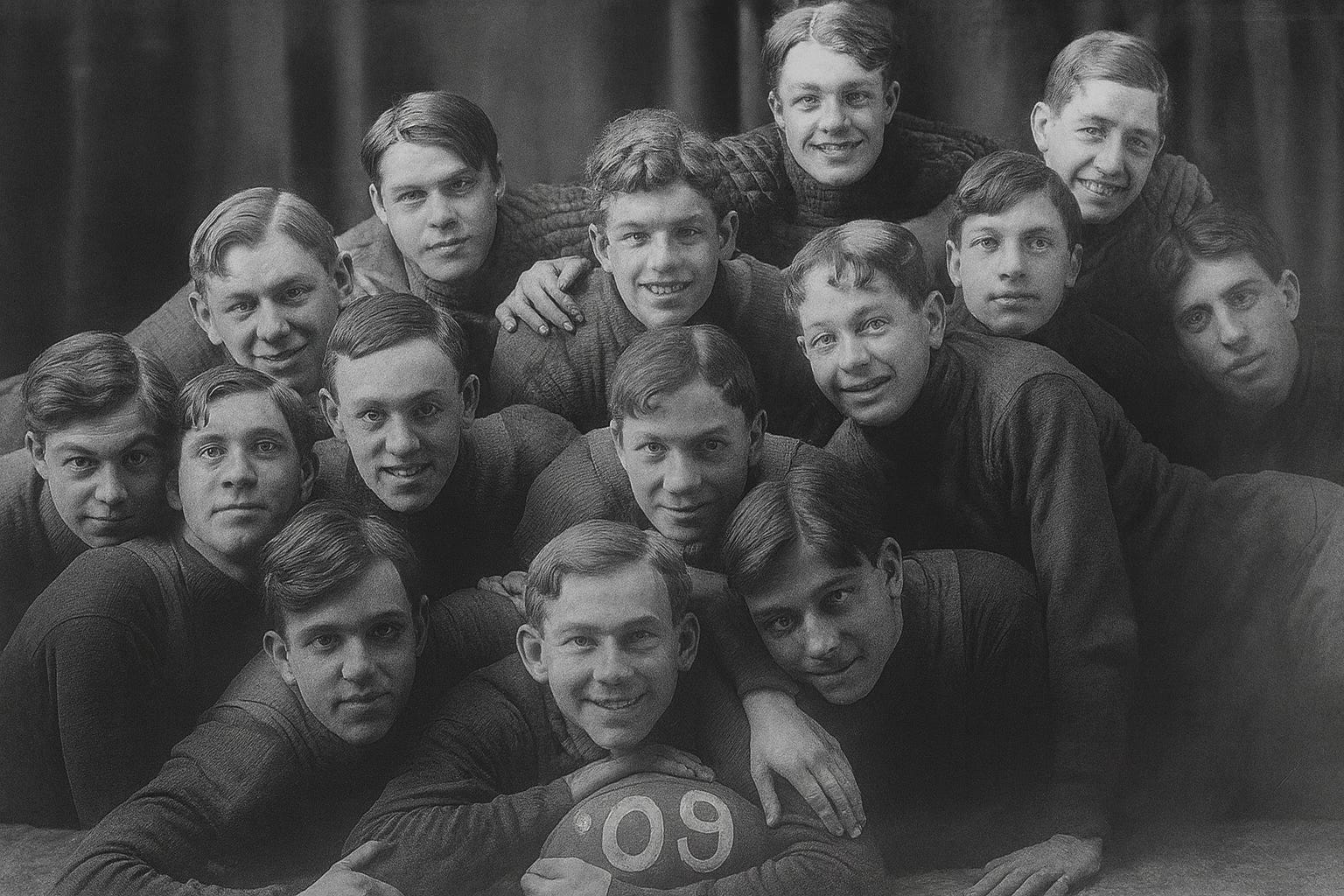
For example, take a look at these photos from back in the day. What’s your first reaction? Just some normal dudes hanging out?


These were very common male poses just 100 years ago. The Art of Manliness documents hundreds of examples in the article: Bosom Buddies: A Photo History of Male Affection. But what we are looking at isn’t homosexuality. Hell, prior to people studying the idea in the early 1900s, the idea of male intimacy involving sex wasn’t in the zeitgeist. That didn’t mean homosexuality didn’t exist; it just wasn’t considered by heterosexuals and society writ large. As The Art of Manliness explains:
The term “homosexuality” was in fact not coined until 1869, and before that time, the strict dichotomy between “gay” and “straight” did not yet exist. Attraction to, and sexual activity with other men was thought of as something you did, not something you were. It was a behavior — accepted by some cultures and considered sinful by others.
There wasn’t homophobia because there was nothing acknowledged to be afraid of. It wasn’t an identity, and men showing intimate affection did not cross into the bedroom. Consider also that men and women also did not associate outside of strict social structures, and so heterosexual physical affection was not associated with male physical affection at this time either. Simply put, men and women didn’t cuddle in public, and so men's ‘cuddling’ in public was not associated with sex.
Once homosexuality transitioned from an action to an identity and began being studied, attacked, and eventually accepted, male physical touch became associated with sexual activity, and men started taking great care to avoid any association with being gay. This aversion occurred, in part, due to the quirk that women might love their gay friends but rarely sleep with a man who's been with another man. Conversely, men have significantly less issue accepting a woman who’s been with another woman. (hell, invite your friend along! 🤓)
This leads to a problem where a heterosexual man cannot risk being perceived as homosuspicious in the crazy culture we live in. And that line kept moving as the continued integration of women offered increasingly public displays of affection, causing the connection between physical touch and sex to become solidified. So much so that we now look back at these pictures and just assume there were some latent, and patent, homosexual tendencies where none exist. Further, our current culture only accepts rough male touch that cannot be perceived as intimate.
As fellow Substacker Von commented on a Note, his experience was that male-to-male touch had to border on violence. Which is funny because the place I encountered the most ‘affectionate’ touch is also where we conducted the most violence: the Army.
I joke that “You can’t out-gay a Ranger,” especially when people start acting weird about male contact. The thing is, there’s a ton of truth in that statement regarding the masculine shenanigans that go on in elite military units. However, it toes a clear line of being non homosexual.
A funny story about that line is from Ranger School, where my teammate from Moldova and I were freezing in the mountains of Northern Georgia in December while pulling security at a patrol base. We were both shivering while lying in the prone position, watching for the ‘enemy.’ I scooted closer, he scooted closer, and soon we were side by side. Then I flopped a leg over his, and he flopped his arm over my back, and it was delightfully warm. After a few minutes, he says in his thick Moldovan accent:
So… you like to eat the pussy?
As we like to say, “Spooning saves lives,” and the physical touch was fine, but he just needed to make sure that line was holding firm.

Now, before you lose your mind that this essay is somehow anti-gay, that’s half the problem. Affectionate male touch is so embedded in our conciousness as gay that I risk accusations of homophobia when I talk about heterosexual men, displaying affection yet also wanting to make sure signals aren’t crossed.
There’s also a lot going on here, and just like homosexuals added a sexual connotation to male touch, so too did the integration of women into male spaces. This occurred across the board, from work to fraternities to clubs, along with the social pressure stigmatizing those organizations that remained unintegrated. As the article, The History and Nature of Man Friendships, uncovered:
fraternal organizations, ranging from the Freemasons to the Odd Fellows, were at their peak in membership in American history. Nearly 1/3 of all American men were members of some fraternal organization at the end of the 19th century. At their lodges, men would bond, connect, and help each other become better men.
These fraternities have slowly come under attack as, first, the truly negative and debauched hovels of toxic masculinity were excised, but the slow creep never stopped. Currently, any exclusive male space is viewed as evidence of patriarchal exclusion or worse.
The loss of heterosexual male-only spaces was something I experienced during my time in the Army. Homosexuality used to be banned from the Military, and women weren’t integrated into combat units. As a result, they were some of the ‘gayest’ places you could imagine. Then, with Don’t Ask, Don’t Tell evolving into Don’t Ask, Don’t Harrass," the line of acceptable touch shifted. Couple that with the integration of women and the risk of homosuspicion, and heterosexual physical touch and camaraderie vanished into “Don’t be gay, dude.”
There’s a similar prudishness between men and women, resulting in standard HR policies that don’t allow any physical touch beyond a handshake. Even giving a hug to a close friend who just suffered a miscarriage landed me in a conversation. Heaven forbid men display any physical touch lest it be seen as suggestive, dominating, or otherwise. For example, I had another discussion with HR after clapping a co-worker on the shoulder for doing a good job, after someone complained. It was explained that since today’s culture doesn’t tolerate that, if I did that to a woman, I couldn’t do it to anyone. So, we’ve turned normal human contact sexual. I think this is what happens when actual potential sexual partners are part of the mix.
I understand how this sounds in today’s milieu as well. Good riddance, we say! Men shouldn’t treat men in a manner that they wouldn’t treat a woman, and heaven forbid we even consider treating a woman that way! I’m torn by these findings because I don’t believe homosexuality should be illegal or hidden, and I think society benefits from female integration. I also believe that loutish behavior from men isn’t acceptable either. However, in our attempts to deal with this, we’ve turned into prudes.
We are so worried about the perception of unwanted sexual touch that we don’t do any touch. The result hasn’t been an improvement in anything. Women report that men are less willing to mentor them. Homophopia has increased, not decreased. We have an explosion of male loneliness as friendships lack the depth of platonic physical affection. Worse, it places a much greater burden on the woman in the relationship to fill that void.1 I need more hugs and touch than my wife does because, while gays and women still maintain a good deal of touch, heterosexual men do not.
But that physical touch is a critically important element of who we are as humans. The physiological benefits are incredible, as is the connection, bonding, and trust. We all understand the benefits of a healthy sexual connection, but you can get the same benefits when it’s non sexual. That’s because we are social beings, so much so that we’d be better described as Homo Socialis instead of Homo Sapiens.
You don’t have to look far into the primate world to see the complex bonding rituals from grooming to wrestling, to the piles of cuddling Bearded Saki. What we’ve uncovered today ignores so much of that social structure and, worse, actively tears it apart under the guise of dismantling the patriarchy or toxic masculinity.

There are other cultures where this did not happen to this degree. For example, when I first arrived in Korea, the in-processing had a cultural awareness session explaining that we’d see Korean soldiers on the trains holding hands, arms draped around each other, and more, and that it wasn’t gay. In fact, men holding hands in Korea is a sign of deep respect, a lesson my father learned when he met my brother’s Korean father-in-law at the wedding. The catch here is that Korea is a conservative culture with firmer rules against homosexuality and female integration. Hence, it doesn’t have the sexual implications that we’ve uncovered here.2
Back to the Army’s Ranger School, one of the funniest times was, while waiting for our buses on top of a mountain as the sun set, we were hunkered down trying to stay out of the wind when someone had the idea of making a ‘puppy pile.’ Just picture 100 dudes all sprawled on top of each other while we rotated from the outside to the inside. It was just like those Bearded Saki, and I’ll tell you what, I’ve rarely laughed as hard or been as warm as that night.
That’s not toxic masculinity. That’s the best of masculinity. It’s critically needed. We need more bromance. We need more affectionate platonic touch. We need to get over our homophobia, and we need to desexualize normal human contact. I’m not keen on going back to the structures we shed, but we lost something along the way that we critically need back. It’s also a behavior that models the fact that physical male touch isn’t predatory.
I believe healthy, non-sexual touch can re-emerge because we have evidence that it existed. I don’t want to go back to the social mores of yesteryear,3 so I’ll flip this over to you: How do we re-engage with non-sexual physical touch given the challenges laid out here?4 This is undoubtedly an ‘Us’ problem, not a guy problem, because the structures that enforce it are greater than just the men. I’d love to know your thoughts, insights, and ideas on solving this.
For more on the topic of sex, check out Clothing and Sex:

Polymathic Being is a reader-supported publication. Becoming a paid member keeps these essays open for everyone. Hurry and grab 20% off an annual subscription. That’s $24 a year or $2 a month. It’s just 50¢ an essay and makes a big difference.
Further Reading from Authors I Appreciate
I highly recommend the following Substacks for their great content and complementary explorations of topics that Polymathic Being shares.
Goatfury Writes All-around great daily essays
Never Stop Learning Insightful Life Tips and Tricks
Cyborgs Writing Highly useful insights into using AI for writing
Educating AI Integrating AI into education
Socratic State of Mind Powerful insights into the philosophy of agency
This came to light recently, when I realized I was starved for physical touch, and it’s hard to communicate to my wife, who was not starved for it. She has her friends, the kids never stop touching her, and then me, who regularly gives her hugs. But I was giving her hugs, and I wasn’t getting any other, non sexual touch. It kind of exploded one evening, and I had to get real and explain that I’m hugging her because I’m doing to her what I want done to me. That little reset then empowered here to just come in a and rub my back, give me the hug, and cuddle a bit more at bedtime. Culture has limited me to virtually zero physical touch outside of my wife.
The same is true in other, similarly conservative, cultures. There’s more male physical touch in Iraq than in the US. There’s more touch in hyper-machismo Hispanic cultures as well.
Hannah Spier, MD recently penned an interesting perspective from a different angle. But it’s crazy how explosive this topic is because we have such a baked in idea that any correction to a situation like this must be homophobic of misogynistic when all I’m trying to do is figure out how to heal broken male relationship (I’m sure some will say that’s men’s fault as well and there’re issues underlying that doublestandard which also need addressing.)
Kyle Shepard already has his own ideas which I’ll share here: 😆
I've said for a long time that people (primarily women, but not just) need to fight their own battles, and only drag HR or the lawyers into it when all else fails. A physical contact that leaves one uncomfortable is one you can address with the person. Just say "Hey, that made me feel a little uncomfortable, can you please not do that again?" Simple as pie. You treat the person like an adult and he'll likely appreciate that you didn't run off to HR like a disempowered little girl with her hairpins flying. This happened to a male friend of mine--the comradely arm around the shoulder--and he reached out to me because he really didn't understand what was so wrong about that.
You're right, we have turned into prudes and it's harming *all* of us, not just men. It needs to stop, without going back to the Mad Men days of unfettered, consequence-free sexual harassment.
Touch is fine, but context rules everything.
If I have not seen you in ten years and we almost died together once = Gentlemen’s hug.
If you are six months sober = Single slap on the back.
If we served in war together = Manly hug only. Two seconds max.
If doing mushrooms together = Verbal expression of manly love allowed. One mention only.
If your father died this year = Hand on shoulder. Silence encouraged.
If you helped me move a couch up three flights of stairs = Nod of mutual respect.
If you saved my life but we are not close friends = Firm handshake. Eye contact. Nothing else.
If we are drunk and talking about our dads = Side hug permitted. Ends before tears.
If you paid my bail = Hug allowed. Never spoken of again.
If you are getting married = Quick hug. Pat on the back during release.
If your dog died = Hand squeeze. Immediate release.
If we played sports together in high school = Chest bump
If we fought once and then became friends = One shoulder bump. Side smirk required.
If you are leaving the country forever = Hug allowed. Awkward pause expected.
If you told me a secret that could ruin your life = Quiet nod. Absolute loyalty.
If we survived a natural disaster together = Hug plus eye contact. No words.
If anyone brings this list up afterward, = Deny everything.
Those are the rules, every man knows them. This is the way...