


Welcome to Polymathic Being, a place to explore counterintuitive insights across multiple domains. These essays explore common topics from different perspectives and disciplines to uncover unique insights and solutions.
Today’s topic is a reminder that we have a lot more control over our lives than many actually manage to apply. We’ll look at how much of our chaos is based on the demand that we react to everything, and how avoiding that unlocks calmness, clarity, insight, and peace as you handle chaos like water off a duck’s back.
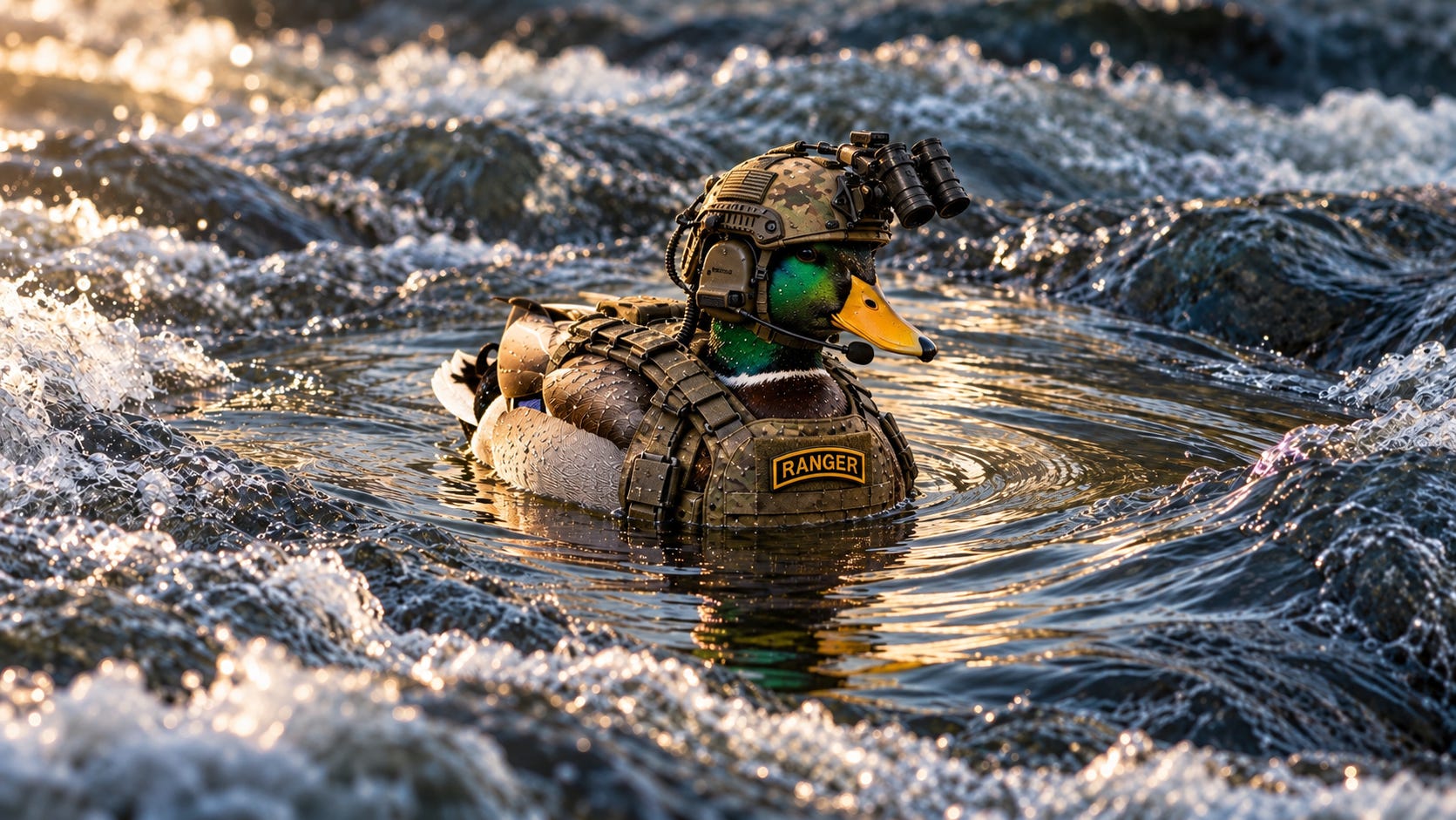
Not a day goes by without me shaking my head at the outrage I see over the most banal, manufactured, or misconstrued situations. I have friends and acquaintances reach out to ask whether I’m bothered by one thing or another or, worse, upset that I’m not bothered by whatever outrage is trending.
Frankly, it’s exhausting… but it’s also much less chaotic in my life because I’ve learned to step away and avoid the mess. It’s as simple as realizing that regardless of the outrage, very little changes, and the world goes on to the next outrage. The trick is very aligned with what Sam Alaimo wrote about in How Special Operations Face Uncontrollables, where he describes the Norwegian Special Forces learning a “sense of water” in facing chaos where:
The irony is the Marinejegers’ “sense of water” has nothing to do with knowledge of the water, and everything to do with knowledge of one’s self.

Let’s build on this concept and apply it to our less special and often very average lives. Here are a few examples of chaos that demands our attention:
Yes, Trump is an ass. Yes, he says absurd things. Yes, he’s been doing that for… ever… Yet each utterance is met with exactly what he wants: noise, confusion, anxiety, and distraction.
Yes, AI has risks. Yes, data centers have concerns. Yes, big tech doesn’t seem to give a crap about anything but profit… Yet every hyperbolic claim is met with pearl-clutching outrage. Falsehoods like data-center water consumption prevail, and the fingers of Chinese disinformation are ignored. The result: noise, confusion, anxiety, and distraction.
Yes, the climate is changing. Yes, we need to conserve our environment and not pollute. On one side it’s apocalyptic; on the other side they ignore it. In the middle? When you follow the incentives and money, both sides are getting exactly what they want: noise, confusion, anxiety, and distraction.
The result is collapsing mental health, perpetual outrage, and manipulations of algowhores, scammers, and legitimate nation-state manipulations, which is one key reason why I treat everything that demands my attention as a PSYOP, until proven otherwise. Each of these challenges is why it’s so important to be aware of where our attention is focused and to discern whether you are ceding agency over your actions.
So, what do we do?

Going back to Sam’s example of the Norwegian Special Forces, I’ve been in that kind of situation during my own Ranger Training where instructors are screaming in my face, demanding the absurd, and watching for one thing in particular:
Are you reacting?
Or are you acting?
The Norwegians needed to show a “sense of the water” that wasn’t the actual water to pass this test… what the heck does that mean?
Well, we also have the common idiom "water off a duck's back," which implies criticism, insults, or outrage have no lasting effect or emotional impact on a person.
Fundamentally, they’re the same idea because it's not about the water; it's about understanding the situation, recognizing our inherent capabilities, and letting the noise and chaos flow around us without letting it interfere. It's action through intentional non-action... Put another way, it’s non-action toward what doesn't matter and then action only toward what does. In a nutshell, the Daoist principle of Wu Wei.
It’s action through intentional non-action.
In Ranger School, I learned that intentional action or non-action was always preferable to reaction. Once the Ranger Instructors (RIs) got me to react, it was over; I was theirs, and they would continue to pull my strings.
A great example was the classic tactic of RIs challenging your decision. Their goal wasn’t to show you were wrong but to inject doubt by asking leading questions. The trick was to consider their input and, most often, the right answer was to stand by your decision or plan. Yet, too often, a candidate would react and try to change the plan, which created chaos. The RIs then fed that chaos and watched the unit struggle and fail to execute the mission. We were our own worst enemies and continually made the training harder than it needed to be.
I saw this happen over and over, and when it was my turn in leadership and the RI challenged my plan, I tried a different response: “Sergeant, based on the information I have and the recommendations of my squad leaders, this is a workable plan. It might not be the best, but I’m confident that we can execute. Unless I’ve missed something safety-critical, do you have any new information that would be worth changing it?”
I remember seeing the RI’s eyebrows rise as he cocked his head with a slight smile and said, “Well, if you think it’s going to work, Ranger, then continue.” Having no new information, I let the noise flow around me, didn’t grab onto the potential chaos, and felt the angst and panic of constant changes ebb in the team. As we humped through the woods, the same RI came up and offered a few quiet tips, and the mission executed smoothly, efficiently, and successfully, albeit not perfectly, but… that’s war. At least the chaos that did exist wasn’t self-inflicted by our own reactions.

In our daily lives, the chaos agents aren’t like the RI who stepped back. Just look on social media: the chaos agents won’t stop; they’ll just adapt, but the more you step away from the swirl, into the center, and let the ‘water’ flow off your back, the less likely you are to be targeted because you aren’t worth the effort. And that’s a good thing! It means you have agency, you have resiliency, and you have a grounding that keeps you focused on what does matter.
It’s not easy.
Now, I’m going to hit this one a little closer to home: The response of reacting to everything is what children do. It’s what my children do when someone upsets them. It’s a very natural response and a very easy response. It’s a response I work very, very hard to teach my children they don’t have to fall into.
It is hard to bear insult, accusation, injustice, inequality, and outrage without reacting. However, once you do, once you let the water flow, once you face the physical manifestation as the Special Forces do, you realize that over time, the intentional non-action is actually easier.
Better yet, you find that the actual actions you do need to take become clearer, cleaner, simpler, and more effective. It helps you pick your battles, and it helps you understand what’s actually happening.
Trump is chaos, but what is he doing while everyone reacts? Where do we really need to ensure we don’t screw up? Who are the ones not reacting who can help? If you want to make a difference, it’s pretty clear the outraged reactions of the last 10 years have solved — counts on fingers — zero problems.
AI is a very useful tool that’s overinflated by tech-bros and overreacted to by pessimists. History shows us that this is a common feature of technological revolution, from books to the printing press to photography. Further, data centers are common (you probably live right near one) and are how you are able to read this essay and post outrage on social media. Yes, we need to pay attention to energy and water, but the real outrage is actually largely manufactured by China as Alexander Muse recently found in this article.
For more insights, check out Taylor Trandahl’s essay: Why Didn’t Anyone Tell Me This About Data Centers?
Yes, the climate is changing, but why is the response that we have to react and stop it? What if we adapted? What would that change, and how could we make it better? Why do we have to react to every weather event as if it were the worst instead of looking one layer deeper and seeing the larger patterns? Even when we consider the rate of change, we find a precedent just 12,000 years ago.
This is where we get back to something ancient, a simple question that reframes the problem and Sam’s favorite question: “What Then?”
Attributed to both Epictetus and Diogenes the Cynic, the latter’s style is captured in an account of Alexander the Great finding the beggar-philosopher relaxing in the sunlight. Diogenes begins questioning the young king about his grand ambitions:
Diogenes: "What are your plans?"
Alexander: "I plan to conquer Greece, then Asia Minor, and eventually the whole world."
Diogenes: "What then?"
Alexander: "I suppose I would relax and enjoy myself."
Diogenes: "Why not save yourself a lot of trouble and enjoy yourself right now?"
“What Then” allows us to consider the worst case and then consider what comes after. What’s fascinating is that you find we are more adaptable and resilient than you’d think. And bringing this all full circle: What is stopping you from enjoying yourself right now?
Why do we allow the architects of chaos to control our experience when we can literally let the ‘water’ flow off our backs like a duck?
It’s a cycle we haven’t broken yet because, about once a year, I end up writing on the topic, as you’ll remember from 2024 with Heaven is High, and the Emperor is Far Away, and just last year with Go Touch Grass. These are reminders of different ways to work on achieving the same outcome, namely, regaining agency, separating the noise and chaos from life, and taking intentional non-action when it’s clear that the goal is your reaction.
And the steps to take are about that simple:
Recognize that the goal is your reaction
Sense the water. Start to apply the Mixed Mental Arts we’ve explored here before so that you can grapple with complex problems in the octagon of life.
Find the flow, discern the turbulence, find the calmer eddy.
Take intentional action or, even better, non-action as appropriate
Repeat
That’s it, yet this will be one of the hardest things you’ll do. So hard, it’s used as a test for Military Special Forces around the world and has been talked about by philosophers for millennia. With that difficulty, you can unlock calmness, clarity, insight, and peace as you handle chaos like water off a duck’s back and reclaim your agency and self through the tried and true insights that Wu Wei provides.
This is why I’m able to stand in the chaos and not lose my mind.
Want to join me?


Did you enjoy this post? If so, please hit the ❤️ button above or below. This will help more people discover Substacks like this one, which is great. Also, please share here or in your network to help us grow.
Polymathic Being is a reader-supported publication. Becoming a paid member keeps these essays open for everyone. Hurry and grab 20% off an annual subscription. That’s $24 a year or $2 a month. It’s just 50¢ an essay and makes a big difference.
Further Reading from Authors I Appreciate
I highly recommend the following Substacks for their great content and complementary explorations of topics that Polymathic Being shares.
Goatfury Writes All-around great daily essays
Cyborgs Writing Highly useful insights into using AI for writing
Educating AI Integrating AI into education
Mostly Harmless Ideas Computer Science for Everyone
The Shepard Scale - Kit Perez - Counter Intelligence Insights
My 2 Cents - Karina Schneidman MBA, MS-MFT