

Welcome to Polymathic Being, a place to explore counterintuitive insights across multiple domains. These essays take common topics and investigate them from different perspectives and disciplines to come up with unique insights and solutions.
Today’s topic is Mixed Mental Art, which addresses a classic maxim and shows how important it can be to our sanity in a world that demands affiliation and compliance. We’ll explore the nature of arguments and when it’s no longer prudent to continue. We’ll also learn that, while you might not cast your pearls today, you can help others refine their iron for tomorrow.

In the Bible, there’s a wonderful maxim captured in Matthew 7:6 where Jesus says:
"Do not give dogs what is sacred; do not throw your pearls to pigs. If you do, they may trample them under their feet, and turn and tear you to pieces." - NIV
In shorthand, this is known as “Pearls before swine,” and it’s become one of my go-to reminders as I engage in extracting counterintuitive insights, butchering sacred cows, and challenging the status quo. In fact, the goal of Mixed Mental Arts is to wrangle with complex ideas in the octagon of life. However, that’s naturally combative and, when you push back on the common tropes, you find people who voraciously disagree.
Now, disagreement isn’t an issue at all. Frankly, I love disagreement because, to borrow from the Bible again in Proverbs 27:17, "As iron sharpens iron, so one person sharpens another.” It’s the reminder that there’s a refining tension that helps make the conversation better, and disagreement is the core of true innovation. Like martial arts, mental arts require grappling with others to take theory and put it to practice.
The key here is to avoid the false binary of “I’m right, you’re wrong.” In the simplest manner, we can disagree, and neither of us is wrong and/or both of us are wrong. But that’s not good enough for many people. As an example, I was recently accosted online by someone who disagreed, which was great, but demanded that, if I didn’t agree with them or concede points, I was, somehow, in violation of my own stated goals here on Polymathic Being, namely Insatiable Curiosity, Humility, and Intentional Reframing.
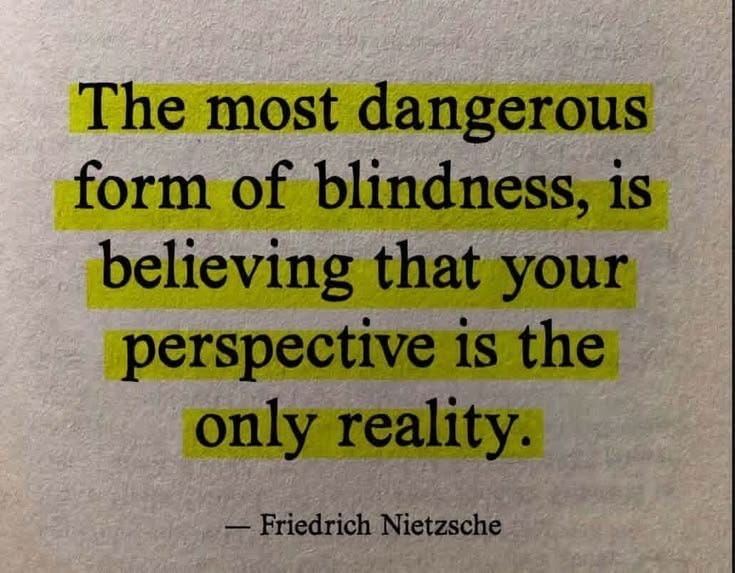
The most annoying part is when the disagreement is built on a bevy of logical fallacies that the other person demands I address. Certainly, I could spend a half an hour deconstructing the fallacies it took them ten seconds to throw out there, but they’ll just take ten more seconds, pivot, and I’ll be in the same position. Their goal isn’t exploration or refinement; it’s subjugation of my thoughts to theirs.
These are the swine in the proverb, and it goes hand in hand with another recommendation: "Never wrestle with a pig. You both get dirty, and the pig likes it."
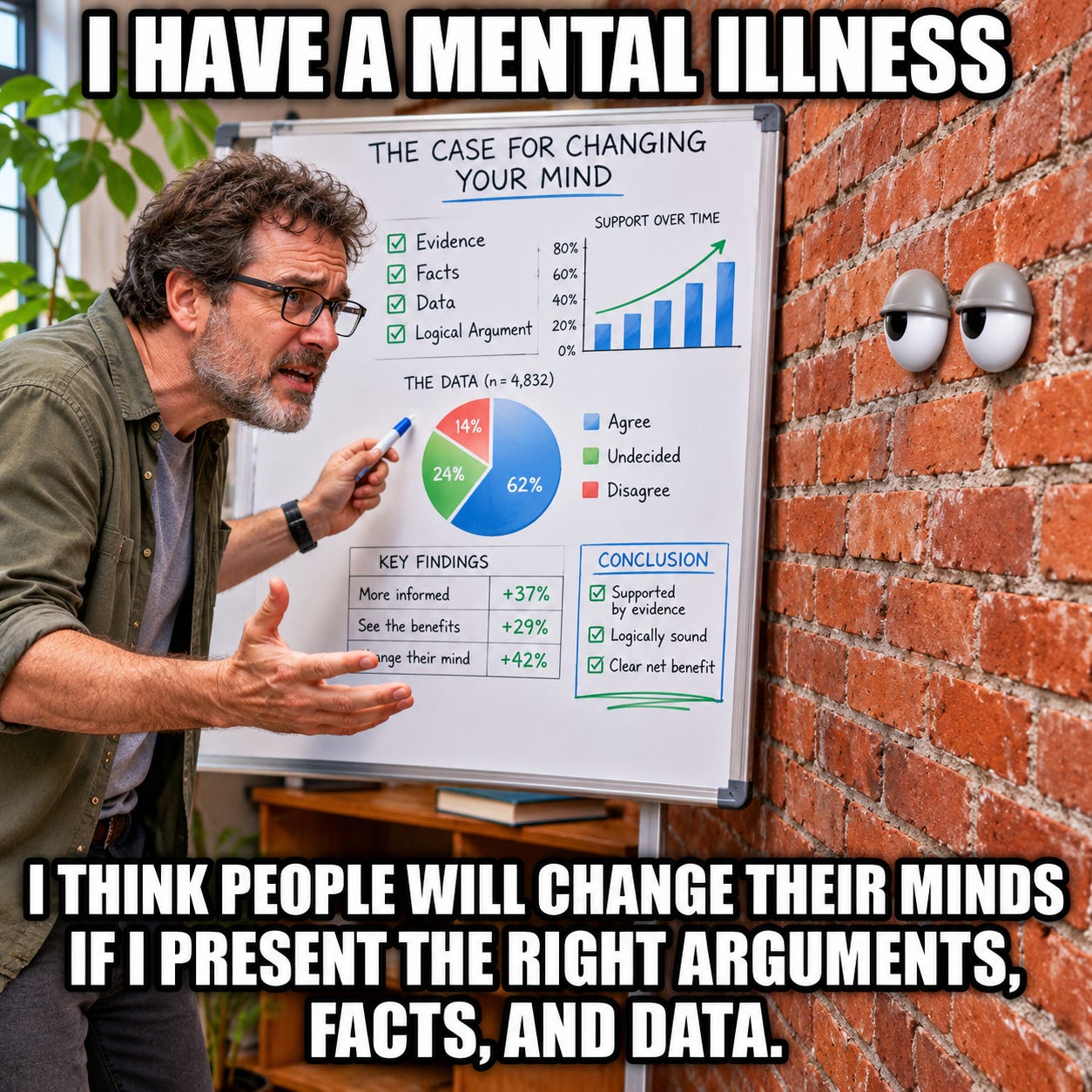
Sometimes I still give it a go because it can uncover a lot of interesting human psychology and, in some ways, is akin to the debates the ancient Greeks loved to participate in. However, I know I’m casting pearls before swine and, yes, I do know it is pointless. To date, I’m batting exactly zero on getting anybody in that mindset to change their opinion. As the popular meme goes: “I have a mental illness. I think people will change their minds if I present the right arguments, facts, and data.”
Before you interpret this as self-righteousness, I have to stress that we all suffer from cognitive blindness. As I’ve said before, “Everyone is biased; the key is understanding what yours are.” However, in a Catch-22, because I work to apply this to myself, first, I’ve typically already honed my position through intentional critical thinking.
Now, I need to pause here because half the problem is that most people consider critical thinking as the thing they, and those that agree with them do, and everyone else is clearly deficient. I found myself struggling with the same feeling and, so, sat down with Joshua Deiches and created a framework that I mentally run through involving Knowledge Management, Logical Formulation, and Objective Critique.

That last bit is important because part of what I do when I engage is stress-testing my knowledge against a willing debate partner. I’m letting it be challenged because that’s necessary, and I am paying attention to the nature of the critique.
However, not all critique is valid. Sidestepping a logical fallacy is no less avoidance of critique than sidestepping a feint in a sparring match in the octagon is avoidance of a fight. It’s recognizing that some arguments are worth considering and others are not. Some arguments are an intentional deflection or misdirection to muddy the water for perceived advantage. In fighting, you maintain your footing through the structure of your discipline. In an argument, it’s the structure of your logic and avoiding distractions.
That’s the second half of the Catch-22: when you apply critique to well-structured thinking, the argument is sharper, and it will highlight logical fallacies faster. As iron sharpens iron, you can end up with a razor-sharp position that cuts easily.
“So what you're saying is….”
“No, go back to the beginning and address the points.”
And as we add in appeals to authority, emotion, and any other logical fallacy, you can start to see the intended manipulation in the conversation. Ignoring these isn’t mean. Side-stepping those isn’t avoidance. Holding a hard line isn’t harsh or uncaring. These actions allow the separation of the noise so that the actual arguments the other person makes, the ‘pearls’ they cast, often unaware, can be seen in all the mud.
And to that point, there are many, many times when, in the middle of what looks like a shit-show, I found a pearl that was important enough for me to pick up, and I’ve changed elements of my argument even if I haven’t conceded the position whole cloth. When there are no pearls, that’s just confirmation that it’s a Matthew 7:6 moment and I need to walk away because the engagement isn’t edifying for either of us. However, sometimes the argument isn’t what you think…
When the Argument isn’t the Argument
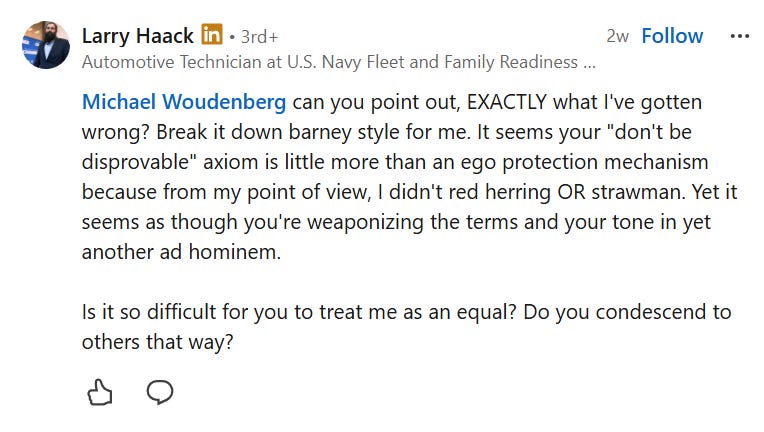
This is the pearl I gleaned from that conversation I mentioned earlier, which taught me something in retrospect: I don’t think his argument was about the topic at all. Over the course of the conversation, there are constant pleas to be seen on an equal intellectual playing field. Larry was no longer arguing about science; he was arguing about his identity and how others, and I, perceived him. The irony here is that I went in treating him as an equal and held him to the same standard I try to hold myself.1
As iron sharpens iron, it cuts both ways. I have to be careful on engagements. I have to bite my tongue. I have to walk away, though I’d love to go deeper. I really need to learn to walk away sooner. It’s a trait I’m working on where I know I hate being ‘wrong’ and I’m stupidly curious to keep testing these ideas.
What’s completely counterintuitive is that I’m not approaching it from the ego to be right, but from the desire not to be wrong. I’m not approaching my sparring partner as weaker, but as equal. It’s typically only later that I realize what’s happened. While I recommend embracing your white belt in Mixed Mental Arts, that doesn’t mean everyone is engaging from the same position.

It reminds me of something Kyle Shepard and Andrew Smith describe with Mixed Martial Arts in that, if you’re experienced in a technique and have years of practice, you need to meet people at their level, and you have to, sometimes, not partner with someone who isn’t ready. There’s no honor in wiping a noob across the mat.
If we can accept that idea in Mixed Martial Arts, think of how that applies to Mixed Mental Arts. While I prefer the sparring of iron against iron, I have to realize that sometimes it is a Matthew 7:6 moment and the right thing to do is to step away. And I hate how egotistical that actually sounds because it’s completely at odds with what I’d like to do in wrangling with those complex ideas.
This is one reason why I write about religion, but will rarely debate it. I love to dig deeply as Jared Bruder and I did in “I Am,” but if it came to ‘proving’ we were right at the cost of someone’s faith, both he and I refuse. We might be right, but in debating someone who wasn’t ready, we’d be completely wrong.
Summary
As hard as it is, sometimes, we need to walk away from the Mixed Mental Arts mat and address the situation from a different perspective. This was something I learned back in the day when the vibe of a group shifted from grappling with complex ideas to Idea Sex. I lost that fight because I was fighting the wrong battle. I lost, not because I was technically wrong, but because the very nature of the debate changed, which ended up making me wrong.
We’ve all been there at multiple points in our lives, and Matthew 7:6 is a maxim that stands the test of time. However, it’s important to remember that we are all in different places on our journey, and we’ve all been swine in our lives. Therefore, always leave the door open, allow people to grow, and while you might not cast your pearls today, you can help them refine their iron for tomorrow.
Additional Proverbs:
Proverbs 26:4 “Do not answer a fool according to his folly, or you yourself will be just like him.”
Meaning: Engaging in a foolish debate on their terms lowers you to their level and wastes your energy.
Proverbs 26:5 (Immediately following verse 4) “Answer a fool according to his folly, or he will be wise in his own eyes.”
Meaning: At times, a brief and measured response is necessary to expose error so that the foolishness does not go unchallenged. (The two verses together require discernment to know whether speaking or walking away is appropriate).
Proverbs 29:9 “If a wise man has an argument with a fool, the fool only rages and laughs, and there is no quiet.”
Meaning: Arguing with someone closed to reason yields no resolution, only emotional frustration and mockery.
Proverbs 14:7 “Leave the presence of a fool, for there you do not meet words of knowledge.”
Meaning: You do not have to participate in a fruitless conversation; walking away is often the wisest choice.
Did you enjoy this post? If so, please hit the ❤️ button above or below. This will help more people discover Substacks like this one, which is great. Also, please share here or in your network to help us grow.
Polymathic Being is a reader-supported publication. Becoming a paid member keeps these essays open for everyone. Hurry and grab 20% off an annual subscription. That’s $24 a year or $2 a month. It’s just 50¢ an essay and makes a big difference.
Further Reading from Authors I Appreciate
I highly recommend the following Substacks for their great content and complementary explorations of topics that Polymathic Being shares.
Goatfury Writes All-around great daily essays
Cyborgs Writing Highly useful insights into using AI for writing
Educating AI Integrating AI into education
Mostly Harmless Ideas Computer Science for Everyone
The Shepard Scale - Counterintelligence and Leadership
And no, I did not handle that conversation as well as I could. I was especially annoyed at the combination of self-righteousness and self-deprecation, and it didn’t help that a friend stepped in and stirred the pot.
As one of your frequent debate partners and iron sharpeners, I can vouch for the fact that whether we agree or not (and we DISagree on a fair amount even though we agree on much), you have always treated me with respect and as an intellectual equal. We have some of the best conversations ever, and while we might not change our opinion, I think we both leave the convo thinking more about our own positions. Sometimes you have to be challenged to better refine your argument, and that's part of the beauty of the debate itself. So far, I haven't seen you ever be a jerk to someone who engages you in good faith.
The problem is that few people engage in good faith. ;)
What Nietzsche DID say, which hardly anyone remembers today, is "If you can't dance, you shag a lot of waitresses."