


Welcome to Polymathic Being, a place to explore counterintuitive insights across multiple domains. These essays explore common topics from different perspectives and disciplines to uncover unique insights and solutions.
Today's topic explores three common threats to marriages everywhere: Money, Sex, and In-laws. They are three independently challenging topics, and if they start weaving together, it can be catastrophic. This essay uncovers practical insights, personal examples, and the latest recommendations to manage each one.

Intro
Early in my Army Career, a Chaplain at Fort Sill, Oklahoma, shared that he only needed to give marriage counseling for three things: “Money, Sex, and In-laws.” It’s an idea that’s stuck in my brain for twenty years and has proven true over and over as I matured my own relationship and watched other relationships fail.
There may be a litany of other issues that get blamed, but when you strip back and get down to root causes, these three pop up with surprising regularity. These are also three topics that uncover the core of another person and will be areas I help my kids pay attention to when they start seriously considering a spouse. Let’s dive in!
Money
How a person deals with money tells you a lot about that person. Do they constantly need to have the latest things? Are they capable of long-term planning, or do they live in the here and now? It’s important because money is rarely just about dollars. It’s about values, priorities, security, fear, identity, and control, and those couples who openly discuss financial expectations and spending habits have better long-term relationship stability.
It is important to note here that the key is not agreement, but rather transparency and shared decision-making. Healthy couples approach money as a team, not adversaries. One might be a saver and the other a spender; that can work if both understand why the other does what they do. The Gottman Institute calls this “love mapping,” which involves understanding each other’s emotional backstory behind habits.
However, that doesn’t mean each is willy-nilly able to do what they want. You have to sacrifice for each other. Another Lego set or another Purse? To be honest, both are probably a band-aid for a different problem. If you find yourself getting defensive about either, that’s a good signal to check your own motivations.
Because a relationship is about openness and shared living. Running it like housemates with separate incomes, budgets, and just splitting expenses starts the situation with a us vs. them mentality. “My money,” “His money.” It’s also important for both parties to be financially astute. This is where a program like Financial Peace University can provide solid financial acumen and a structure to have the important conversations, shape the right mindsets, and learn how to work together.
Two additional tips are, first, never keep up with the Joneses. You don’t see their financial arguments; you just see their displays of wealth. Use them to discuss your own finances with your relationship as the priority. Don’t try to impress neighbors who are barely holding it all together. Second, avoid secrecy. Financial infidelity (hidden credit cards, secret purchases) is as destructive as sexual infidelity.
Sex
“You don’t look outside the home for what you get inside.” This is an adage I’ve heard from my wife over time. It’s a simple sentence with an inordinately complex situation underneath. The truth is that sex is essential in a relationship… for both parties.
The weird thing is that sex is also one of the most natural things we can do. It feels great for both. The physical and mental health benefits of an orgasm are INSANE.1 But we throw up so many stupid barriers. We make it insanely complicated or awkward. We create a separation of expectations that doesn’t make sense. This meme is an example of how we start the conversation off wrong:
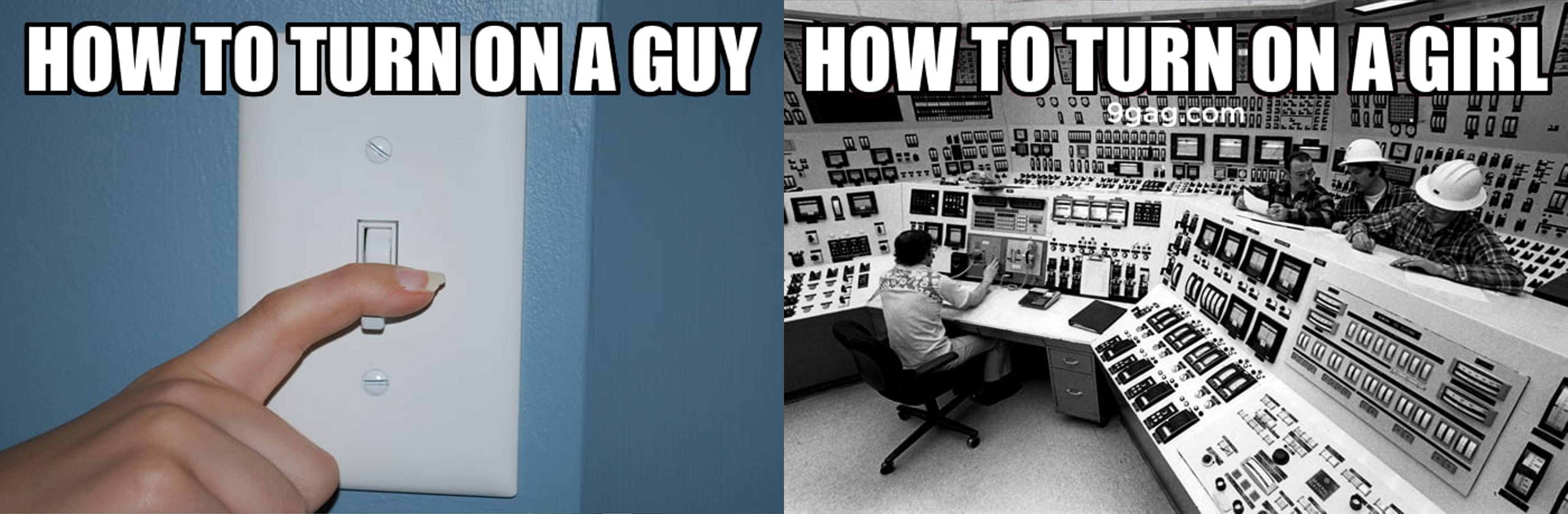
And the conversation is essential. Couples must talk about needs without shame or blame. This isn’t easy at all. If you thought baring your body was exposing, baring your soul about that activity is even more exposing. It’s made worse by societal contradictions between the raw physicality of sex and our angelic aspirations for being above those needs. It’s a topic we introduced in Sex, Poop, and Rock ‘n Roll.
And there’s a middle ground because sex in long-term relationships is not just physical; it’s tied to emotional connection, self-esteem, safety, and identity. Desire naturally fluctuates over time, and mismatches in libido are normal, not an emergency. There’s no right answer or easy button. Romantic love takes a lot of pragmatic effort.
The challenge is that sex is a major catch-22 where, without the physical connection, men will often withdraw the emotional, and without the emotional, women will withdraw the physical. In the book Love and Respect, they call this the crazy cycle, where at least one, preferably both, have to stop the bullshit and have a conversation.

For the guy, you need to be emotionally available. For the gal, you also have to lean into the physical. There will be negotiation, there will be boundaries, but when approached through love and respect, you can unlock an amazing sex life. But it requires open and raw conversations to maintain the balance.
For my relationship, it’s been one of the most painful yet rewarding alignments I’ve had to work through. After nearly 20 years of marriage, I would also say that we are still learning about each other, as we’ve changed over time. Sex is a regular exploration, not an infrequent happenstance, where our goal is to create intentional intimacy and not just sex(ual) touch.
What I mean here is that you can be incredibly sexual without the singular act of sex. Both can enjoy nakedness (looking at you gals) without the goal (looking at you guys) of sex. This has the benefit of being incredibly intimate and bonding. Take a shower together, scrub each other's backs, give naked hugs, towel off, and go to work.
Hell, I never like to pass up a chance to see my wife naked, give her a hug, and then go about my day. There’s a twofold benefit. First, the dopamine release for both is incredible, and second, the confidence you inspire in each other just by enjoying each other makes the connection during sex the frosting on an already intimate cake. It’s amazing and does wonders for your connection. Once you do this, you find that you’re an inseparable pair. There’s nothing that can get in your way… except, maybe, in-laws.
In-Laws
Do you know the difference between in-laws and outlaws?
Outlaws are wanted…

This is one of my favorite jokes, after which I follow up with: “I love my in-laws, it’s her in-laws I can’t stand.”
These jokes are funny because of the truth behind them. They also highlight a regularly damaging influence on a couple, if not properly managed. Too often, I’ve seen one or the other maintain a relationship with their parents that defied logic. Whether it was the woman calling her dad multiple times a day for advice, or the man whose mother devoured his agency, and this man-child was never able to step into the adult role of husband.
This is where a simple rule emerges: Your spouse comes first.
Not because parents don’t matter, but because the marital relationship must become the primary emotional home. Couples who successfully navigate in-laws create clear, kind boundaries, striking a balance between gratitude and inclusion, while maintaining autonomy. “We make decisions as a team.” You don’t want your kids playing mommy versus daddy, but that’s exactly what some couples do with their own parents.
Another point about those boundaries is something Kate Wand recently characterized as enmeshment or the inability to differentiate us and others:
Enmeshment is a term to describe the relationship between people, but in this case, I will talk about the enmeshed family, its usual manifestation. The enmeshed family has porous boundaries, or no boundaries. Respect is seen as absolute obedience and compliance to the parents, elders, or power holders of the family system. No one is okay unless everyone is okay. People meddle in the affairs of their family members, and this is to be expected, usually despite deleterious consequences.
Simply put, you are adults and you are a team. Letting your in-laws, on either side, dictate, control, or manipulate just pours a toxic sludge into the relationship. I’ll also be brutal here. A good relationship with your spouse will last longer than your relationship with your parents. You’re also the next generation, and you carry the torch moving forward. Letting in-laws interfere is living in the past. While it's important to maintain relationships and know your roots, it’s also important to grow individually and as a couple into new ways of living.
Summary
Money, Sex, and In-laws are not discrete problems. They merge and flow together. They also add up together, where a small problem in each of them can create big problems overall. It’s made worse by our quickly changing social mores, where traditional expectations in these realms are currently vastly different today than they were just 20 years ago, let alone 50.
We also inherited some significant hardware and software that we cannot simply ignore. Archetypes exist for a reason, and one of them, which highlights the difference, is the archetypes of Chaos and Order, where the feminine is generally viewed as chaos and the masculine as order.
The beauty of this archetype is that, when understood and embraced in a relationship, it can create a foundation of anti-fragility that can better weather the challenges of Money, Sex, and In-laws. It’s one step that forces honesty about who you are, and sets the stage to wrangle with money, sex, and in-laws, together, with open communication, no matter how awkward, painful, or embarrassing it is to work through. By losing your ego and leaning in together, you unlock an extraordinary relationship.

What are some ways Money, Sex, or In-laws got in the way of your relationships, and what did you do about it? Leave a comment below!
Did you enjoy this post? If so, please hit the ❤️ button above or below. This will help more people discover Substacks like this one, which is great. Also, please share here or in your network to help us grow.
Polymathic Being is a reader-supported publication. Becoming a paid member keeps these essays open for everyone. Hurry and grab 20% off an annual subscription. That’s $24 a year or $2 a month. It’s just 50¢ an essay and makes a big difference.
Further Reading from Authors I Appreciate
I highly recommend the following Substacks for their great content and complementary explorations of topics that Polymathic Being shares.
Goatfury Writes All-around great daily essays
Never Stop Learning Insightful Life Tips and Tricks
Cyborgs Writing Highly useful insights into using AI for writing
Educating AI Integrating AI into education
Socratic State of Mind Powerful insights into the philosophy of agency
I can’t recommend this article by Karina Schneidman MBA, MS on the health benefits
No lies detected. 👍
Great piece, Michael. Necessary reading for the 20 and 30 something’s who are just getting started. I found the in-law component especially refreshing; for some reason, this topic is frequently dodged in the mainstream, even though it has catastrophic implications. Perhaps it’s because it’s so thorny/complex/foundational.