


Welcome to Polymathic Being, a place to explore counterintuitive insights across multiple domains. These essays explore common topics from different perspectives and disciplines to uncover unique insights and solutions.
Today’s topic is another that names what shall not be named, in what underpins our modern dating culture. Yet, in doing so, we can make it better by excising some of the worst expectations and behaviors that plague the dating world. Let’s grapple with this situation and see how we can improve it.
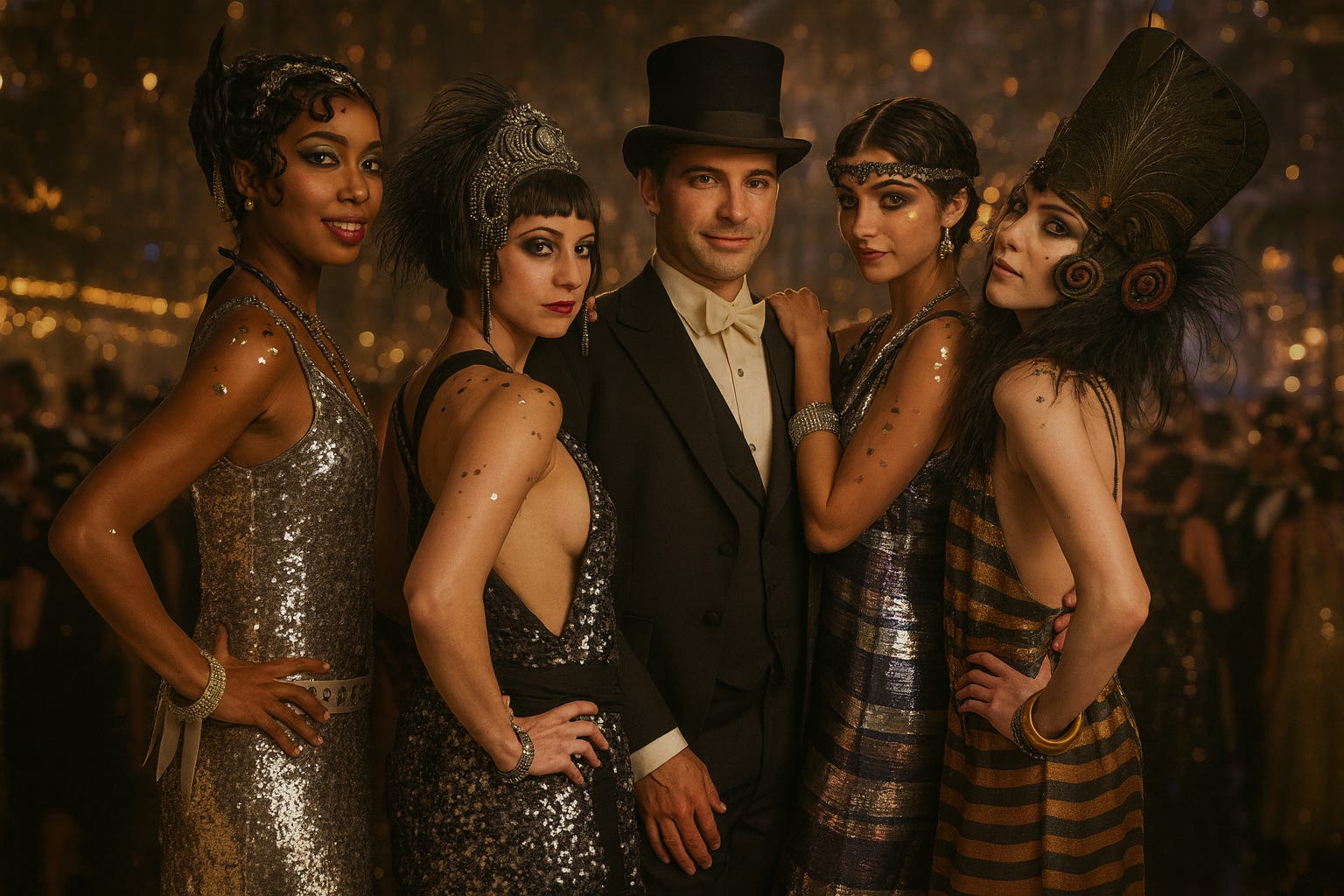
A few years ago, I engaged in a debate that investigated how much of our current dating culture borrowed from the 1920s flapper culture, which, itself, is rooted in a form of quasi prostitution.1 Yes, this is a can of worms of misaligned expectations.
None of you should be surprised by now that I love grappling with complex ideas in the octagon of life. We call it Mixed Mental Arts. In fact, that’s the name of the group I was part of before it fell apart, mainly because the culture of tackling controversial problems head-on was slowly quashed in lieu of not offending. The post on prostitution is a perfect example of that.
The topic in question and the failure of that group fused together in my head as I was reading Lirpa Strike, who wrote In defense of the rationalist bros where she opines:
But to suggest we discourage open debate and encourage mockery of those who participate in it because it includes certain “icky” topics is to squash the very nature of curiosity itself.
It’s apropos to the conversation and to Polymathic Being’s goal of insatiable curiosity because we accept so many traditions and behaviors carte blanche, without any critical analysis. Nay, not even the ability to raise the question to begin with! Half the comments on that post were desperate to shut down the conversation, and what ensued was one of the craziest debates I’ve ever seen. It triggered a few people, and shows where this community began transitioning from Mixed Mental Arts to, super-ironically, Idea Sex, and why it fell apart.2

But our dating culture needs to be critically evaluated. Far from being an empowering freedom for women, it turned a well-structured courtship into a free-for-all, with intense competition and misaligned incentives. Without further ado, let’s introduce the debate when a good friend of mine, Isaiah, posted:
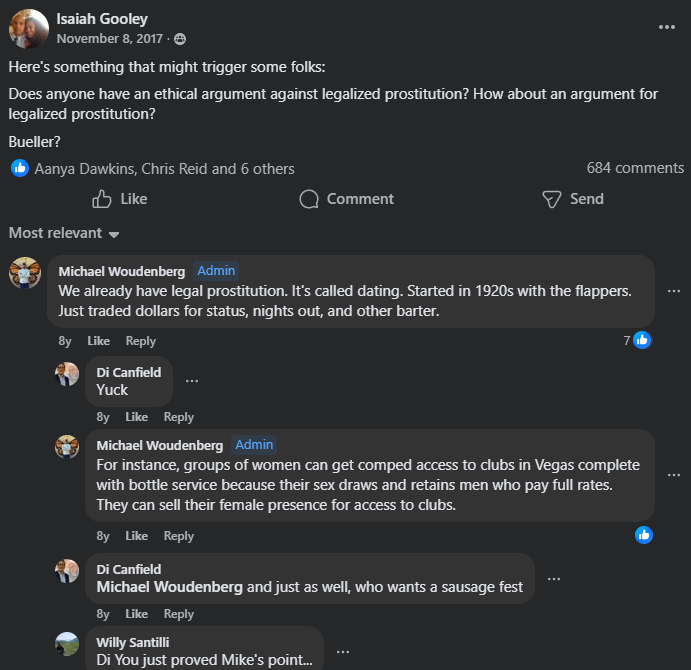
Here’s something that might trigger some folks:
Does anyone have an ethical argument against legalized prostitution? How about an argument for legalized prostitution?
To which I responded with what I thought was pretty obvious:
We already have legal prostitution. It’s called dating. Started in 1920s with the flappers. Just traded dollars for status, nights out, and other barter.
Before really digging in, I need to lay out the necessary caveats: We are discussing broad trends, not specific actions. This also doesn’t mean “all dating,” and this doesn’t excuse poor behaviors. That said, there’s an undertone that needs to be named in dating, so let’s break this down a bit more, because there are a lot of layers.
Dating as Prostitution
It always interested me to hear women brag about never having to buy a drink in a bar. When I’d ask them how they manage, they said they just ‘wiggle and giggle’, providing attention and dances. Similarly, hook-up artists and culture writ large recognize that there’s an appropriate way to meet a girl, which is to buy her that drink.3 It’s so evident that you’re still probably wondering what the big deal is.
Underlying this simple ‘tradition’ is a game of transactions that opens a social contract. I buy a girl a drink, and if she accepts, she provides me with some attention and, hopefully, time. If the conversation goes well, I might get the opportunity to contact her again. Conversely, if she refuses the drink, it’s a clear communication that the invitation is rejected, and there’s zero expectation of her time and attention.
Take it one step further, and you find the ‘juicy girls’ in South Korea who play the exact same game for bar owners to attract soldiers and revenue. Cute girls are brought in, typically from the Philippines, and often through human trafficking. When you go into a bar, you buy a $20 drink for the girl, which is just pineapple juice, and she spends time with you, telling you how amazing you are.
Prostitution is illegal in Korea, and most of these girls aren’t selling sex, but we still call it sex slavery because the boundary blurs. This situation blurs even more because it regularly does ends up in sex with the soldier, the girl often gets intentionally pregnant, the soldiers often marries the girl, which allows her to get out of her situation, get a green card, and all the benefits. It’s a crazy mess!
Now, taking a half-step back to how groups of women can get comped access to clubs in Las Vegas, complete with free drinks, because their sex draws and retains men who pay full rates. They can sell their female presence for access to clubs.
Lest you think this is just hypothetical, when my wife went to Vegas for a bachelorette party, they submitted the required group photos to a variety of clubs, and after review, many offered comped packages. On arrival, they skipped the line and were seated front-and-center in the club, on a raised area where everyone could see them, surrounded by the tables of the highest-paying men. My wife came back and just felt weird about, quite literally, selling her sexuality for access to the clubs.
“But they weren’t having sex!”
That post in Mixed Mental Arts dealt with that objection a lot while comparing dating to prostitution, and, in the end, I don’t think it even matters. Right, wrong, or indifferent, men don’t buy women drinks in this circumstance for anything but casting a hook, and women don’t take the bait without knowing the expectations, and I’m not even suggesting it shouldn’t end with sex. Dating is for mating, and sex isn’t the problem. The problem is we are so damn prudish that we can’t state the obvious, and that causes us to be willfully ignorant of how certain behaviors crept in.
So let’s pull this back to flapper culture, because alongside the image of the independent urbanite, many more young women were coming from rural or working-class backgrounds. These girls relied on wealthier men to fund their glamorous Roaring 20s lifestyle that they couldn’t afford on their own.
These flappers often entered into transactional relationships where men paid for drinks, clothes, and nights out a la The Great Gatsby, and women provided companionship, excitement, and, yes, sex. A great example of this is the musical Gigi, which blends many elements of this culture, albeit being made in 1958 and set in 1900. Interesting to point out is that France, where the movie takes place, is, and has been, much more honest with themselves about this behavior. Americans, not so much.
Fast forward to today, and the book by Peggy Orenstein, Girls and Sex talks about a very similar and recognized quid pro quo of modern dating. Peggy doesn’t pull any punches, and neither do the people she interviews. It’s eye-opening, refreshing, and describes a world we’d like to ignore, but most of us have experienced. One that is much more transactional than we want to acknowledge.

Let’s fuse this back to that Mixed Mental Arts post because it got interesting when others tried to shut down these points while accidentally admitting their validity.
I would love to see the dating show where guys tell women they are prostitutes. Is there a technical term for cock blocking yourself?
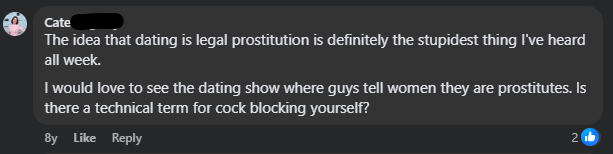
Ironically, Cate makes my point. If I suggest that a woman on a date is a prostitute, I “cock block” myself. Cate fully recognizes the layers of expectations. She already knows the game. She named the goal. In her own admission, the date is a dance for sex. A date where sex is often better achieved by how much money the guy spends on flattering the girl.
Remember my caveats because my original comment specifically scoped the dating scene toward the flapper side of the house, not all dating for sure. Still, the culture and rules underlying it all align more closely with flappers than with traditional courtship.
So, let’s pause and consider what happened before flapper culture infiltrated dating. Simply put, dating, as we think of it, didn’t exist in that women did not intermingle unaccompanied the way we do now. They weren’t ‘sponsored’ by men for evenings out. Women were typically introduced to a fellow and propriety was directed by strict social mores. In fact, flapper culture was scandalizing even back then.
While there were still exchanges of gifts and time, and, in the end, when you were married, sex, I contend that flapper culture added a flavor of significantly more overt transactions. This positions it closer on the spectrum to prostitution than otherwise. It’s also interesting to consider how the word “prostitution” has such a dirty connotation to many. Isaiah was poking at an ethical argument for prostitution,4 and my comment showed how even drawing a comparison is a bridge too far for many.
The result of all these layers and taboos on discussion is that the modern (and recent historical) dating scene is a mess of violated women. It violated expectations because we aren’t understanding the unspoken contracts that people are assuming. I hate to say this, but when you start selling access, you invite the sort of guy who’s willing to buy and expect access. #MeToo is a perfect example of how the whole lid got blown off the transactions in Hollywood and other positions of power.
Bottom line, when you transact for goods or currency, drinks or attention, based on what is between your legs, intercourse or not, you are selling your sex. How is that not a form of prostitution? So, ethically, morally, culturally, or otherwise, if you don’t care for that association, what’s the solution?
A Practical Solution
I made a rule in college years ago that I would never buy a girl a drink because I didn’t want to start down that lane. If she wanted to hang out with me because she liked me, that was one thing. If she felt obligated to hang out with me because I paid for her attention with a drink per societal ‘rules,’ I didn’t like the implications.
The first thing my wife and I did when we started our relationship was to lay out the end state. We decided we were together to determine whether we should get married because she was still in college and I was a young Army Officer, so dating, in the traditional sense, was just kind of silly. We ended up picking a more traditional courtship model instead, which invited more practical discussions.

Then we defined physical boundaries. How far were each of us comfortable going, and where should we draw the line so neither of us loses control without checking back in? We also talked about expectations. Did she expect me to pay for things? Did I expect her to pay for things? We agreed to an equitable share that didn’t lead to an imbalance.
Now, these were a series of conversations, not like sitting down to negotiate a contract. It was a great way to set expectations, open lines of communication, and lay out the unspoken rules and replace them for ones we both appreciated and wanted. It built trust and allowed us to have conversations the ‘game’ doesn’t allow, because the goal was to determine whether we should be married, not the weird dance of dating.
The solution is one part understanding what’s driving the issues, which we’ve explored today, and one part doing things differently. It might, like my wife and I did, revert to older traditions, or it might explore new opportunities. I’d merely add that understanding and respecting the older ways offer time-tested solutions to problems. Maybe we do need to go back to those traditions because the state of the current dating world has only gotten worse over the past twenty years.
Summary
Back to that Mixed Mental Arts debate: I’ll be honest, it was a group of rationalist bros exploring an icky topic, complete with all of the posturing opposition from outright dismissal to the “A very long thread by almost only guys,” to comments wondering why the women weren’t chiming in. After slogging through all the pearl-clutching, I loved how Isaiah summarized my position as:
“a rejection of a customary system where the exchange of currency, goods, and services for the presence of women in a non-professional capacity is normal.”5
My goal wasn’t to destroy dating. It wasn’t to denigrate prostitutes. It wasn’t to attack women. It was to name an underlying system of behaviors that drives outcomes we’d all like to avoid. It was grappling with complex problems in the octagon of life and trying to pull out insights that we can apply, teach, and influence. Dating as prostitution names the worst inclinations and outcomes and helps us avoid the very real consequences of not understanding the game.
What do you think? What would you do differently in dating? What might you recommend to the next generation?
Polymathic Being is a reader-supported publication. Becoming a paid member keeps these essays open for everyone. Hurry and grab 20% off an annual subscription. That’s $24 a year or $2 a month. It’s just 50¢ an essay and makes a big difference.
Further Reading from Authors I Appreciate
I highly recommend the following Substacks for their great content and complementary explorations of topics that Polymathic Being shares.
Goatfury Writes All-around great daily essays
Never Stop Learning Insightful Life Tips and Tricks
Cyborgs Writing Highly useful insights into using AI for writing
Educating AI Integrating AI into education
Socratic State of Mind Powerful insights into the philosophy of agency
As background, I’ve facilitated dozens of sexual assault awareness/prevention classes prior to 2016. My insights are informed in a large part by what was articulated by the people in those classes. These young people recognized the rules and weren’t socially inhibited from talking about them yet. I was shocked at two things I’ve uncovered in these classes.
How well understood the rules were
How little they actually varied by US cultural background.
Fundamentally, what was happening, which I didn’t appreciate until much later, is what Anuradha Pandey has been describing as the feminization of organizations. Not to get too deep, but what she describes isn’t the feminine; this isn’t about women, but about patterns of behavior that women tend to enforce. I won’t steal her thunder, so if you want to learn more, check out her essays here, here, and here.
I’m going to be approaching this from my perspective as a man with the understanding that women also play an active role. I’m also taking this perspective because the general trend is for men to take the first step.
If you want to jump down a really interesting rabbit hole, look at the major division within feminist circles on whether prostitution is empowering sexuality or exploitative masculinity. It’s interesting to be attacked as both a misogynistic creep AND an empowering ally by two different liberal feminists.
Interesting to note is that two of the people who had the biggest issues, both online and then in the background, ended up dating and married. However, he’s a rich kid with a terrible history of love, and she’s a girl who was desperate to get out of her country’s conditions. Long story short, this conversation on transactions struck way too close to home as there were some difficult-to-deny commonalities with this topic. I’m not saying there wasn’t love. I’m saying the love didn’t hide the reality.
This was deeply enjoyable- you managed to touch a sensitive topic and dissect it without apology, where most wouldn’t go near this. And fwiw, I agree completely that dating is low grade prostitution. The thing is, if prostitutes are sex workers and sex work is destigmatized as bourgeois white women are attempting, then there really shouldn’t be any consternation if you name dating as part of that lineage. This also reminds me of the whole sugar baby phenomenon. I honestly wonder if anyone has looked into those womens’ life outcomes. It never once occurred to me to trade attention for dinner or drinks. I don’t even think any man has tried to buy me a drink who I wasn’t already friends with—perhaps it’s the RBF. Sometimes I wonder how easy life might have been if I had traded on beauty. But I wouldn’t be writing this comment if I had. It’s a trap.
I have to bring up one of my favorite exchanges with my grandmother. She made a comment about my sister and her boyfriend: “why buy the cow if you can get the milk for free?”
I said (paraphrasing all these decades later): “That’s a good point, Grandma. If I get married and “buy the cow,” the woman gets half my salary for the rest of my life. The average married couple has sex twice a week. If we do the math, that means that every time I “get the milk,” it costs me $$$$ (I actually did the math). But if I go to a prostitute, according to some quick searched on the internet, it will only cost me $$$.
“So, Grandma, the best thing for me to do is not get married, but hire hookers twice a week. Thanks for helping me understand that.”
Yeah, I got into a lot of hot water for that.
One of my arguments for legalized prostitution is it’s honest. A lot of dating/mating isn’t, as you’ve rightly pointed out.