

Welcome to Polymathic Being, a place to explore counterintuitive insights across multiple domains. These essays explore common topics from different perspectives and disciplines to uncover unique insights and solutions.
Today’s topic expands on our previous explorations into personality and uncovers that even cultures have different styles of engagement which, if we aren’t careful in understanding, can result in the perception that an individual may have a pathology, not a cultural personality. Let’s discover how to reclaim appreciation of personality.

After letting the dust settle on our explorations of individual personality and what we risk in pathologizing it, or how misunderstanding it masks truly bad behavior under the banner of neurodivergence, I thought it was important to appreciate an often overlooked point: cultures also have personality. In the essay, True Neurodivergence, I shared the overreach of clinical diagnoses by introducing the non-parody book “Am I German or Autistic?” Spoiler: it’s not autism.

However, if we look at cultural personality through the lens of clinical pathology, the pragmatic, direct, and sometimes gruff Germans can appear to code as autistic. This is especially true when the diagnostic definitions have been blown out of proportion, people are constantly looking at disability as a frame for diversity, and we are fundamentally ignorant of normal, human personality proclivities, let alone cultural ones.
This is where another book by Erin Meyer, titled “The Culture Map,” comes into play. She studies different cultural behaviors and codes them into a series of measures that help us define normal engagement while contextualizing how that results in dramatic cultural and personal differences. She buckets her measures into:
Communicating: Low Context to High Context - Descriptive vs. Implied
Evaluating: Direct vs. Indirect communication
Leading: Egalitarian or Hierarchical
Decision Making: Consensual vs. Top Down
Trust: Task-based or Relationship-based
Disagreement: Confrontational or Avoidant
Scheduling: Linear time vs. Flexible time.
Persuading: Principles first or Applications first.

For example, the United States is characterized by a high-energy, low-context communication style where messages are explicit and precise. This directness, however, shifts to indirectness when giving negative feedback, as Americans often wrap criticisms in positive praise to remain professional. The culture leans heavily toward egalitarian leadership but utilizes a top-down decision-making process where a boss may consult others but ultimately makes the final call quickly while maintaining a moderately confrontational stance where open debate is viewed as healthy.
The way Americans wield logic is primarily applications-first, favoring practical facts over abstract theory, while trust is task-based, built through reliable performance rather than deep personal bonds. Another important consideration is that the US operates on linear time, valuing punctuality and fixed schedules above all.
But did you know that Japan sits at the opposite end of the spectrum from the US?
Japanese culture is defined by its exceptionally high-context communication, where the most important information is often unsaid. This is famously encapsulated in the concept of "reading the air," which is considered an essential social skill of sensing unspoken moods, body language, and atmospheric cues to maintain harmony. (Remember, the US is low-context: explicit and precise.)
Unlike the US, Japan is hierarchical in leadership and consensual in decision-making. This means they favor a slow process (ringi) to ensure everyone is on board before a final choice is made. Leaders do not make fast decisions and will take the time to build consensus and understanding.
Negative feedback is extremely indirect, trust is relationship-based and built over long periods of shared time, and the culture is non-confrontational, avoiding open debate to protect group cohesion. This might seem counterintuitive given the tropes we see about their honor, but that honor is bound by the consensus, not the cowboy behavior Americans are known for.
Finally, while Japan is linear-time regarding punctuality, its persuasion style is holistic, looking at the big picture and how all parts of a system interconnect, rather than starting with a single practical application. For a Systems Thinker like me, that’s refreshing, but as I’m also an action-biased executor, that can be frustrating.
What happens, in reality, is that Americans and Japanese have more than a language barrier to overcome, and the case studies are legion where misinterpretations turn into business partnership catastrophes. The 2003 movie “Lost in Translation,” starring Bill Murray and Scarlett Johansson, highlights a more personal example of the barriers that these different cultural personalities display.
Another great example is evident in WWII, where the American hierarchy and direct communication actually allowed very dynamic execution in warfare. Compare this to the Japanese honor with consensus and ‘reading the air,’ where orders were unclear, decisions weren’t delegated, and they were rolled back, island by island.
A similar experience I had running into these cultural personality differences was when working at Honeywell Aerospace, where we had a large Indian contingent working on our engineering program. India is high-context and deeply hierarchical, where deference to authority and formal titles are standard. Furthermore, while the US operates on a linear-time (where "time is money"), India uses a polychronic approach and views schedules as flexible and subject to the needs of the moment or relationship.
As you can imagine, it was super annoying working with them when you’d ask a direct question and not get an answer. In one situation, this was because their boss was on the line, and they couldn’t answer the question because their superior didn’t know the answer, and providing the answer would have caused that person to lose face. Similarly, with time, deadlines, much to the chagrin of my program management background, weren’t firm.
And if you think this is extreme, during my time deployed to Iraq, I learned their culture has a view of time totally backward from us, where a person is like a rower in a boat, and the future is ‘behind’ them. So, when pressed for a commitment, the common response was Inshaallah… God Willing. This was my first major exposure to this concept of time, and it taught me that, as opposed to being lazy, they thought Americans were hubristic to think we could see the future, as, in their cultural view, you can only see what’s happened, not what’s comming1
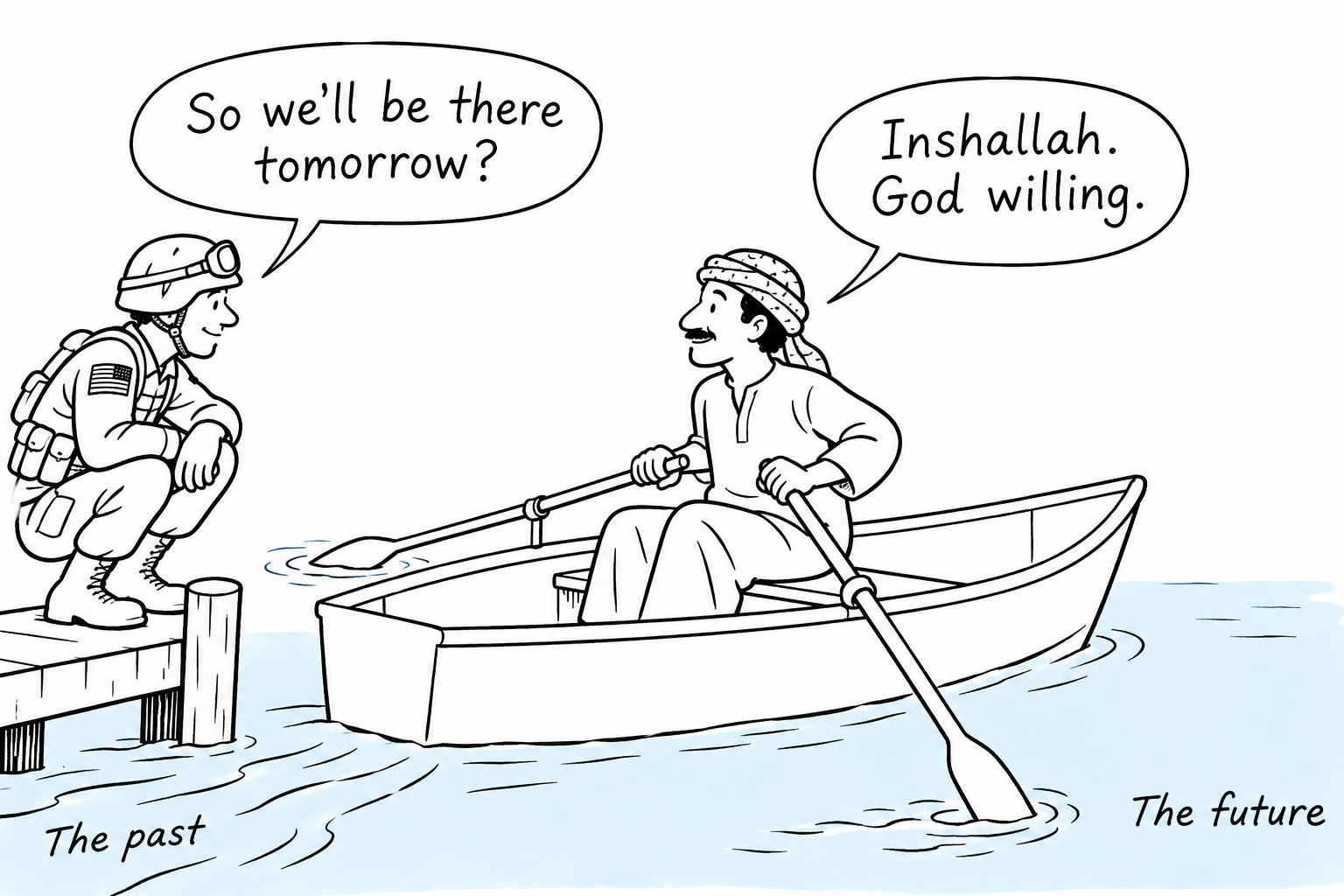
Pulling this back to the individual, it’s pretty clear that cultures have different collective personalities and modes of engagement that are imparted both socially and even genetically. Not to go too deep here, but a culture rewards those who fit in and excludes those who don’t. One reason for America’s unique culture is that it’s made up of a lot of ‘misfits’ who were disagreeable enough to leave their homes and families and go to the other side of the world. This helps explain the unique American individualist and the tension between a deeper coding for familial and societal identity. Simply put, individuals can inherit cultural imprints even separated from the original culture, and new behaviors can emerge.
Lest you think this is trivial, let’s consider that I’m ethnically Dutch, but not culturally so. However, the Dutch are known for directness, and this happens to be a proclivity that gets coded through mate selection. For years I felt out of sync with my peers due to my directness, and when I came across this meme, it all made sense:

Dutch directness: The Dutch are renowned for speaking their minds: from complete strangers reprimanding you for chatting in the train’s quiet zone, to a friend not telling you a white lie about your bad haircut. Outsiders often see this as being rude or tactless, but for the Dutch it is actually a virtue of sincerity and honesty.
They don’t mince their words or beat around the bush, and are often not afraid to discuss hot topics such as religion, politics, immigration or money. In fact, it is even seen as a cultural faux pas to not have an opinion. Some Studies trace this directness back to the country’s history of Calvinism: Calvinist are concerned with the essence of things and what is really important. The good thing about this ‘callous’ openness? At least you know exactly where you stand with The Dutch
I’ve also heard it emerged, in part, because the Dutch spent centuries pushing back the ocean to reclaim the land, and directness was essential if a dyke was failing. There was no ‘Hey Willem, just thought I’d mention, that next time you’re out in your field, you might want to look at that dyke… when you have a chance, it’s probably nothing…” Instead, the culturally proper thing would be “William, check your dyke, it looks like it’s leaking.”
"I try to avoid asking a Dutch audience for criticism after my workshops; the experience is much the same as being machine-gunned."- Fons Trompenaars - Author
In the article The Perks of Dutch Directness by Caitriona Rush, she contrasts how a Dutch neighbor and an Irish neighbor reacted to a last-minute request to babysit her son. The Dutch woman gave a flat, unexplained "No." However, this didn’t carry hard feelings and simply meant she wasn't available that afternoon, and it left the door open to ask again later. Conversely, an Irish neighbor feels socially obligated to be polite and says "Yes" and, even after a drawn-out back-and-forth of "Are you sure?" doesn’t say no, only to complain to her husband later that her quiet afternoon is ruined and the mother only finds out later through the rumor mill.
Rush points out that while Dutch bluntness can feel jarring, it completely sidesteps hidden resentment while protecting personal boundaries far better than indirect ‘politeness.’ However, it can sound harsh if you don’t understand the culture, but personally, I’d much rather have a clear answer than the indirect bullshit.
The fun part is this can be tracked with the Culture Map, where we can compare the Netherlands to the UK and see enough divergence to create that difference. Even crazier is the difference between the Netherlands we just explored and the examples from India earlier:


So what does this mean? Well, first, we are different, and cultures do have personality. On the one hand, that’s totally obvious; on the other, we tend to ignore those personalities. It’s the classic: we’re expecting from others what we expect from ourselves.
The real challenge emerges similarly to what we explored in Personality or Pathology, where, according to our hyper-diagnoses, if you took a Dutch (or German) person and put them in India, they’re going to look very autistic. However, if you took an Indian person and put them in the Netherlands, or even the US, they’d take on characteristics we might see as Social Anxiety Disorder (SAD) or Avoidant Personality Disorder. Similarly, the Japanese would appear avoidant even in India.
And this is supported by research which shows that the Dutch Autism label comes from being ‘blind’ to context, whereas the Japanese Anxiety label comes from being ‘hypersensitive’ to a context that the Western environment doesn’t acknowledge; a function of the direct vs. indirect communication styles where context is either explicitly communicated or assumed to be inferred.

Within these cultures, we call adherence to these ‘personality proclivities’ social graces. It’s understanding the behaviors that are expected and aligning to them in a way that reduces social friction. But this can still create conflict because, to repeat, we expect from others what we expect from ourselves, and the feeling “but I would never do that!” highlights a lack of social insight as well as not valuing diverse personalities.
A great example is the funny story told by my friend, J. Prust, regarding his grandmother, where she highlights the double-edged sword of social graces. In his essay Read the Room, he describes how his grandmother feigns falling asleep in an attempt to get two guests, engrossed in conversation, to leave. The implication is that they failed to read the room. But did she also fail to communicate her desires? As I commented there:
“I wouldn’t have been offended had she been direct. In fact, if I were them, I’d be offended at her passive frustration that she refused to communicate.”
Especially so if I found out she was annoyed and faking it. Maybe it’s my Dutch directness, but how can I trust her in the future that what she says and how she acts are authentic and that she’s not just faking?
The story also highlights another maxim of mine: unspoken expectations are guaranteed to be violated.
Grandma said nothing about her expectations and was annoyed that they were violated. Given what I can only assume are both different individual and cultural personality proclivities, I’m not at all surprised her unspoken expectations were violated. The other two were synced together but different from her.
Similarly, I’d be annoyed in that situation because I expect directness, and she was more about ‘reading the air.’ Conversely, I’ve had people get offended because I was direct when they asked a direct question. And none of this is wrong except when we fail to appreciate the diversity of personalities.
Summary
We love to celebrate diversity, and then we demand everyone behave like ourselves.
We also love to pathologize healthy personalities both individually and culturally.
However, we need to understand that the brusqueness of the Germans isn’t Autism. The directness of the Dutch isn’t being an Asshole. The indirectness of the Irish isn’t always social graces. The consensus of the Japanese isn’t always empowering. Now, consider the other elements of Communicating, Evaluating, Leading, Decision Making, Trust, Disagreement, Scheduling, and Persuading.
What emerges is a beautiful diversity that requires intentional understanding and appreciation. It's the amazing capability to surround ourselves with people who don’t think like us and can challenge us to think differently. And that’s the beauty of personality; we are different but not so different that we can’t understand each other. Just remember, you expect from others what you expect from yourself, and unspoken expectations are guaranteed to be violated. These are the first steps in discovering how to reclaim appreciation of personality.
What stories do you have about running into these cultural personality differences?
Did you enjoy this post? If so, please hit the ❤️ button above or below. This will help more people discover Substacks like this one, which is great. Also, please share here or in your network to help us grow.
Polymathic Being is a reader-supported publication. Becoming a paid member keeps these essays open for everyone. Hurry and grab 20% off an annual subscription. That’s $24 a year or $2 a month. It’s just 50¢ an essay and makes a big difference.
Further Reading from Authors I Appreciate
I highly recommend the following Substacks for their great content and complementary explorations of topics that Polymathic Being shares.
Goatfury Writes All-around great daily essays
Cyborgs Writing Highly useful insights into using AI for writing
Educating AI Integrating AI into education
Mostly Harmless Ideas Computer Science for Everyone
The Shepard Scale - Kit Perez - Counter Intelligence Insights
My 2 Cents - Karina Schneidman MBA, MS-MFT
Iraqi culture also builds trust based on relationships vs. the American task-type trust. As such, simple tasks actually require significant relationship building that American Soldiers just didn’t recognize, often to the detriment of mission success. This was a lesson I shared in The Enemy’s Gate Is Down, where the simple act of smoking cigarettes with the Iraqis and talking about life allowed me to get more work done, as well as gain critical intel that kept us from running into IEDs.

What about language? Do you think language has a role in shaping personalities or or did personalities shape the language?
While living in Europe I was always struck by how culture and cuisine would dramatically change in just a few kilometers. Simple case in point. Try finding fish in a German grocery. Maybe frozen fish sticks and the occasional fresh salmon. Cross the border into France and viola, fresh fish galore.
Thanks for the post. Insightful and thought provoking.
Oh, when I was in the Netherlands, I always knew where I stood, usually about 8 inches below the Dutch. Also always dealing with a sore throat, trying to speak the language.
I've been thinking a lot about nation-states as people ("national personification", I guess) lately, while I've always sort of viewed the framework as overly simplistic (it is), it's also incredibly useful as long as you keep that in mind. I'm a fan of this kind of metaphor, and I think it works for cultures too. It gets really interesting when you start envisioning two people of a certain mindset interacting with both frameworks.
I tend to associate Calvinism with the very opposite of openness, but maybe that's a direct result of my own interactions and less grounded in actual history. Presbyterians were punks!