


Welcome to Polymathic Being, a place to explore counterintuitive insights across multiple domains. These essays explore common topics from different perspectives and disciplines to uncover unique insights and solutions.
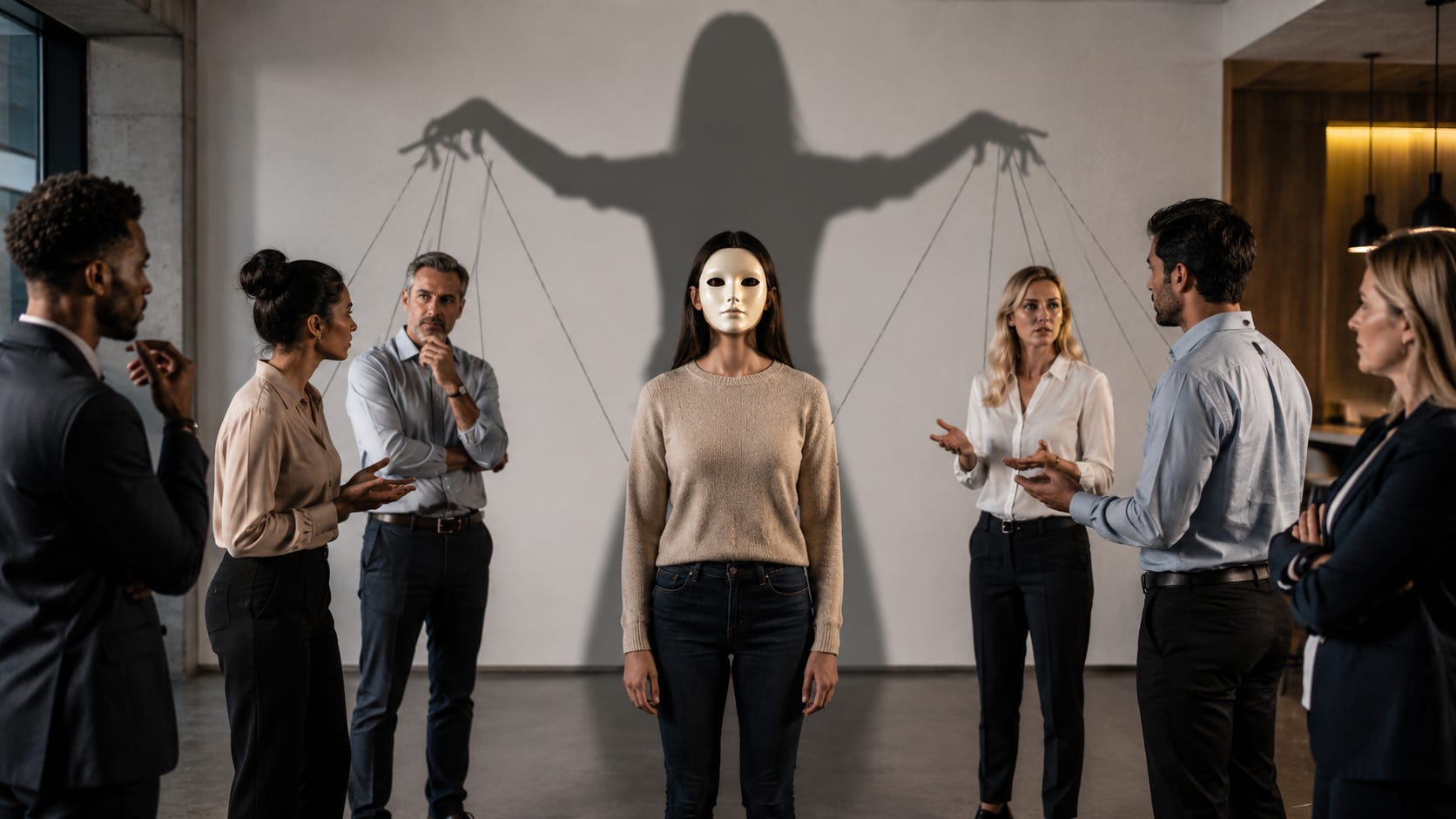
Today’s topic attempts to unmask true anti-social behaviors from the protective cover of neurodivergence. We’ll explore the current state of the neurodivergent world, identify key patterns to pay attention to, and in doing so, I truly believe that once we pull off that mask, we can create healthy, inclusive cultures.
Intro
Human behaviors have broad diversity in cognitive, emotional, cultural, and social expression. There are, however, toxic behaviors; the shadow behaviors that manipulate, control, and exploit. When I started investigating neurodivergency, I was annoyed at how healthy behaviors were getting classified as divergent and personality profiles, which are useful for identifying the healthy diversity of neurotypicality, were being ignored, which allowed anti-social pathology to hide in plain sight.
As I explored, I found that we collapsed neurotypicality into a facsimile, some largely undefined ‘other’ which, apparently, controls and designs everything to exclude the neurodivergent. This allows the ‘divergent’ to be victims, set apart, and special, openly claiming status as gifted and exceptional while also, paradoxically, claiming disability.
This cocktail of victim + special is intoxicating and has exploded the diagnostic window of neurodivergence, where a majority of Gen Z claims neurodivergence as core to their identity. This is bad enough, but as I kept digging, I found something more sinister lurking beneath that I felt in my original post, and confirmed as I kept digging. There is clear manipulation within neurodiversity by classic Cluster B.
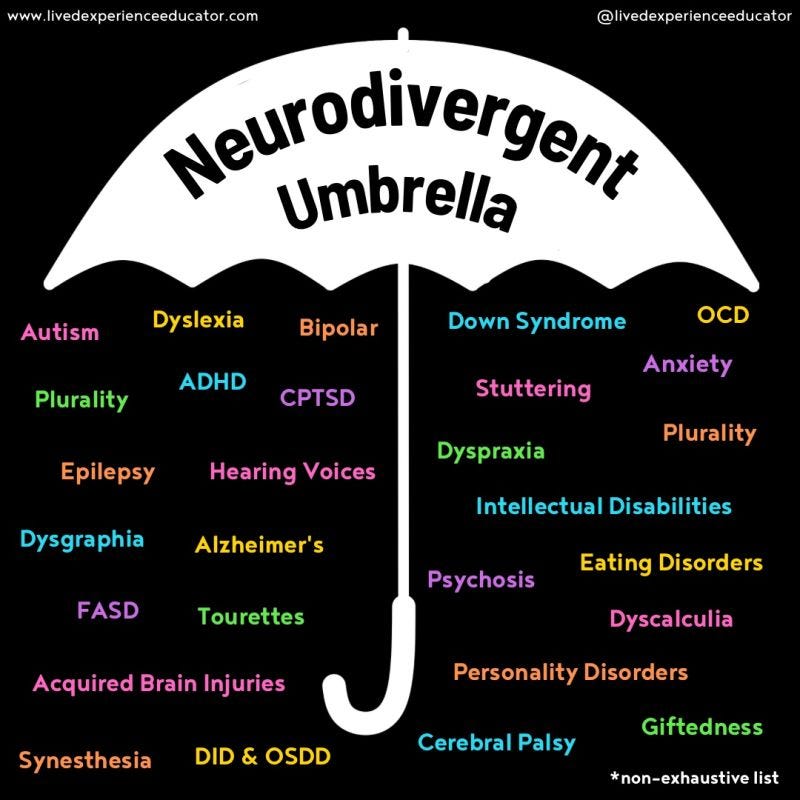
All these variables make this both difficult to critique without being accused of ‘punching down’ and impossible to pin a definition where quirky personality sits next to Down Syndrome, Stuttering, Giftedness, and Anxiety. It’s so broad as to include anyone and claims enough legit disabilities to create a minefield for analysis. So what we’re going to do is start picking it apart, starting with the pathology of Cluster B.
Cluster B
To better understand, in psychology, Cluster B is a category of personality disorders in the Diagnostic and Statistical Manual of Mental Disorders (DSM-5). It encompasses four distinct conditions regarding emotional regulation, impulse control, and maintaining stable relationships:
Antisocial: Disregarding laws, norms, and others’ rights.
Borderline: Intense instability in emotions and relationships.
Histrionic: Constant attention-seeking and excessive drama.
Narcissistic: Grandiosity and lack of empathy.
What makes Cluster B challenging to recognize is that it’s largely a feminine cluster, in contrast to the Dark Triad's (narcissism, Machiavellianism, and psychopathy) masculine tendencies. Add to this, Cluster B manifests as what can sound and look like caring, but it’s the feminine shadow, the devouring mother, and reveals itself as toxic empathy, which isn’t empathetic at all!

I don’t make this claim lightly, because as I dug deeper into understanding True Neurodivergence, I kept coming across social media and Substack accounts that were purportedly neurodivergent, but all started to sound the same. It was the victim + special cocktail where anything and everything that held these influencers back was blamed on the nefarious neurotypical.
Three accounts highlight this best:
The Cognitive Ecologist writes about how everything that holds her back is the fault of everything else. Her recent article, Fragile Men and the Women Who Outlast Them, is a perfect example where, if you replace Neurodivergence with Cluster B, the reasons for her ‘harassment’ become clear.
The Gifted Experience is a case study on what can be best described as ‘intellectual masturbation,’ where any sense of agency or acceptance of challenge is pushed away for the easy button. No surprise that she claims a PhD in ‘Creativity’ and that comes through in her fantastical justifications. She’s also (self-described) ‘gifted,’ so that purportedly gives her unquestionable wisdom.
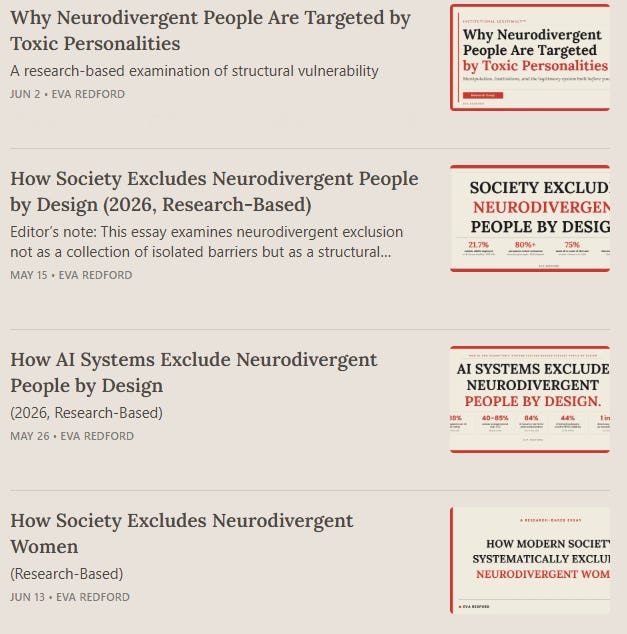
Eva Redford’s most popular articles all lament exclusion and, with no irony intended, include one on how toxic personalities target neurodivergents. I don’t place Eva in Cluster B yet, but she’s a great example of utility for Cluster B, which we’ll get into shortly.
I could add in the NeuroDivergent Rebel and Phoebe-Lily <3 and The Neurodivergent Uprising and Neurodivergent Geek Girl and Marie Martinsen and Neurodivergent Journals and Jeanie Gee ADHD and The Neurodivergent Mama and Anne ✨, ad infinitum1 because, as I explored that area, I kept coming across more and more accounts that all had something critical in common:
They are women.
Of higher socioeconomic status
Claiming disability as core to their identity
Displaying clear Cluster B behaviors in their writing and/or reactions.2
Now, I don’t want this to be viewed as an attack purely on women, but two things emerged: first, it was nearly exclusively women3 and, second, Cluster B manifests under the neurodivergent banner much more seamlessly than the masculine Dark Triad. Put another way, it’s much easier for the shadow feminine to hide there than for the shadow masculine, because it masks itself in caring, nurturing, and comforting. It’s the perfect recipe for toxic empathy and the devouring mother archetype, which creates the very exclusion the nuerodivergents fear.
Cluster B Exclusion
The challenge is that it actually weaponizes those with true disability. This is where I think Eva plays a role in that she may very well be autistic, but her language and her supporters push her away from agency and accountability and into victimization, which, in turn, helps hide the Cluster B manipulators. Eva is a useful lackey and perversely views her manipulators, selling her the cocktail of victim + special, as allies.
To add insult to injury, Cluster B designs intentional exclusion, fosters division, and stokes animosity while weaponizing the vulnerable who actually need help but convinces them it’s a superpower that no one should take away. So, those who are divergent are pushed further away, not by people like me who want to see Eva integrate and grow, but by those who relish the power the division provides while being able to excuse socially pathological behaviors.
The perverse result of the Cluster B infiltration is the exclusion of truly autistic and ADHD people who need the attention and resources to lead more productive lives. As more people try to gain influence, accommodation, and disability compensation, we see the explosion of pathologizing personality and the subsequent siphoning of funds and resources from those who need them the most, as Fell Choice describes:
Note here, they have to append “desperately” to help you understand that these are what we merely called “disabled” twenty years ago. Similar to how Sarah | Profound Autism Mom (note the modifier ‘profound’) writes about her autistic children who are lumped in with a social media influencer with a quirky personality.
It’s so bad, Christianity On The Spectrum, writes about the gentrification of level 1 autism (formerly Asperger's), and recently described the exclusion thusly:
Redefining autism to exclude its negative symptom because they embarrass the least disabled autistic people is harming those of us who do not have the luxury of denial.
The resource drain is becoming more and more obvious as Karina, who works as a practicing therapist, has this to say about the situation:
Hannah Spier, MD also pulls no punches in “The Spectrum”: How Autism Was Hijacked By Narcissists, where she puts it plainly that neurodivergence now feeds those Cluster B behaviors where autism now,
“means you’re socially odd, intellectually superior, and emotionally detached in an edgy and endearing way. For many, especially mothers with narcissistic tendencies hungry for a narrative of exceptionalism, this offered a seductive reframing of their child’s misbehaviour and non-conformity as evidence of giftedness. She could thus become the one who gave birth to the quirky but special genius. She alone saw the hidden brilliance beneath the “weird” behaviour. She became the martyr and the insider to an elite subculture. It’s Munchausen by proxy, 2025 edition.
Likewise, a year ago, Nathalie Martinek PhD wrote Dark neurodivergence or Cluster B traits? where she delineates the ever-eroding line between disability and anti-social pathology and how the latter demands no fix for the former. This is why you now see people protesting the push to prevent or cure autism, because if we fixed the problem, we’d take away their social currency and mask.
Masking as Neurodivergent4
Here’s where it really gets truly messy because Cluster B traits can resemble autistic behavior at the surface,5 and the intelligent narcissist learns to mask. This is profoundly counterintuitive because nuerodivergents have been using the term “mask” to explain how they’re expected to fit into normal life, which, I have to point out, everyone does, and sociology calls it code-switching among other terms. However, in a true twist, Cluster B successfully uses neurodivergence as a mask to hide, or cloak6 their behavior where:
Emotional volatility may look like a meltdown
Criticism sensitivity, like rejection sensitivity
Unstable relationships, as social-communication difficulty
Entitlement like accommodation-seeking
Cruelty, like autistic bluntness
Identity instability like late “unmasking.” (You can tell a brilliant cover where they tell you what they’re ‘masking’ but make it sound like they’re masking for neurotypical while they’re actually masking Cluster B as something else)
The strongest warning sign is their selective incapacity, where the person invokes neurodivergence when challenged, yet demonstrates restraint, social awareness, and strategic presentation when reputation, authority, or personal advantage is at stake.
Which brings us back to Eva Redford, of recent fame for her 5,000-word AI-generated posts, published near daily, which end up being insightful in a perverse way. In her essay on being Targeted by Toxic Personalities, she nearly gets to the problem when she identifies that: “One in three autistic women has received at least one psychiatric misdiagnosis before an autism diagnosis, most commonly a personality disorder.”
The challenge here is that we’re finding it’s not a misdiagnosis at all! In fact, it lines up with my own analysis that 1:3 women claiming autism are using it as a mask for their personality disorder, and it isn’t autism at all! It wasn’t a misdiagnosis because personality disorders are typically much more strenuously diagnosed, with multiple observations, whereas I can go online, schedule a meeting, and walk away with an autism diagnosis in minutes.
This allows neurodivergence to be an unusually effective identity shield for people who display manipulative, narcissistic, borderline, histrionic, antisocial, and other abusive behavior. It’s brilliant at reframing misconduct as disability. It protects by accusing criticism of ableism. It deflects demands for accountability by claiming they’re a denial of accommodation.
It hides this exploitation as a misunderstanding, all while allowing access to disability and accommodation. Even worse, it feeds narcissism by claiming to be ‘gifted’ and ‘exceptional.’7 In her most amazingly close assessment of the situation, while I was drafting this essay, Eva actually wrote Why Neurodivergent People “Attract” Narcissists, which indicates that she perceives the same thing but hasn’t figured out that Cluster B are creating these problems and she’s their lackey. She worries that it paints the neurodivergent as defective, while I think most of us see how their innocent vulnerability provides a perfect mask for pathology.
That’s where we find The Cognitive Ecologist (real name Sher) wearing this mask so well as she laments feeling excluded from everything. Unlike Eva, the Cluster B is much more obvious as she blames everyone else. The catch is, her behaviors are a poison that our long-evolved social systems were designed to exclude because they’re a pathology, not some cute cognitive quirk. Mike Hind noted that her rant reads as deeply aggrieved, entitled, and antisocial, while trying to say it’s a superpower being held back by the neurotypical. She’s right that it’s being held back; she’s wrong that it’s a superpower, at least in the protagonist sense.
Mike also astutely points out that most of these writers studiously police their comments, deleting anything they disagree with, ironically, excluding anything that diverges from their narrative. This is something even Eva did on a post about the problems with exclusion… Yes, the irony goes deep.
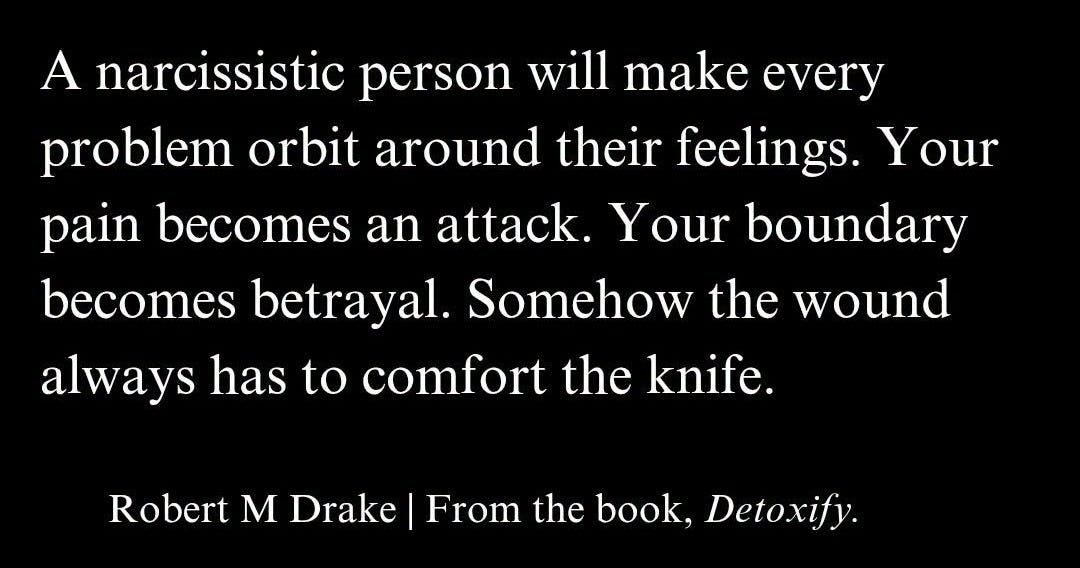
This reinforces the idea that the easiest discernment is in their response to accountability. A person acting in good faith can usually say, “This explains why it happened, but I recognize the harm and will work to prevent it.” Conversely, the mask produces a recurring cycle of harm, denial, justification, identity-based counterattack, victim reversal, ally recruitment, censoring, and blocking with no sustained, nor even attempted, behavioral change.
Unmasking Cluster B
I want to be clear that I’m not offering a diagnosis, but I’m seeing and naming patterns. This discernment allows me to accommodate legitimate disability, state my engagement boundaries explicitly, expect reciprocity and repair, and judge whether the diagnosis is being used to improve functioning or to create immunity from consequences. It helps me be maximally inclusive while protecting me from toxicity.
As far as a recommendation for you, dear reader, the easiest way to discern the difference is that neurodivergency produces lifelong, broadly consistent difficulties with social communication, sensory processing, rigidity, and repetitive patterns, whereas Cluster B behavior is more often organized around abandonment, validation, status, control, entitlement, or exploitation.
Once you see the behavior for what it is, it becomes much easier to distinguish it whether online or in person, and all you have to do is start watching for the pattern. This recommendation is for both neurotypical and truly neurodivergent people, as we aren’t as far apart as the Cluster B manipulators would have you believe. I truly believe that once we pull off that mask, we can create healthy, inclusive cultures.
I’d like to point out that many others are starting to see the same thing, including Josh Slocum, who opened my eyes to Cluster B behavior through his personal stories about his mother growing up. He has this to add to the conversation:
So does Thalia ⚡ Immortal Wit:
Did you enjoy this post? If so, please hit the ❤️ button above or below. This will help more people discover Substacks like this one, which is great. Also, please share here or in your network to help us grow.
Polymathic Being is a reader-supported publication. Becoming a paid member keeps these essays open for everyone. Hurry and grab 20% off an annual subscription. That’s $24 a year or $2 a month. It’s just 50¢ an essay and makes a big difference.
Further Reading from Authors I Appreciate
I highly recommend the following Substacks for their great content and complementary explorations of topics that Polymathic Being shares.
Goatfury Writes All-around great daily essays
Cyborgs Writing Highly useful insights into using AI for writing
Educating AI Integrating AI into education
Mostly Harmless Ideas Computer Science for Everyone
The Shepard Scale - Kit Perez - Counter Intelligence Insights
My 2 Cents - Karina Schneidman MBA, MS-MFT
Case in point, after publication, I came across Ella Thompson who epitomizes what we are talking about here with clear Cluster B, claims of Neurodivergence, losing her voice to AI, and posting gems like this, below. It’s certainly a way to get ahead of the curve…
Or, as Kit Perez describes it: “midlife women wanting to reinvent themselves as gurus even though their own lives are shit”
If you want a great listen, check out our recorded live-stream where we dig into her frustrations with the Cluster B in Neurodivergence:
In True Neurodivergence, I poked at Nicholas Kircher, but, unlike the women mentioned, he actually engaged in a very productive dialogue that didn’t attempt to shut down the conversation, strawman the argument, or shame. In fact, he acted very typically for a nerdy dude: with curiosity.
Masking is also used as a negative as if a neurodivergent has to hide… which is what we uncovered Cluster B are doing. The thing is, masking is also called adulting as Hannah Spier, MD wrote in this note:
There are comorbid presentations of both Neurodivergence and Cluster B, which muddy the water, but the more I study it, the more I think they can still be teased apart. With women, this is much harder because they have much more overlap, which is another reason why men are largely not part of this analysis because Dark Triad behaviors don’t mask well here, whereas Cluster B fits in quite nicely. Consider that Autism, 20 years ago, used to be a male-dominated pathology, and once they broadened the clinical diagnosis, the most significant growth was with women. Further, the increase in autism has been in Asperger's, not ‘profound’ autism of levels 2 and 3, which we used to just call Autism.
I originally titled this essay “Cloaking as Neurodivergent,” but I thought masking played into the claims this group makes about fitting in with the neurotypical. However, cloaking is a slightly better word because it implies deception, versus just hiding.
This may involve genuine autism or ADHD, mistaken self-diagnosis, comorbid personality pathology, motivated self-deception, or deliberate deception.
Hello, I was sent this to read and, although I’ve not been mentioned, have thoughts on this that I would like to discuss!
Whilst it appears you want to come across as fairly neutral, I’d like to highlight certain language that rang alarm bells for me. Referring to a woman making an article on backed scientific findings as “nearly gets to the problem” comes across as condescending, and a very common pattern for men to dismiss women’s voices.
Also you referring to the women writing about neurodivergence as “influencers” and not writers, or advocates. However, and even more alarming, is how you have worded your ‘findings’.
“The challenge here is that we’re finding it’s not a misdiagnosis at all!” is what you have written here. However you are not a doctor, have not conducted any scientific study, and have come to your own conclusion and stating it as factual evidence. Which actually goes against the peer-reviewed research: 1 in 3 autistic women report being misdiagnosed with a personality disorder before their autism was correctly identified. Meaning autism was the accurate diagnosis and the personality disorder label was the mistake. This is a reflection of gender bias in diagnostic criteria, and not on the women themselves who this post focuses on.
You’ve taken that finding and flipped it to mean the opposite of what the researchers found.
“it lines up with my own analysis that 1:3 women claiming autism are using it as a mask for their personality disorder”. what credentials do you have to identify personality disorders? What study did you conduct? Has it been peer reviewed and evidence backed?
You write “I’m not offering a diagnosis, but I’m seeing and naming patterns.” But you’ve just told your readers a named list of specific women displaying “clear Cluster B behaviors” Cluster B being four DSM personality disorders. Naming the diagnostic category and attaching it to real, named people is diagnosing by another name.
There is a difference between exploring whether there is a link, and posting an article positioning yourself as providing factual findings that actually provide more harm than education.
You may disagree with my points, and scientific research, which you can do as you are your own person, i’m just highlighting the issue that arises when you push these out as factual evidence! I’m not here to name call, or slander, and we can agree to disagree on these matters. I just wanted to highlight them!
I’ve been on Substack but a month so imagine my surprise to find myself so noticed!
We may not agree on everything but I agree with you on several underlying points: The DSM and our current diagnostic understanding and categorization aren’t perfect, a diagnosis shouldn't exempt anyone from accountability for harmful behaviour, and people with very high support needs shouldn't be left out of conversations about neurodivergence.
However I am unclear on how your proposed method actually distinguishes between the people you're describing. You identify accommodation-seeking as potentially entitlement, late unmasking as potentially identity instability, and objections to criticism, etc. as evidence of the Cluster B pattern.
At the same time, you acknowledge that genuine autism and ADHD may be present.
So what evidence would distinguish a Level 1 autistic woman genuinely describing her disability and requesting appropriate accommodation from someone using autism as a shield for Cluster B pathology?
With only a month's worth of notes to go on, you don't know me terribly well. For example, I come from a very working-class family and I'm not of high socioeconomic status. So I'm also curious: what could any one of the women you've named here say or do that would cause you to conclude that your assessment of her needs updating? Is that possible? Or not?
My feed is also quite full of Level 1 autistic men, many of whom talk about late diagnosis and masking as well. If Cluster B pathology isn't the explanation there, is there an equivalent mechanism you think is driving that?
I'm asking sincerely, because if disagreement, defence, blocking, seeking support, identifying as disabled and requesting accommodation can all become further evidence for your hypothesis, I am unclear how the hypothesis remains falsifiable. What evidence could ever count against it?
Thanks — I’d be genuinely interested in your thoughts.