


Welcome to Polymathic Being, a place to explore counterintuitive insights across multiple domains. These essays explore common topics from different perspectives and disciplines to uncover unique insights and solutions.
Today’s topic asks you to reflect on whether you’re balanced in your identity or falling into the trap so many find themselves in, where others define who you are and satiate you with narcissistic validation. By the end, you’ll understand the problem and have a path to crafting a true identity intentionally tethered to firm anchors that help navigate the chaos of life.

There’s an odd trend recently that I can only describe as the combination of two seemingly contrary ideas. The first are the NPCs, and the second are the narcissists. For those unfamiliar with the NPC meme culture, it stands for Non-Player Character, a reference to the scripted plot lines in video games where you, the real player, interact with these avatars that regurgitate the same script every time. An NPC doesn’t have agency and follows only the computer program.
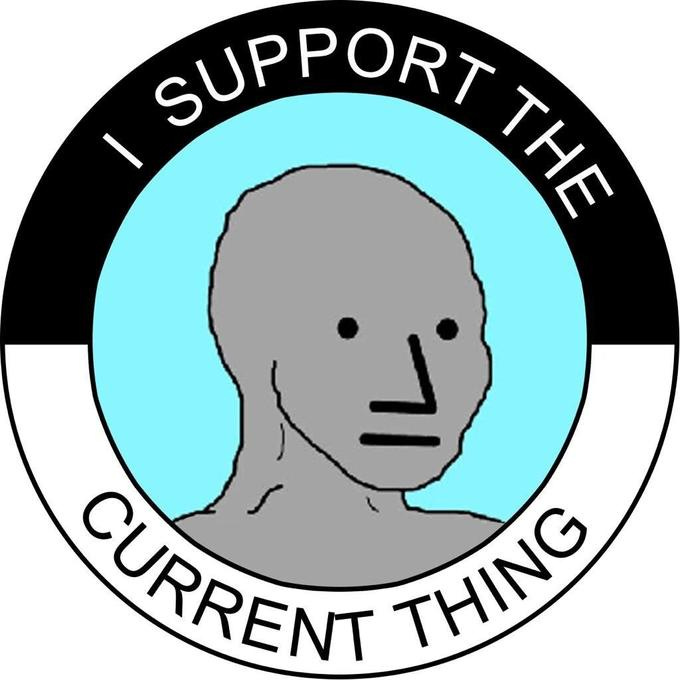
Lest you think this is just a pejorative, there are legitimately millions of people who fall into this category on all sides of the political aisle. They support the ‘current thing’ and will pivot with political winds so quickly it’ll give an observer whiplash a’la Orwell’s 1984.1 These are also the folks that can get riled up into a frenzy by Fear Porn, are constantly at risk of PSYOPs, and are the ones regularly targeted by Algo Whores who rely on that rote compliance and lack of critical thinking to manipulate.
The NPC appears to have no internal identity separate from their group, nor any willingness to hold a critical viewpoint against their tribe. In a way, the NPC embodies the psychology of a religious mindset, even if they’re atheists. In fact, people who flipped from religion into atheism often have the worst NPC mindset and become the same pawns in their new tribe because their identity is defined by others.
Then, there are the narcissists. Most think these would be the opposite of an NPC, as their identity seems to be ego-centric, defined as:
High self-esteem and a clear sense of uniqueness and superiority, with fantasies of success and power, and lofty ambitions.
Social potency is marked by exhibitionistic, authoritative, charismatic, and self-promoting interpersonal behaviors.
Exploitative, self-serving relational dynamics; short-term relationship transactions defined by manipulation and privileging of personal gain over other benefits of socialization.
You might be tempted to think NPCs and narcissists sit at opposite ends of a spectrum, with one defined by the absence of self, the other by an excess of it. But that framing misses something important. There are two types of narcissists: the definition we just read is Grandiose Narcissism, which we’re mostly all familiar with. The other is called Vulnerable Narcissism, which is defined as:
Low and contingent self-esteem, unstable and unclear sense of self, and resentment of others’ success.
Social withdrawal, resulting from shame, distrust of others’ intentions, and concerns over being accepted.
Needy, obsessive relational dynamics; long-term relationship transactions defined by an excessive need for admiration, approval, and support, and vengefulness when needs are unmet.
In practice, both vulnerable narcissists and Non-Player Characters suffer from the same underlying failure: neither has a stable, internally grounded identity capable of resisting external pressure.
Narcissistic NPCs
Now this is where it gets interesting because vulnerable narcissists looks like an NPC in many ways, but weaponize it into something else. Let’s look again at some of the key words describing vulnerable narcissism: unstable, resentful, obsessed with relational dynamics, and vengeful. This isn’t a healthy, confident, independent agent. These are your zealots, your enforcers, your witch-hunters, and your moral panickers. They have the ego of a narcissist but cloaked in soft, not overpowering dynamics.
NPCs outsource identity, which explains conformity without thought. Vulnerable narcissists outsource validation, which explains moralized resentment and vindictiveness. When these two failure modes coexist in the same person, they don’t cancel each other out; they compound.
What emerges is zealotry, fueled by an emotional volatility, moral certainty without self-authorship, and enforcement without reflection.2 This is exacerbated by the fact that they aren’t selective about where they get their validation. They’re as fervent about the latest thing as they are about anything, and they exhude righteous indignation and the hubris of moral superiority. Their lives are slogans and signalling, with rabid reactions to any challenge.

Sadly, this is not a rare edge case. It’s a predictable outcome in environments that reward conformity and victimization over agency. They’re also the easiest to weaponize by grandiose narcissists who become demagogues. And demagogues love narcissistic NPCs because they’re both empowered by and empower the vulnerable narcissists to maintain their rule. You see this play out in the online mobs, real-life riots, the pandering of politicians, etc. Anytime there’s an easy answer to a problem, a scapegoat, or the ability to silence challenge, the Narcissistic NPC is your enforcer and a damn good one at that.
Once this dynamic exists, certain cultural environments will reliably select for it. This is what Anuradha Pandey and Hannah Spier, MD write extensively about regarding the soft-power dynamics prevalent in feminine spaces as highlighted in The Contemporary Expression of Female Narcissism and Why Women Get Away With Narcissism. This is a root cause of Toxic Empathy and isn’t a female thing specifically, but heavily influenced by soft power enforcement. Simply put, cultures tend to reward vulnerable narcissistic strategies more often in feminine-coded social spaces and grandiose narcissistic strategies more often in masculine-coded ones.

At this point, some might conclude that we have to reject external influence altogether, sever tribal ties, stop caring what others think, and embrace self-defined autonomy. If outsourcing identity creates NPCs, and outsourcing validation creates narcissists, then what other option do we have? It’s not wrong, but let’s first ensure we don’t overcorrect.
Avoiding Overcorrection
The key to vulnerable narcissism and NPCs is to develop agency. Philosophies share that the antidote to manipulation is to stop seeking external validation, to look inward, find inner peace, and cultivate self-control.
“To be yourself in a world that is constantly trying to make you something else is the greatest accomplishment.” -Ralph Waldo Emerson
“Care about what other people think and you will always be their prisoner” -Lao Tzu
“You will deserve respect from everyone if you will start by respecting yourself.” -Musonius Rufus
These ideas point toward autonomy and self-definition, which are great solutions for the narcissistic NPC; however, taken too far, they become their own distortion. This is because a basic reality is that humans aren’t built to exist in isolation. We are fundamentally social creatures. In fact, I’ve argued before that Homo Sapiens (wise man) is a misnomer. We are better described as Homo Socialis (social man). We didn’t rise from prey to apex predator through individual brilliance alone, but through social intelligence: cooperation, shared narratives, traditions, and trust networks.
That advice sounds wise, and in moderation, it is, but taken to its extreme, it produces the grandiose narcissist, and history gives us plenty of examples like Nero, Qin Shi Huang, Stalin, and Idi Amin, who severed feedback loops and replaced them with dominance. Complete rejection of external validation is also not a strength.
Where the narcissistic NPC has no healthy sense of self and is lost in the whole, the solution isn’t to eliminate external validation. It’s about choosing it intentionally and earning it from people and institutions grounded in reality.
A Solution:
This is where Kyle Shepard, writing Resilient Mental State, offers a balance where he highlights the external vs. internal validation as the seam at which to begin identifying your values. He shares:
… core values offer the opportunity to lay the foundation for your authentic self. There are no inherently “correct” values to hold, however, it’s beneficial to keep them to principles rather than outcomes. Tying values to desirable results places them outside of your control. It also encourages projection rather than reflection. Control what you can - your impressions and subsequent actions. Only you possess the ability to verify the How and Why alignment in a given action.
Cultivation of values and application of virtue, however, takes time. Values also constantly evolve based on changes in life circumstance. Support is essential for individual success in all endeavors.
He clarifies the balance by explaining that only you can define your values. However, you do need external validation that you’ve picked the right values. Too often, we’ve been Aiming at the Wrong Targets and Misunderstanding Success and don’t have our true value proposition identified. It’s also important because your current targets may, and sometimes should not, actually be yours.
For example, my marriage and children are more than me. However, I also need to ensure they’re aligned with the proper external actors. (i.e., my family over Twitter, my community over a demagogue.) This is the balance between grandiose and vulnerable narcissism, and can pull you out of being an NPC by respecting your unique value and agency, and how you best fit into the world to add value.

The way I do this personally is to ensure I’m only tightly coupled to a few things that really matter. For example, my religious identity doesn’t rely on the Bible being literally true. It relies on the fact that it contains thousands of truths, which are also represented in other faith structures.3 I can appreciate the truths and live my life that way, a topic we explored deeper in The Truth of Myths. I’m not controlled by a dogma, and I also ensure that I’m not accidentally embracing atheistic dogmas because religion is more of a psychology than a theology, and the most atheistic are often just as religious.
I did the same by decoupling from the false binary of American politics. In fact, I actively reject that binary as I explained in Quantum Superposition and Politics. By doing this, I’ve stepped away from the crazy manipulations, found my identity elsewhere, and abide by the Taoist mantra that Heaven is High and the Emperor is Far Away. I live my own life, not letting politics live rent-free in my brain. This helps keep from being an NPC.
Lastly, to avoid the problems of narcissism, I embrace my Whitebelt and strive for humility, while also fostering an intentional, Insatiable Curiosity to explore and aim to intentionally reframe problems to see what I missed. Am I perfect? Hell no. I still have my biases, I still make mistakes, I’m still learning, unlearning, and relearning. But I have my identity, and it’s intentionally coupled to firm tethers that help me navigate the chaos in life.
That’s why a polymathic mindset is so powerful. It rejects false binaries, resists single-tribe capture, and applies ideas inward before wielding them outward. I control myself. You control yourself. You can choose your anchors. You can cultivate healthy agency. And once you recognize the toxicity of the Narcissistic NPC, you can see it for what it is and step out of its orbit entirely.

Did you enjoy this post? If so, please hit the ❤️ button above or below. This will help more people discover Substacks like this one, which is great. Also, please share here or in your network to help us grow.
Polymathic Being is a reader-supported publication. Becoming a paid member keeps these essays open for everyone. Hurry and grab 20% off an annual subscription. That’s $24 a year or $2 a month. It’s just 50¢ an essay and makes a big difference.
Further Reading from Authors I Appreciate
I highly recommend the following Substacks for their great content and complementary explorations of topics that Polymathic Being shares.
Goatfury Writes All-around great daily essays
Never Stop Learning Insightful Life Tips and Tricks
Cyborgs Writing Highly useful insights into using AI for writing
Educating AI Integrating AI into education
Socratic State of Mind Powerful insights into the philosophy of agency
Or my more recent favorite, the Epstein Files, which went from extreme right-wing, complete with Pizza Gate, to mainstream right when Trump campaigned to release them, to, post-2025 government shutdown, the left suddenly jumped on board as if they’d always been on board. I mean, I’m thrilled they’re on board now, but the whiplash was crazy, where I went from accusations of conspiracy theorist to accusations of defending pedophiles if I even mentioned the flip-flop.
I recently met FreeStateofPortland who has won the prize for the most restacks of my articles and notes, but sadly, a narcissistic NPC. It’s been painful to watch, but insightful into the psychology of it all as well.
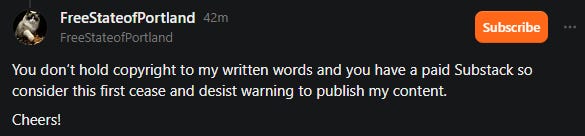
The bigger issue is that they’re an anonymous account and act more like a Russian Troll Bot, yet are still useful to observe. In reality, they’re probably a sophomore art major with no life experience, but hopefully, they can mature a little bit, like knowing what you put on social media takes on a life of its own.
In fact, it's somewhat absurd to force it to be true when Jesus speaks in metaphor all the time, as evidenced in John 3 and Matthew 13.
Enormous. I love how you are building on previous works. What an important essay - and so pertinent while navigating the current toxic news cycle.
I'm pretty unplugged from much of popular culture, so I did not know what an NPC meant—it is doing some heavy lifting and whoever made this connection deserves some credit. Thank you for this awesome archetype to play with, one that is impossible not to see now.