


Welcome to Polymathic Being, a place to explore counterintuitive insights across multiple domains. These essays explore common topics from different perspectives and disciplines to uncover unique insights and solutions.
Today's topic dusts off some critical leadership lessons from my time working in Lean Six Sigma that I’ve incorporated into every job I’ve had since. It’s a critical lesson in both leadership and followership to ensure we are involved, aligned, and empowered.

When I was a Raytheon Six Sigma Expert, one of the principles that I appreciated the most was “Involve, Align, and Empower Employees.” It resonated because, in so many organizations, the pursuit of quarterly profits makes it feel like employees aren’t considered beyond just cogs in a machine to print money for someone else.
And to be fair, that wasn’t even untrue of Raytheon during my time, which made the aspiration for that principle more important. Back then, there were frequent complaints that employees lacked loyalty. This was a problem for two reasons. First, frustrated employees were leaving for 30% pay raises (which means the company was underpaying them by 30%), and second, we’d hire their replacements from other companies, paying them 30% more than the employees who stayed!
Neither group had skin in the game to fix the problem, and so the frustrations grew. and very few embraced the idea of Involving, Aligning, and Empowering. It doesn’t take a rocket scientist to immediately see this trifecta has value. Yet, for something that would grow a workforce, open your company to new, fresh ideas and innovation, and engender the loyalty companies thrive on, it’s shocking how few companies and leaders can actually pull these three concepts together. Let’s start diving deeper with Involve.
Involve
I’ve run many teams in my career, but the one that taught me the most was a team of 16 direct reports, all but two of whom were under the age of 30. The interesting aspect is that a decent number of them were outliers in their areas; they didn’t quite fit into their old teams. The rest were fresh from college. My team was seen as the place for both the newbies and the disenfranchised, which, you’d think, might be a bad mix.
The opposite was true. I’d learned enough about working with divergents to know that asking a fish to climb a tree was stupid for both of us. So I involved my divergents in the solutioning and team growth. Instead of letting them bitch, I told them to figure out how to solve the problem. One fellow came back a few weeks later, a bit chagrined, and said he had learned a lot more about why the systems that had frustrated him existed. That didn’t mean they shouldn’t be improved, but instead of trying to rip everything out, he began to appreciate why they were there, which is a key function of the concept of Chesterton’s Fence, namely, don’t rip something out before you fully understand the reason they exist. It took involvement for him to see this.

Involvement includes more than just the team. In another improvement project I led, I was told to avoid working with a guy named Joe. He was, apparently, a pain in the ass to deal with. However, Joe was also at the center of why so many projects failed in that area in the past. So, I ignored the advice and brought Joe onto the team, and quickly recognized why that advice had been given. But, unlike the others, I involved Joe. When he complained, he got the chance to fix it. When he railed against past efforts, I put him in charge of leading this effort.
I forced Joe to have skin in the game and an opportunity to put his fingerprints and ideas on things. In the end, Joe became a huge advocate for me and one of my biggest supporters of improvements in his area. He went from always being a resistor to an early adopter of a new system because he was involved. I just had to make sure he was aligned.
Align
Over the years, I’ve learned that leaders love to tell themselves stories that take the effort of leadership off their shoulders. One of these stories is the idea that “The people doing the work know what they need to be successful.” Ironically, it’s an element of involving and empowering, which is good, but it comes with the abdication of alignment.
Yes, the people doing the work know the work better than most. But that can be a problem as well because they often only know the work they know, and they’ve never considered other options. It’s like the Henry Ford quote, “If I had asked people what they wanted, they would have said faster horses.” Too often, the people doing the work don’t know how to be successful, especially when true success requires a paradigm shift.
This is where alignment is so important. I don’t dictate, but I do ensure everyone knows the common direction we are pulling and, most importantly, the why. This also doesn’t mean I’m the only one with the vision. As we read in Lead as if You Won’t Survive the Engagement, the best leaders have instilled alignment in their teams so that their performance continues long after they’ve left.

One way I’ve done that is to ensure we provide leadership with two things:
Situational Awareness: Leaders need to know where we are and what we are doing. This helps them ascertain the situation and where you’re headed, and, done well, helps them point out the risks and opportunities before you see them.
The ability to put their fingerprints on the work: You want your leaders to have skin in the game for your work. I ensure my leaders are involved as much as I involve my teams because, if they aren’t, it’s too easy for them to avoid accountability.
The best leaders I’ve had have done both. I had one leader who loved to hear what I was up to and problem-solve with me. Sometimes he didn’t have much to add, but even though he wasn’t sure of the solution, he'd provide top cover when stakeholders were upset about a change. He was also unique because his view was “If you’re not pissing someone off, you’re only average.”
This is where alignment meets empowerment and shows how it’s greater than yourself. It also forces you to set aside your own ego so that you can truly empower your teams.
Empower
Your teams need energy to improve performance. No one would suggest that for a car to go faster, you don’t need more energy, but we seem to ignore this critical idea in business. David Mann, in the book Creating a Lean Culture, builds on the car idea where different tools can help leaders add that energy. He describes four elements:
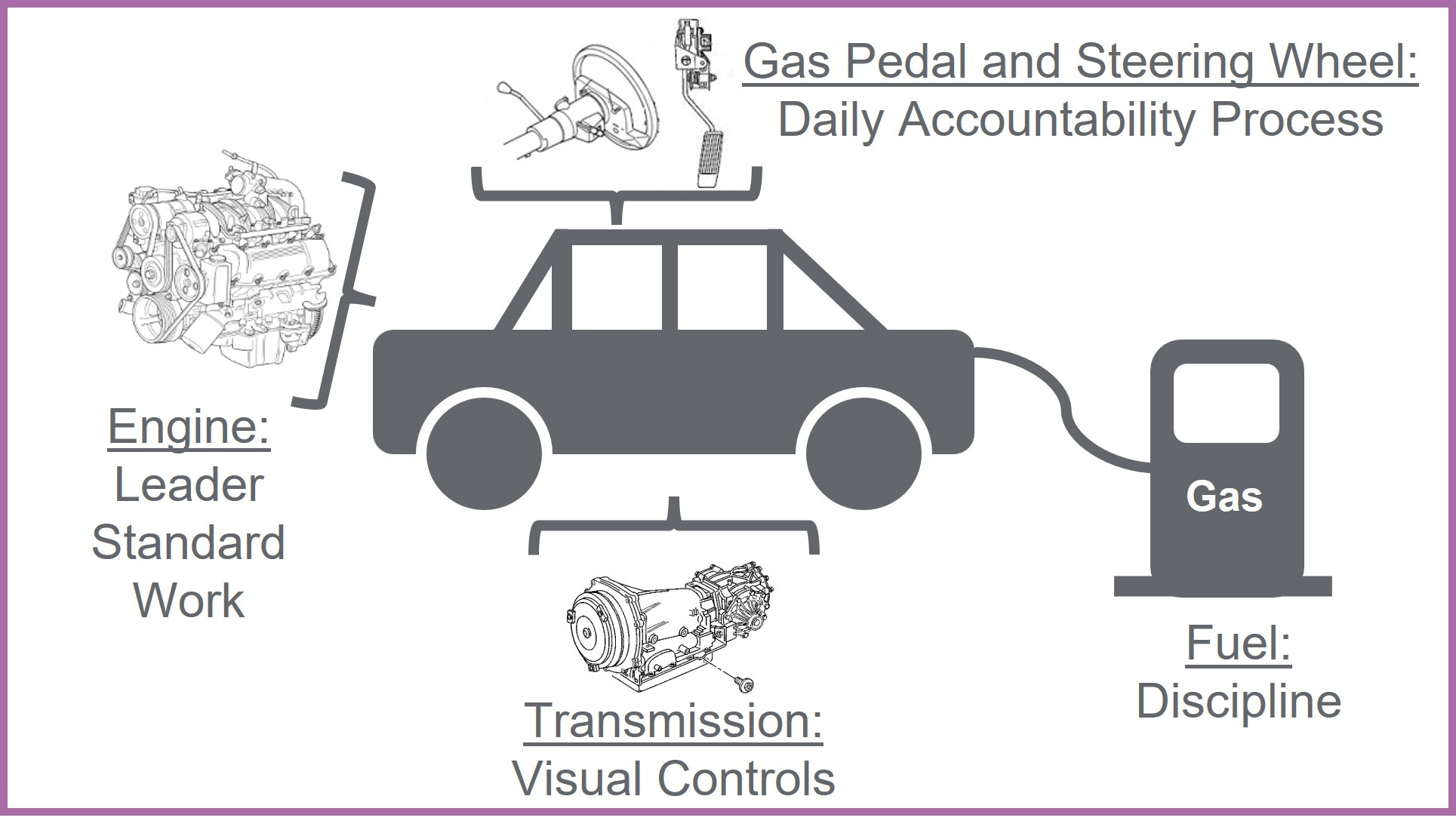
The engine is Leader Standard Work. It's the most difficult tool I’ve ever gotten people to use, and it’s not difficult because it’s complicated. It’s difficult because it requires accountability. It also requires alignment because most of the chaos is driven by different layers of leaders pulling in different directions.
The transmission is the set of tools that help make the processes and systems visual. This helps inform decision-makers when to shift .for the conditions of the effort.
The gas pedal is the daily accountability process. This isn’t micromanaging; this is giving the space to involve and align your team members so that you can step on that gas to empower them.
Lastly, none of this works without the fuel of discipline. Simply put, without discipline, you cannot empower anyone or anything. I can’t emphasize this enough because without disciplined execution, you’re just never going to move the needle.
Back to Joe, I empowered him, and as he saw continuous improvement, he realized that the structures he hated before weren’t a problem with structure writ large, but with systems that weren’t adding value and processes that didn’t have accountability. When this was solved, he became a very loyal team member
To empower, you must provide accountability mechanisms so that, as you go faster, the entire car doesn’t fall apart around you. With that structure, you can be adaptable in your execution and continue to improve the team’s performance as you go.
Summary
It’s not hard to see that without all three, you’ll have an imbalance. Involving without aligning and empowering is an abdication of leadership. Aligning without involving and empowering is dictatorial. Empowering without involving and aligning is chaos and just pours gasoline on an existing conflagration.
When you balance all three, two things occur. The first is that your employees become more loyal to the organization as they see themselves in the processes and systems they helped create. The second is that you see more loyalty from the leadership who have invested themselves in the same things. Both sides now have, as Nassim Taleb says, skin in the game, which creates a better work environment.

This balance of ideas can be applied quickly, no matter if you’re a formal leader, a project manager, or an individual contributor. As you start to look at the work around you. Are you involved, aligned, and empowered? Are you involving, aligning, and empowering others? If the answer is no, start looking in these areas to make your work experience significantly better! You’ll also find that this is an amazing way to build loyalty within your teams.
I’d love to hear from you! When have you experienced either the negative or positive aspects of being involved, aligned, and empowered? Leave a comment below!
You may also recognize that this is very related to providing Direction, Energy, and Accountability. However, there is enough nuance and a slight change in the frame of reference for the two to stand alone and work together. I’ve found great success in balancing those two trifectas depending on the teams as they work together exceptionally well.

Did you enjoy this post? If so, please hit the ❤️ button above or below. This will help more people discover Substacks like this one, which is great. Also, please share here or in your network to help us grow.
Polymathic Being is a reader-supported publication. Becoming a paid member keeps these essays open for everyone. Hurry and grab 20% off an annual subscription. That’s $24 a year or $2 a month. It’s just 50¢ an essay and makes a big difference.
Further Reading from Authors I Appreciate
I highly recommend the following Substacks for their great content and complementary explorations of topics that Polymathic Being shares.
Goatfury Writes All-around great daily essays
Never Stop Learning Insightful Life Tips and Tricks
Cyborgs Writing Highly useful insights into using AI for writing
Educating AI Integrating AI into education
Mostly Harmless Ideas Computer Science for Everyone
Such an awesome essay, Michael, thanks a lot for that! I would like to point out a numerical error in your logic, if I may.
When someone receives a 30% raise, it means their new salary is 130% of the old one. But the company was not underpaying them by 30% — it was actually underpaying them by less than that.
Suppose the salary at the company was $100.
The employee left to earn 30% more → $130.
Now, how much was the company underpaying relative to the new salary?
(130-100)/100 ~ 23.08%
In other words, the company was paying approximately 23% less than the market rate, not 30%.
So the percentage difference is not symmetrical because the bases are different. A 30% increase over the smaller value is not the same as a 30% decrease over the larger value.
The general rule is, if someone receives a raise of x%, the company was actually underpaying relative to the market by: x/(1+x)
In the case of 30%: 0.3/1.3 ~ 23.08%
Kind Regards,
Rod
the obvious disconnects about corporate level missteps you mention, I know little about. my experience with corporations and committees being minimal. At one time I employed 25-30 employees in a gas station and later 2-10 employees in construction remodeling projects, so that might be a very small scale microcosm of team relationships .
I slowly learned that some folks tend to be better leaders or willing to take initiative when given the chance, and those folks I gave the responsibility for the team they lead. I eventually realized it was not wrong to acknowledge sincere efforts and people respond better when they are recognized as individuals, (even when their efforts may be misplaced). A team work ethic or "espre de corps" or good morale always being essential to making headway.
Without unity of will and consensus about the objective, being effective/efficient is blunted. Experience in athletics and "the battles of Briton were won on the playing fields of Eton" gave me an ideal of performance to strive for. Lastly, and what took me a while to learn, was if I did not explain what I expected or teach my team how to do the job properly, then it was not their fault, but mine, if goals were not achieved. From knowing very little at the beginning to having a real crack team of cooperative, effective, and loyal people, was a real achievement for me. And after putting a good team together, there are few things sadder than leaving that group and not taking them on to other endeavors.