


Welcome to Polymathic Being, a place to explore counterintuitive insights across multiple domains. These essays explore common topics from different perspectives and disciplines to uncover unique insights and solutions.
Today’s topic introduces two amazing writers on Substack who are helping improve the health and resilience of… anyone. The focus is on Functional Fitness, which simply means being able to do what you want, when you want, without significant limitations, no matter your age, condition, or experience. You’ll discover that, when you embrace the challenge, how much potential you’ve left on the table.
It’s time to shift gears from leadership and psychology and get back to the practical applications of fitness. We’ve covered a few threads here before that you might want to look back on as foundation elements, like how we Breathe Wrong, Walk Wrong, and even Poop Wrong. These aren’t necessary to move forward, but they do provide great insights into how common biomechanics of modern life are out of whack.

This is why I wanted to introduce you to Kyle Shepard, who does great monthly fitness challenges that have kicked my butt. He writes Resilient Mental State, and you may also be familiar with some of his other writing I reference on mental resiliency. The other half of his equation is physical resiliency, which is driven by functional fitness.
Functional fitness is physically training in order to build, maintain, and enhance function in domains of interest across the lifespan. The body is always capable of adapting to demands imposed on it. Functional fitness aims to establish a baseline and improve all possible adaptations.
One’s why will greatly influence how they approach their what. When your why for training is function, your approach will aim to progressively improve performance in life rather than a particular concern in health, appearance, or biometrics.
There is not a profession or lifestyle that wouldn’t benefit from physical training to improve function. Train for function and expand your capacity to live your life to its fullest.
His top recommendations for you to read are focusing on Intentional Stress, Efficient Training for Maximal Results, and a podcast on Strength and Health with Scott Shetler.


I’d also like to introduce you to John Dailey who writes both Walking Point and Ruck The F* Up (RTFU). I asked him to provide an intro to functional fitness and what that means in his view:
The goal of functional fitness is right there in the name. Are you fit enough to function at the things life might require? When I was on active duty that meant one thing. When I retired from the Marines and started running ultras, it meant something else. As a human you should want to know that you will always be able to do what is needed and have something in reserve.
As we get older, we need to reevaluate what ‘function’ means. At 56, I’ve realized that I need to focus on what function will mean when I am 99. If I want to lift my carry-on into the overhead bin at 99, I’d better be able to overhead press at least 135 now.
I want to be able to go out in the woods with a ruck on my own. I want to travel and carry my own weight. I want to lift my grandkids if I ever have any. Or, if I realize that I never will have grandkids I may resort to kidnapping one. That will require strength, stamina, and speed.
We start losing around 3% of our muscle mass and 1% of our bone density per year after 50 if we aren’t working to keep it. The earlier you start lifting and the harder you keep at it, the better off you will be.
I like to believe that you don’t get weak because you get old, but you get old because you are weak.
To get kicked off with John’s suggestions, I highly recommend his essay Building a Base and We Must Undergo A Hard Winter Training.


As you can see, John’s response is right in line with what Kyle described, and I’m not surprised. To underline just how serious John’s statement about age really is, take a look at these MRI images of leg muscles of a 40-year-old and a 74-year-old triathlete compared to the center image of a 74-year-old sedentary person. The triathletes both look similar and healthy. That 74-year-old isn’t… old. The sedentary 74-year-old is also clearly not able to do much with those muscles.
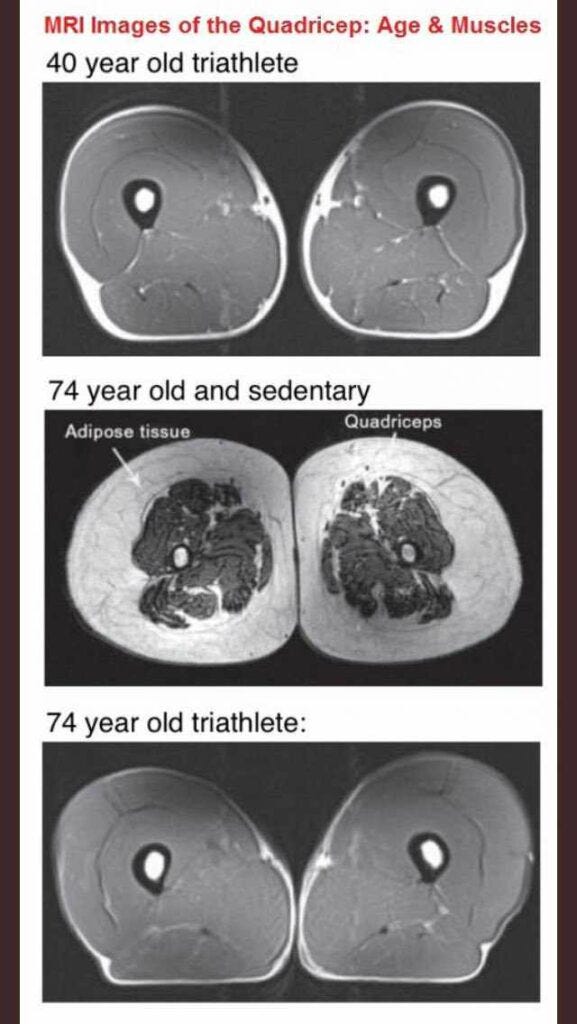
Instead of optimizing for any fitness, that sedentary person optimized for ‘comfort’ at the cost of that comfort. I can only imagine how well they can get around. I’ve lived in Florida and Arizona, and there’s an adage: “Arizona is where you go to retire; Florida is where you go to die.” What I saw between the two was stark. Here in Arizona, people are out and about, doing outdoor things year-round, and are more functionally fit. In Florida, that didn’t happen as much, and the results are pretty stark from both a quality and quantity of life; they were comfortably sedentary and miserable.
Here’s a good test for you to try right now: Squat down to your heels and back up. If you can’t make it before you need support, that’s a problem. You’re demonstrating the fact that the elderly don’t ‘fall’, they collapse, which Peter Attia shares on a Joe Rogan Podcast, is the highest cause of accidental death of the elderly. Peter goes on to share that eccentric strength, or strength while lowering, is a core feature of true functional fitness and critical to maintain as we age.
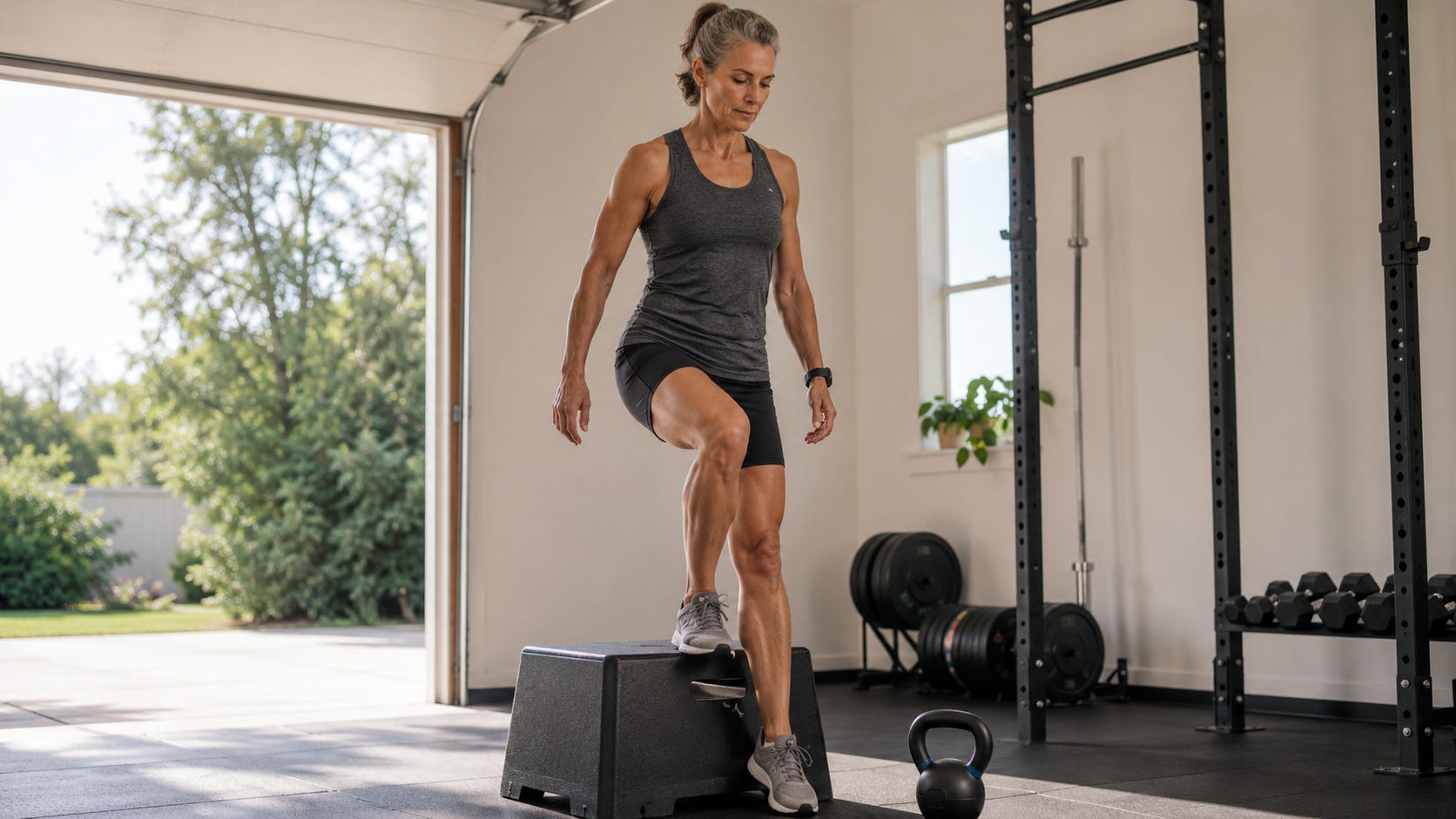
For example, stepping down from a 16-inch block and taking more than three seconds to lower under control is a great way to start building that strength. I use a 24-inch box as well as working in deep, body-weight squats. Additional exercises, like Farmer’s Carry, which is just walking with weights in your hands, can help prevent collapses and improve balance and flexibility. You can’t get more functional than this!
Let me bring this back to bear on myself on why functional fitness is so important over specialized fitness. I currently have degenerating discs in my lumbar from my time in the Army, and so, functional fitness, the core elements, are crucially important for me to remain active, healthy, and enjoying life. While I’ve embodied the mental and psychological benefits Kyle and John talk about, my biggest need is ensuring I can continue doing this long into the future.
Recently, I started mountain biking more as my daughters have been racing here in Arizona in both Fall and Spring leagues. I was getting fitter and faster on my bike, but my general back pain turned acute and began to affect my mood, behaviors, and my family’s life. It turns out that mountain biking with my kids is great, but it meant I was optimizing for that and not focused on balancing my glutes equally.
That imbalance was creating torsion in my lower back and exacerbating my degenerating discs. The pain was excruciating, and the Veterans Administration Hospital wanted to increase my dose of painkillers, give me trigger point injections, and advise me that I may need surgery. I demanded physical therapy instead.
As we’ve gone through the basics of glute engagement, my low back pain is going away. The key here is that, even with my background in functional fitness, there’s still more I need to learn. To help bring that point home, my cousin is a Physical Therapist working in Home Health, caring for elderly patients recovering from surgery. Here’s what he wants you to know about functional fitness today, which can help you avoid seeing him in the future:
I’m a physical therapist, and I see patients in their homes and get to observe them interacting within the environments they live in. The main issue I find when it comes to treating injuries, or the issues that lead to surgery, is that they are often caused by an imbalance or overuse of a particular structure.
For instance, a lifelong receptionist only answered phones by pinning the phone to her ear with her right shoulder. Over time, her cervical muscles tightened on one side, and nerves became pinched, and hands went numb. Either the imbalance is dealt with and lifestyle changes are made to bring structures back into alignment, or the issue is ignored and tolerated until surgical intervention is needed to relieve the impinged nerves.
Another example is a middle-aged man never getting his weight under control and carrying an extra 50-pound belly that extended past his toes. This imbalance caused decades of strain on the low back, compressing his discs, leading to sciatica pain. His front side abdominals were stretched and weak, while his back muscles were extremely tight and rigid.
Pain is the signal that something is out of balance or alignment, but too often we attempt to mask the pain, ignore it, or treat it just long enough until it pops up again like a game of Whack-a-Mole. Towards the end of life, within the geriatric population, I see significant tightness within the myofascial connective tissue layer that surrounds the entire body‘s musculature.
This tightness can lead to a significant loss in mobility, and when inflamed, can cause burning and aching in all areas of the body. Most of these symptoms and injuries could have been avoided with a disciplined functional fitness routine that maintains the 4 foundational areas of fitness: Balance, strength, flexibility, and endurance. With these four, a body can remain resilient, capable, and injury-free. But for those who don’t, it gives me great job security.
This highlights the point of functional fitness: It’s a combination of intentional stress, balanced activities, and whole body focus. The result is the ability to do things, most things, without much worry while also being able to manage injury and pain better.
For example, the other weekend, even while dealing with my back issue, I shouldered a 50-pound backpack and hiked 13 miles round-trip up a mountain to camp out with friends. Because I had my glutes under control, my back didn’t hurt, and, although I was a smidge sore for a couple of days, it didn’t require weeks of training preparation.
Likewise, I can go paddleboarding, rock climbing, snowboarding, mountain biking, and more without worry, even as my body ages and injuries flare up. That ability easily puts me in the top 5% of my age group, but that doesn’t mean it’s out of reach for you. It just means you have the opportunity to join the adventure.
Taking Action
The point of functional fitness is to define your goals, balance your needs, and get yourself moving in that direction. Write out your goals, go to Google, or even better, an AI like ChatGPT, and have a conversation. Ask it to provide references and resources and begin taking action.
You don’t need an expensive gym membership or complicated home gym equipment. You can do almost everything you need with a plyo box and a kettlebell, but you can also just do body weight exercises, as I used to put together for my physical training group in the past, which you can see HERE.1 The key isn’t sophisticated, equipment-intensive training, but functional movement. Dr. Jess DO, FAAP, CAQSM emphasizes this in 4 Muscles to Train for Maximum Anti-Aging Effect and recommends focusing on quads, glutes, core, and grip, offering great intros to simple exercises
I also recommend asking for physical therapy or hiring a personal trainer, as treatment from your doctors is typically muscle relaxers, pain killers, and anti-inflammatories. It’s easy to pop pills. The harder answer is learning how the body functions so that you don’t need them. When I go to physical therapy, I learn the core fundamentals of functional fitness and where I still have gaps. I take every opportunity I can, just to have them check out and correct my form and provide insights for where I’m neglecting functional fitness.
The fastest way to fail is to think you can or should do it yourself.
It’s also important to remember that the fastest way to fail is to think you can or should do it yourself. This is why I suggest surrounding yourself with others who are doing the same thing. A key to my success was building a routine with friends, family, and neighbors, who joined our garage workouts. We’ve had a constant flow working through our weekly exercises and, when others show up, I have no excuse not to work out. These days, we’re focused on just the family, and when my kids turn 10, the workouts become mandatory. The result is an established routine where they push me as often as I push them.


So, take that step, get moving, understand who you are and what you want, and remember: “A healthy body is HARD to sustain; it takes a lot of Discipline. An unhealthy body is HARD to maintain; it takes a lot of Medicine. Choose your HARD.” Let’s take advantage of your potential and take the first steps so that you can do what you want, when you want, without significant limitations, no matter your age, condition, or experience.
“It does not matter how slowly you go so long as you do not stop.” - Confucius
Now, for the best part, if you want to listen to John and Kyle together, talking about functional fitness, check out this podcast:

For another outstanding essay on the dangers of sugar, please check out Sweet Death:

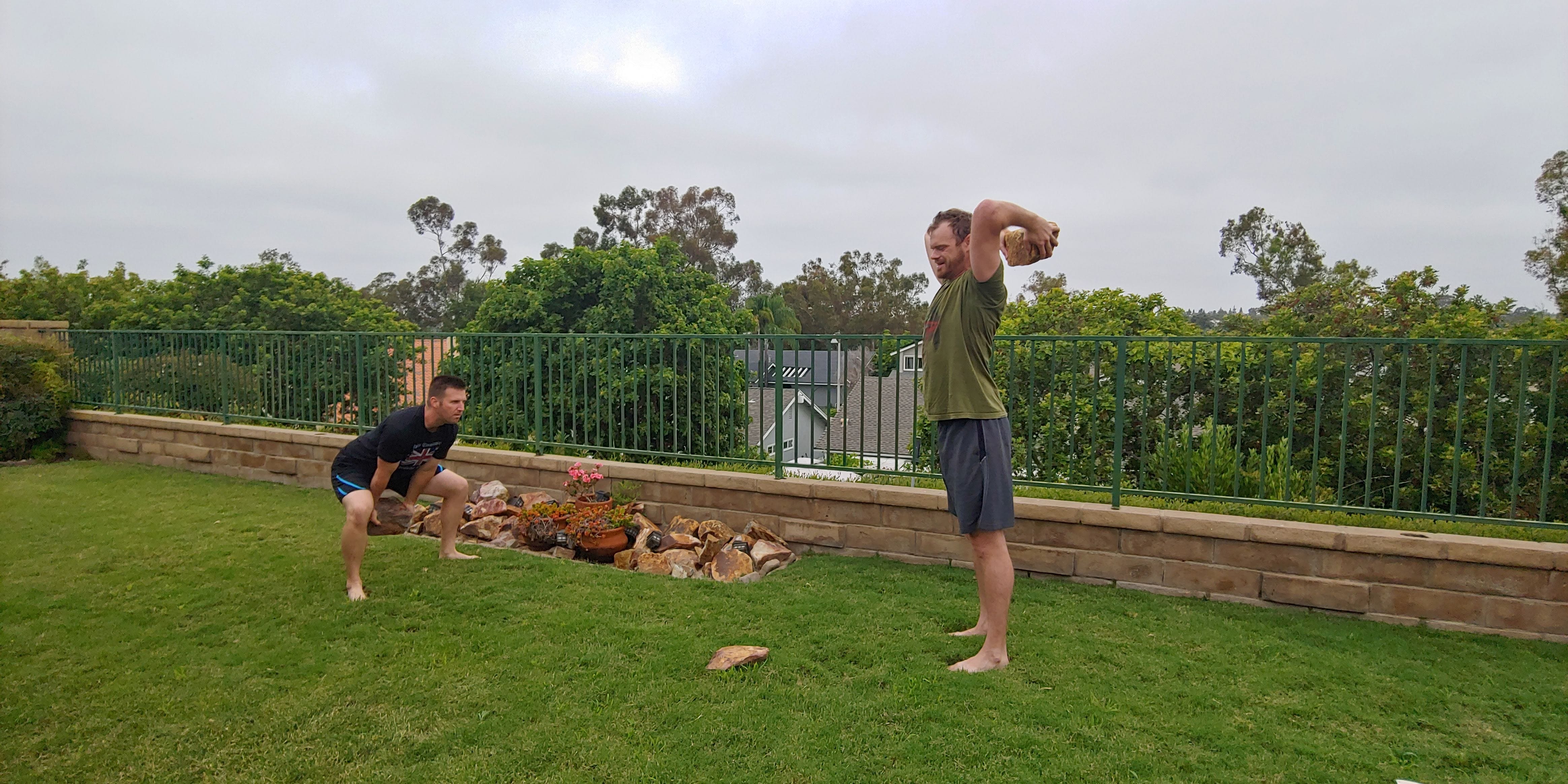
Remember, you don’t need fancy equipment, even landscaping rocks, in the backyard of a VRBO, the day before a wedding, with the groom, makes for a great way to keep yourself balanced.
Did you enjoy this post? If so, please hit the ❤️ button above or below. This will help more people discover Substacks like this one, which is great. Also, please share here or in your network to help us grow.
Polymathic Being is a reader-supported publication. Becoming a paid member keeps these essays open for everyone. Hurry and grab 20% off an annual subscription. That’s $24 a year or $2 a month. It’s just 50¢ an essay and makes a big difference.
Further Reading from Authors I Appreciate
I highly recommend the following Substacks for their great content and complementary explorations of topics that Polymathic Being shares.
Goatfury Writes All-around great daily essays
Cyborgs Writing Highly useful insights into using AI for writing
Educating AI Integrating AI into education
Mostly Harmless Ideas Computer Science for Everyone
Disclaimer: The content provided is intended for general knowledge and informational purposes only and is not a replacement for medical advice. Always consult with a qualified healthcare professional prior to making any decisions or changes relating to your health. Michael Woudenberg is not responsible for any adverse effects resulting from the use of information in this publication
I enjoyed this piece very much. Thank you. Sendyka Fit Over Forty on Substack and YouTube embraces Functional Fitness. I think he is on the right track.