


Welcome to Polymathic Being, a place to explore counterintuitive insights across multiple domains. These essays explore common topics from different perspectives and disciplines to uncover unique insights and solutions.
Today’s topic works through a great deal of angst surrounding small talk that too many of us dismiss as shallow or irrelevant. However, the research tells a different story of how it unlocks our superpower of social learning and rewards us with feelings of belonging, involvement, and camaraderie.

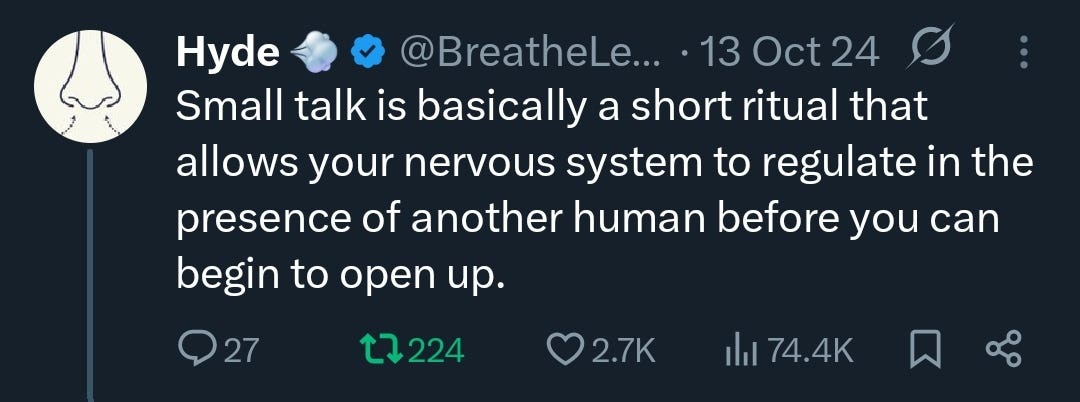
You don’t have to be around the interwebs too long before you find a lament of ‘small talk.’ It’s often an edgy introduction to the humble brag that they want to dive deeply into topics that matter, with the implication that those who engage in small talk are somehow vapid, shallow, and wasting precious time. Here are two common takes:
And then this particularly cringe video on LinkedIn describing ADHD socialization thus: “What exhausts them is this: Pretending to be interested, forcing reactions, performing a personality, so they choose silence… because they value authenticity.”
Now, don’t get me wrong, I’ve had some pretty banal and incredibly boring experiences with small talk where it felt more like I was hearing about a four-year-old’s day than what I expected from a grown adult, but…
Amanda E. White, LPC captures the angst really well: “Somehow we’ve absorbed the idea that connection counts only when it’s deep. Small talk became the junk food of social life: empty, fake, and a waste of time.”
So deeply have we internalized this that 22 different studies indicate we are talking less overall,1 and this isn’t resulting in deeper conversations or more positive outcomes. In fact, the more we close ourselves off to the social connections that surround us, the more we replace them with the artificial connections online where everything seems to bifurcate into Algowhoring, Fear Porn, and PSYOPs.

But the research indicates that the underlying impression is totally wrong:
People underestimate how enjoyable even “boring” conversations will be. Across multiple experiments, participants expected conversations about mundane topics to be less interesting and enjoyable than they actually were.2
Interactions with those you don’t know well, like acquaintances, classmates, and people we casually know, contribute measurably to well-being, and people reported greater happiness and belonging on days when they interacted with more weak ties than usual. 3
Even extremely brief interactions can improve mood and a sense of belonging. In a field experiment, coffee-shop customers who were simply instructed to smile, make eye contact, and briefly converse with their barista experienced more positive affect than customers who were instructed to complete the transaction as efficiently as possible. The former felt better and had a better experience.4
People consistently underestimate the benefits of talking to strangers and incorrectly predicted that interacting with a stranger would be worse than remaining alone, but experimentally assigned conversations produced more positive experiences than solitude. 5
We often underestimate how much we learn from talking to another person. We believe we’ll learn nothing, but are often surprised. This was my own experience on a plane recently, where both my seatmate and I were shocked at how much we learned in a relatively short time.6
Weak ties (The $5 term for these sorts of relationships) are disproportionately useful for exposing us to information outside our immediate social network because close relationships tend to occupy overlapping networks, while weaker ties more often bridge otherwise separated groups, allowing novel information and opportunities to move between them. This is a great method for breaking out of your echo chamber.7
Those findings weren’t a surprise to me because I learned long ago that humans aren’t that wise and our true superpower is actually social learning. As such, we should embrace calling ourselves Homo Socialis over Homo Sapiens, and much of that socialness starts with small talk.
Put in a more memorable way: Dogs sniff butts; humans small talk.
To be honest, I’d rather lean into the chit-chat over butt-sniffing myself. It’s also physiologically important because we have to give our bodies and brains a quick minute to adjust to another human, their styles, tones, culture, language, sex, religion, and dozens of other characteristics that help us suss out the proper profiles to start with and, without significant consequence of a social faux pas, tailor those profiles to match the actual person, learning to stereotype properly.
J. Prust, a fellow I’ve known for almost 20 years, recently wrote on the power of small talk, where he shares the insight from Gillian Sandstrom, a professor at the University of Sussex who has a mnemonic for how to have good small talk she calls QUICK: Question, something In Common, and Kindness. It’s that simple: just start with a question, look for something in common, and lead with kindness.
Justin writes how he was doing this without the framework, and that’s honestly how I got to know him. We worked at the same company, but in different areas. We didn’t have a lot of time to just hang out, so often our conversations were just quick chit-chats that jumped topics somewhat randomly; however, over time, we built a friendship where we learned a lot about each other.
It's still something I love doing in general. Simple questions like, “What’s your favorite color?” seem capricious on the surface until you follow the conversation and see how much it puts someone at ease, opens new avenues, and builds rapport that you just don’t get elsewhere. Chit-chat also, quite literally, saved my life as I shared in The Enemy’s Gate Is Down about my time in the Army, deployed in Iraq:
Similarly, when I’d sit with police leadership and was offered a cigarette, I’d accept, sit back, and ask questions that had nothing to do with my mission. In this manner, I learned a lot about the Iraqis I relied on for my success.
It was those simple, ‘weak-tied’ relationships that connected us on a human level, and that connection allowed us to get intel on an IED that we were able to avoid. Chit-chat works, even with those who might be your enemies - Homo Socialis for the win!

Likewise, I like to start meetings, even with people I’ve worked with for a while, just talking about life. Just five minutes of caring about them, not the job, unlocks so much more value and goodwill for the deeper conversations later. A favorite question is “Tell me something about you I don’t know yet.” It’s never disappointing.
Small talk is powerful, and it’s also core to being human and a sign of social intelligence. I honestly don’t care to go any deeper until I can respect the whole person I’m engaged with. Simple chit-chat will tell me a great deal about your intellectual and emotional mettle. It shows your adaptability and quickness of thought. It lets me see if you can manage to hold onto a couple of threads of conversation at the same time. It gives me time to regulate my initial profiles of you and allows you to relax as well.
And the harder truth is this: Those who cannot pass through chit-chat also rarely have anything valuable to add in the deeper conversations. They’re so enamored with their own intellectual ego that they can’t appreciate the delicate dance and humor of the surface-level. Subsequently, they often carry that same rigidity and closed-mindedness into more complex topics as well, which never bodes well.
That’s because true intellectual curiosity requires broad relational curiosity. That relational curiosity leverages humanity’s superpower of social learning, which allows us to hack into the incredible corpus of human knowledge, insights, and creativity.
So, chit-chat. Approach the world with Insatiable Curiosity about everything. Have QUICK conversations where you ask fun questions to find something in common and be kind. Engage with that stranger on the bus. Share things about yourself. Unlock social learning and feel the rewards of belonging, involvement, and camaraderie. That’s about as authentic as you can get!
Even better, before you leave, tell me something about yourself that I don’t know yet.
Did you enjoy this post? If so, please hit the ❤️ button above or below. This will help more people discover Substacks like this one, which is great. Also, please share here or in your network to help us grow.
Polymathic Being is a reader-supported publication. Becoming a paid member keeps these essays open for everyone. Hurry and grab 20% off an annual subscription. That’s $24 a year or $2 a month. It’s just 50¢ an essay and makes a big difference.
Further Reading from Authors I Appreciate
I highly recommend the following Substacks for their great content and complementary explorations of topics that Polymathic Being shares.
Goatfury Writes All-around great daily essays
Cyborgs Writing Highly useful insights into using AI for writing
Educating AI Integrating AI into education
Mostly Harmless Ideas Computer Science for Everyone
The Shepard Scale - Kit Perez - Counter Intelligence Insights
My 2 Cents - Karina Schneidman MBA, MS-MFT
Pfeifer, V. A., & Mehl, M. R. (2026). Sliding into silence? We are speaking 300 daily words fewer every year. Perspectives on Psychological Science. https://doi.org/10.1177/17456916261425131
Trinh, E. N., Thio, N., & Klein, N. (2026). Conversations about boring topics are more interesting than we think. Journal of Personality and Social Psychology, 130(6), 1167–1189. https://doi.org/10.1037/pspi0000521
Sandstrom, G. M., & Dunn, E. W. (2014). Social interactions and well-being: The surprising power of weak ties. Personality and Social Psychology Bulletin, 40(7), 910–922. https://doi.org/10.1177/0146167214529799
Sandstrom, G. M., & Dunn, E. W. (2014). Is efficiency overrated? Minimal social interactions lead to belonging and positive affect. Social Psychological and Personality Science, 5(4), 437–442. https://doi.org/10.1177/1948550613502990
Epley, N., & Schroeder, J. (2014). Mistakenly seeking solitude. Journal of Experimental Psychology: General, 143(5), 1980–1999. https://doi.org/10.1037/a0037323
Atir, S., Wald, K. A., & Epley, N. (2022). Talking with strangers is surprisingly informative. Proceedings of the National Academy of Sciences, 119(34), e2206992119. https://doi.org/10.1073/pnas.2206992119
Granovetter, M. S. (1973). The strength of weak ties. American Journal of Sociology, 78(6), 1360–1380. https://doi.org/10.1086/225469