


Welcome to Polymathic Being, a place to explore counterintuitive insights across multiple domains. These essays explore common topics from different perspectives and disciplines to uncover unique insights and solutions.
Today’s topic explores the mythos of tribal cultures worldwide. When we dig just below the surface, we find the same humans, the same issues, and the same struggles, whether in the Amazon jungles, among American tribes, or in the cities of the world. We’ll also discover how to reconnect with the land to ensure thriving.
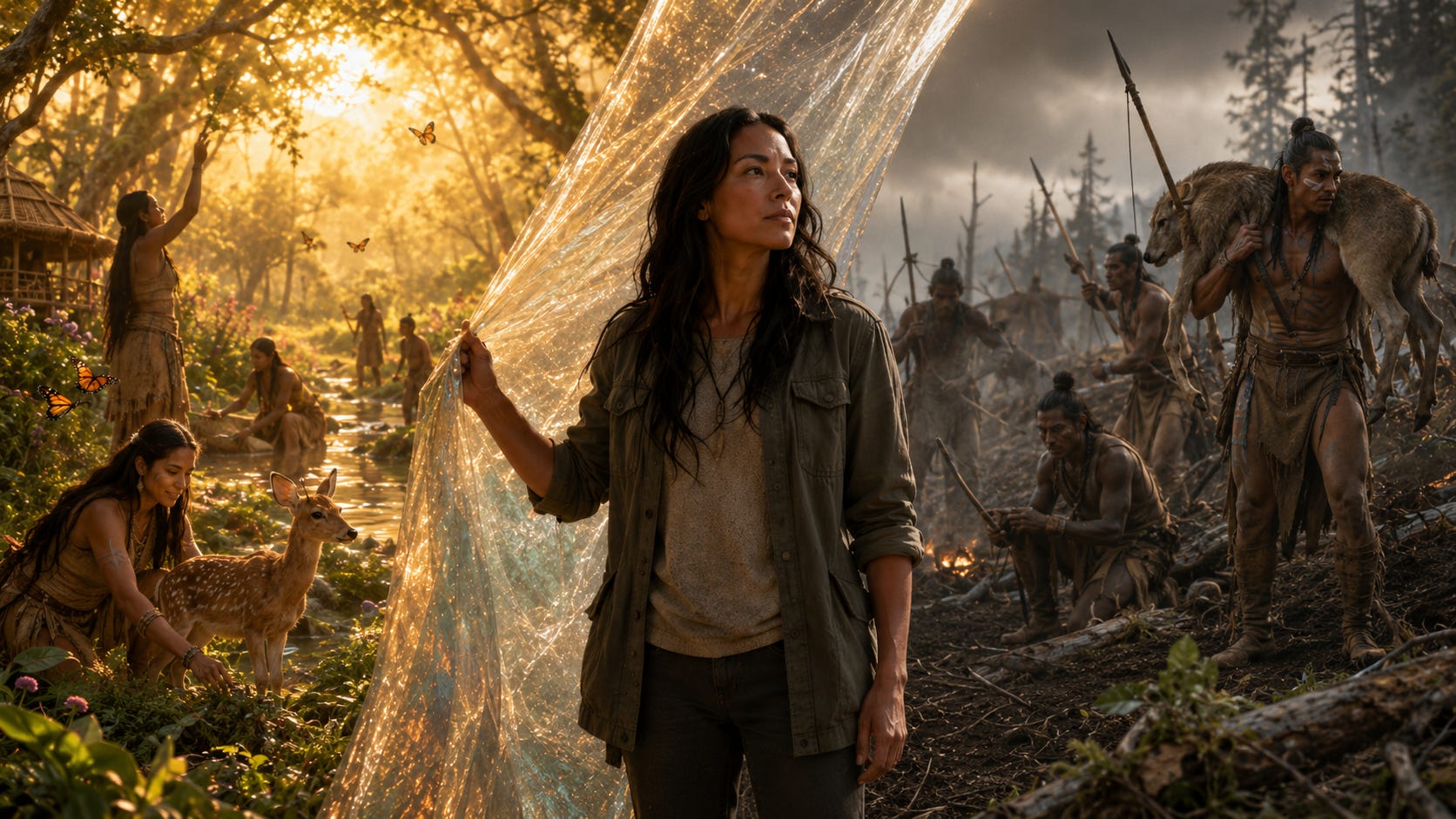
There’s an underlying assumption that emerges in conversations about indigenous peoples: that our historical and current tribal cultures are more in tune with nature than the rest of us. This is especially prevalent with what people love to call ‘first nations’ or what we’d call Native Americans here in the United States. However, it also includes Australian Aborigines, the African Bushmen, and uncontacted tribes around the world.
The image that’s created is the Noble Savage with better ways of knowing, connection with nature, a utopia of harmony, peace, and prosperity where the animals sing, nothing dies, and war is a distant thought, brought by invaders who despoil paradise.
Wait, that was Pocahontas…
This is important to extract because much of that angst is exacerbated by what I’ll call the Disneyfication of indigenous people and, in my generation, Pocahontas, specifically the song Colors of the Wind whose lyrics decry European colonization and exploitation of the Americas, is a perfect example.
It resonates because it has an element of truth in it. Graham Hancock writes about this in America Before: The Key to Earth’s Lost Civilization on the crazy layers of civilization that existed before colonization, and Jason Stannard wrote similarly in American Holocaust: The Conquest of the New World. Simply put, the European conquest reset Native American civilization to the point that what most colonists experienced were the Mad Max apocalyptic survivors, not the nations from before.


However, it fails to fully land because the natives who lived here at the height of their civilizations weren’t any more in touch with nature or any more magnanimous than those who conquered them. This is something Edward Campbell explores in great detail in Conquest Everywhere: The New World Was No Eden. In just one example, he shares how, when the Mayan written scripts were decoded, their culture, once thought to be peaceful, instead carved its true legacy in stone where:
chronology tables read like a ledger: Ah-Cacaw of Tikal captures Jaguar-Paw of Calakmul. Caracol conducts star-war action against Tikal.
More interesting is that the Aztecs, who followed the Mayans, were mercenary soldiers from the North American prairies who moved south. In a twist of fate, they were hired by warring Mayan tribes and, after decades of fighting on behalf of others, decided to just conquer them all and brutally subjugate them.

The stories of mass killings, human sacrifice, and brutal enslavement aren’t hidden, but they also tend to be ignored as inconvenient. It was so bad that when the small contingent of Spanish arrived under Hernán Cortés and conquered Tenochtitlán, they were supported by large numbers of regional tribes, itching to unseat the Aztecs.
Similarly, to the north, the Comanche were some of the most prolific raiders and slavers in North America. In fact, they have more in common with the Vikings than many consider. Like the Vikings, their terror evoked legend and enemies, where the Texas Rangers had no shortage of Native American help, from tribes who were NOT Comanche, to eliminate the threat. Just like the Aztecs.
Another example, pre-dating Columbus, was the Mushkodain tribe from Michigan, also known as the Bone Indians. Their brutality and constant fighting culminated in the creation of the Council of Three Fires consisting of Odawa, Ojibwe, and Potawatomi tribes. The Council responded to the Mushkodain provocations with an intentional war of execution and extermination. Simply put, it was targeted genocide to purge a hyper-violent tribe from their midst. They systematically hunted the Mushkodains down the western coast of Michigan, annihilating men, women, and children, and forcing the few survivors to flee the region permanently, where they were absorbed by other tribes, often as slaves and ‘wives.’
This isn’t isolated, as recent studies in the Mesa Verde region of the Southwest United States show incredible violence, where 90% of human remains from around 1160AD contain trauma to the hands and heads, while other evidence suggests attacks on the pueblo towns in the region as the civilization collapsed. Archaeology continues to uncover long-term trends of persistent war, conquest, and extermination.
What’s really interesting is how this weaves together where the precursors of the Navajo and Apache moved down from Canada and took over the lands recently decimated in the Mesa Verde region. Those who remained hunter-gatherers became the Apache, while those who settled and absorbed the survivors of the Pueblo extermination became the Navajo. However, the Apache were regular raiders and pillagers of the Navajo, and they also raided the Zuni, Hopi, and Taos tribes in the region. The tribes changed, but fighting remained the status quo.
Back to the Comanche, they also weren’t natives to Texas, and, after an internal rift within the Shoshone nation, they pushed down from the north, attacking the Apache in the Great Plains over the course of many decades and pushing them into the mountainous southwest US, where we are most familiar with them. They conducted a war of colonization, pushing from their ‘mother’ tribe in the Wyoming region and capturing the occupied lands south of them, pushing out the ‘natives.’ To close the loop, remember, the Aztecs migrated from this same Texas region further south in their eventual conquest of ancestral Mesoamerica.
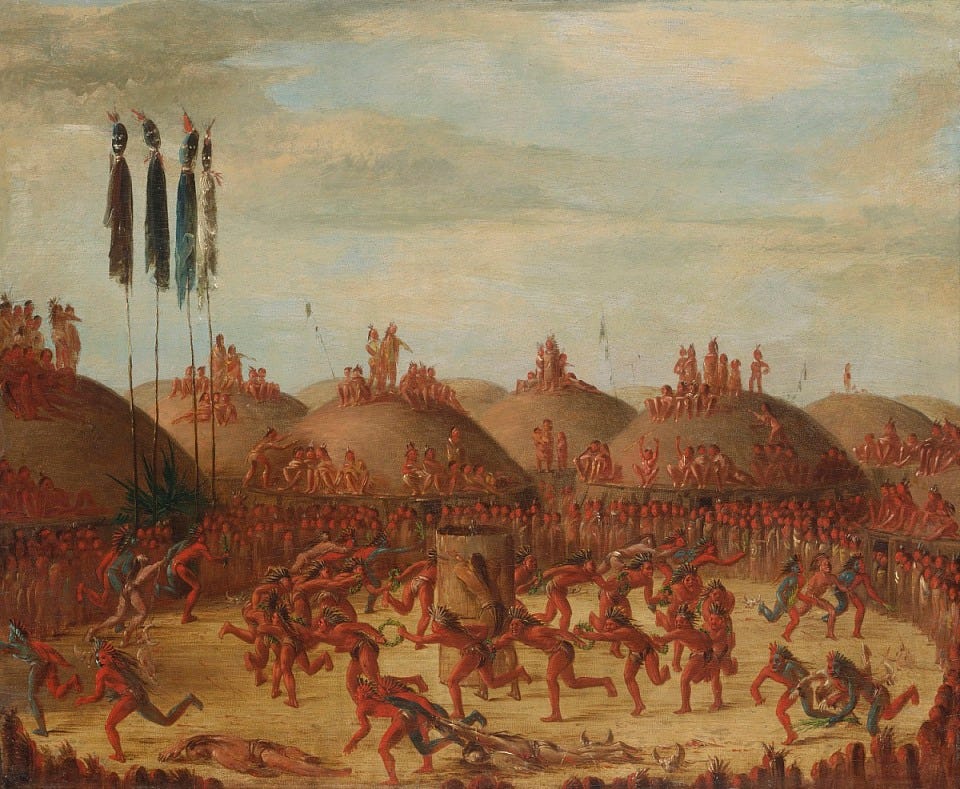
As another example of the brutal nature of the Native Americans is the Mandan of the northeast plains. Sam Alaimo wrote, in detail, about the Okipa, a grueling four-day Mandan initiation ritual that tested young men's endurance to prepare them as warriors. The extreme test started with a four-day fast without sleep, then suspension from the ceiling by wooden skewers pierced through their flesh, and voluntary finger amputation. It ends in a final race where those skewers are hooked to buffalo skulls and the boys are dragged until the skewers rip out, and they fall unconscious, ‘dying’ in practice, to prepare for the realities of war.
While it demonstrated the classic hero's journey and the rites necessary to enter manhood, it also captured the brutal reality of the perpetual war these tribes prepared for. In a perverse way, it was in tune with nature, but that nature is the brutal reality of harsh survival, not the Disneyfication of utopia.
You don’t have to search deeply to find similar behavior among the Apache, Cheyanne, Cree, and other notable warrior tribes. When you read the history, you also find how many tribes allied with the colonists against their violent neighbors, as the Iroquois and Algonquin did with the French and English. This doesn’t exonerate the brutal nature of the Europeans but contextualizes that the Indigenous residents weren’t fundamentally different.
Even when it comes to spirituality, the indigenous Americans weren’t any more attuned to human needs and their connections to nature than other groups in Europe at the time. Andrew M. Weisse levies a similar complaint against the reaction to psychedelics, which ignores that the use likely carried over from the Middle East into Asia and the Americas, as studies in ergot, the mystery religions, and more continue to underlie our ancient history as we expanded outward from Africa. The shamans of the Americas were no more idyllic than the shamans of the Vikings. The truth is, as Andrew concludes, these practices “reflected the full spectrum of human motives, just as modern use does.”
And this really comes close to home when you observe the Indian Reservations across the US. With the exception of a few outliers, what you see aren’t societies living in tune with nature. More often than not, you’re seeing dilapidated housing, broken cars, and zero landscaping sandwiched between reservation casinos and non-reservation urban centers. One of the most jarring being the Salt River Reservation abutting bougie Scottsdale, Arizona. It’s the same land, similar opportunity, burgeoning tribal commerce, and a wasteland on the reservation where the natives survive; they don’t thrive either.
However, all this said, there is a strong case that, in modernity, the West has stepped away from the dirt, the trees, and the blood of its history, and that’s left a gaping hole in our psychology and physiology that causes us to yearn and imagine what life could be if we went native.
Artificial Separation
This separation is undeniable as we sequester ourselves in concrete jungles and subdivisions where everything, including the grass, is artificial. We drive in air-conditioned cars on paved roads and work in steel-and-glass buildings.
Our food is packaged in plastic, thousands of miles from where it grew, perfectly selected, not raw, not too ripe, and surely stuffed full of chemicals we don’t know how to pronounce that don’t exist in its natural state. Food genetically engineered either through selective breeding or laboratory alteration bears no resemblance to what existed just 100 years ago.
Our water pours from taps, perfectly filtered, treated, and clean. In fact, everything is too clean, too sanitized, too divorced from nature. We know this in our minds, and our bodies are also rebelling as our gut biomes are being thrown out of whack.
It’s so bad that our basic physiology is collapsing, where we breathe wrong, we walk wrong, and we even poop wrong because modern convenience separates us so dramatically from our bodies.

Our fabricated societies, crafted online and not in person, are lacking. Even our information is no longer personal, but pumped into our eyeballs through blue light screens, filtered by algorithms, inflamed by algowhores, fear-porn, and PSYOPs designed to trigger your primal brain but divorced from primal responses and tribal safety. We are over-connected and yet more isolated in artificiality. It’s a problem Chris Ryan explored in Civilized to Death.

We are divorced from nature, by and large, and we yearn to get back. Since we are, generally, Western in the United States, it’s easier to blame the origins of that on the East and the solutions on what we took over. It’s a classic game of assuming that Other = Different, and that Different must = Better.
The result is the Disneyfication of Native Americans and the subsequent denigration of everything else. We whitewash the history of the native americans with the colors of the wind, ignore that, not long ago, we were there too, and fail to understand that modernity isn’t something we can manage.
Taking Action
I hope this has added some perspective to the myth of the Noble Savage: that humans are humans are humans, and the solutions aren’t wrapped in some Disney Fairy Tale of natural kumbaya. Nature isn’t nice. Everything is trying to kill you. History is replete with travasty.
However, there are some pretty simple things you can do:
When was the last time you actually stepped barefoot on dirt?
When was the last time you grew food? (or even a houseplant?)
When was the last time you harvested it? Butchered an animal? Hunted or gathered food from the wild? Went fishing for goodness sake?
Because there is something sacred about all of that. It just involves putting down the screens, leaving the chaos of the cities, and touching grass! If you want to find people who are in touch with nature, go to a farm, a hunting lodge, a fishing camp, a backcountry hiking group, a birdwatching, butterfly, or nature photography group. Really, anyone out there who is engaged in real life.

There’s nothing mythological about Native Americans or any other tribal cultures around the world. Europeans were there, not that long ago, and the tribes here were not so noble. They represented the grand texture of human life, ingenuity, and, yes, brutality. However, that doesn’t mean that what we have today is necessarily better.
But it’s also not worse. We are safer, healthier, more peaceful, with more leisure time, more disposable income, and greater freedoms to travel, explore, and more. Put another way, there’s nothing stopping you from reconnecting with nature. You just have to be savage enough to say no and step away to regain that noble connection with the land to ensure thriving.

Did you enjoy this post? If so, please hit the ❤️ button above or below. This will help more people discover Substacks like this one, which is great. Also, please share here or in your network to help us grow.
Polymathic Being is a reader-supported publication. Becoming a paid member keeps these essays open for everyone. Hurry and grab 20% off an annual subscription. That’s $24 a year or $2 a month. It’s just 50¢ an essay and makes a big difference.
Further Reading from Authors I Appreciate
I highly recommend the following Substacks for their great content and complementary explorations of topics that Polymathic Being shares.
Goatfury Writes All-around great daily essays
Cyborgs Writing Highly useful insights into using AI for writing
Educating AI Integrating AI into education
Mostly Harmless Ideas Computer Science for Everyone
The Shepard Scale - Kit Perez - Counter Intelligence Insights
My 2 Cents - Karina Schneidman MBA, MS-MFT
Great post! I loved Pocahontas so much - the “Colours of the Wind” strikes a chord because at a very primal level we all want to be connected to both nature and our fundamental nature. But even a basic understanding of history (and reality) means I can recognise the Disney story for what it is - a (pretty biased) fairy tale. The problem is that the idea of the noble savage became such a pet view of the “cultured elite” that so many people now believe it as truth. It never was. Your analysis is spot on. Thank you.
Solid work. Rousseau probably could have used a choke slam or two here, though.