


Welcome to Polymathic Being, a place to explore counterintuitive insights across multiple domains. These essays explore common topics from different perspectives and disciplines to uncover unique insights and solutions.
Today’s topic explores the consequences of how our social lives transitioned from the front porch to the backyard and what that’s done to our sense of community. We’ll also look at some simple steps you can take to reconnect with those around you!

Think back to the classic image of a house with a front porch, some flowers, a couple of chairs, and maybe even a porch swing rocking in the breeze. It wasn’t uncommon to walk or drive through these neighborhoods and hear the chatter of conversation or just the creak of a rocking chair on the weathered wood porch.
Neighbors said hi, asked about the kids, just general chit-chat that created a connection, letting you know you were not alone and that people, real humans with different lives, saw you.
Today, as I drive through the suburban neighborhoods, I notice that there are no front porches, and if one exists, it’s not designed for more than a vestibule to protect the front door from the weather. There are certainly no neighbors sitting out front, raising a hand in greeting, and commenting on the weather.
What happened?
There was no single event that changed this dynamic but a cascade of different technologies. One of the first was television, which drew people inside more than even the radio, which could be listened to outside in the cooler evenings. Another major shift was the installation of air conditioning, which removed one of the main reasons for spending summer evenings outside.
Another element is the ability to drive into your garage, automatically close your door, and walk straight into the house without ever having to step outside or even enter or exit your front door.
Adding to the trend, we migrated to the backyard, ensconced in tall privacy fences, rarely peeking over for more than a glance to see whether to report their neighbor for a Homeowners Association violation.
Which reminds me: What do you call a group of Karens?
… An HOA. 😁
But there’s more to that joke than just a wry chuckle. The video below highlights the absurdity where a man is told that sitting in his garage, waving at neighbors, is not allowed by his HOA.
It’s clear that we’ve lost something in the process that causes us to live cheek to cheek with a press of humanity and know hardly a soul around us. This was not lost on Lisa and I when we lived in a subdivision and realized that, outside of our next door neighbors, we never got to know anyone else.
Ironically, we got to know one of them because our cat kept knocking over their birdbath, and the other because, every Friday, they’d sit in their garage, listening to music and drinking beer, and I joined them quite often.
What We’ve Lost
Well, we’ve gone from Front Porch Neighbors to Backyard Strangers.
It’s also the loss of the weak-tied social interactions that can be as simple as a wave acknowledging your existence. To highlight the impact, A study of older residents in Miami found that blocks with porches and other usable front entrances were associated with greater perceived social support, which was in turn associated with less psychological distress.
On a personal level, how well do you know those who live around you?
How far do you have to drive to find community?
How much effort does it take to finally connect?
More and more, young adults aren’t even socializing in these groups, but are staying at home, deep in the bowels of the internet, where their digital reality is not reflective of what’s actually happening. The end result is a loss of community, a loss of a sense of identity, and the perceptions that pervert what’s seen online as reflective of what's happening outside your front door. (Just to be clear, it’s a hellscape online, but rarely the same out front) So, what do we do?
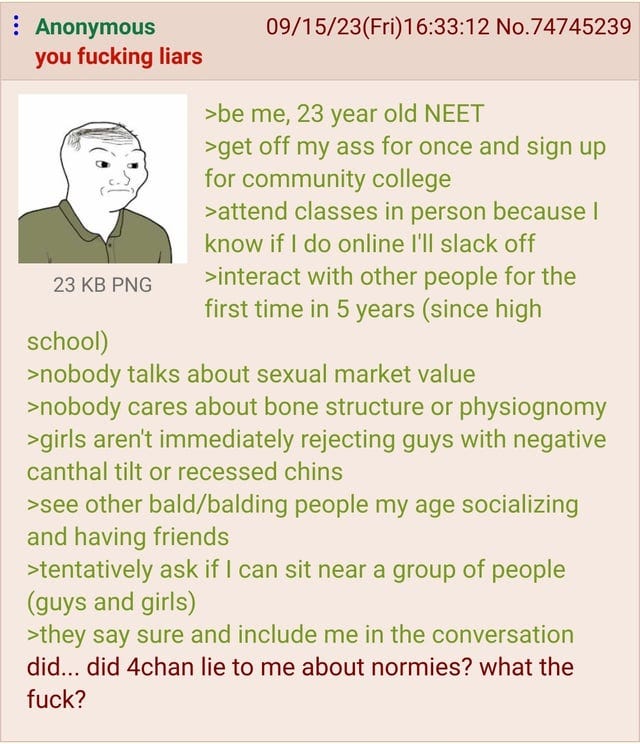
Taking Action
We covered a few ideas previously in Heaven is High, and the Emperor is Far Away, where we recommend not collapsing heaven into the helscape of social media and not inviting the Emperor to live rent-free in your brain. We also showed the power of Touching Grass, where simply getting out and paying attention to what’s happening in life reveals that the world moves in a much less apocalyptic fashion when you step out the front door.

But the overall goal isn’t major transformation but repeated, low-pressure contact where casual familiarity builds into deeper friendship. A few simple actions you can take today are:
Put a couple of chairs in the front yard and use them.
Walk the same route at roughly the same time each day.
Leave the earbuds at home and wave first.
Introduce yourself and learn one neighbor’s name at a time.
Do ordinary tasks out front: watering plants, working on a bike, or reading.
Ask for a small favor or lend a tool. Reciprocity builds connection.
Offer specific help: “I can bring in your trash cans while you’re away.”
Exchange phone numbers with the nearest few households.
Start a simple ritual, such as Friday evening front-yard drinks, without turning it into a major event.
Use neighborhood apps to arrange face-to-face contact, rather than letting the app become the neighborhood.
I want to underscore that the key is consistency rather than intensity. A block party once a year helps, but ten two-minute conversations usually do more. You don’t need to become close friends with everyone because you’re rebuilding the small layer of recognition that turns the strangers nearby into neighbors.
And that’s kind of the main point here: Do step out the front door. Pay attention to what’s happening on your street. Go for a walk and smile and wave. Chat with folks. Put down the phone and just walk and observe. And, yes, spend some time on your front porch and reconnect with those around you!
Did you enjoy this post? If so, please hit the ❤️ button above or below. This will help more people discover Substacks like this one, which is great. Also, please share here or in your network to help us grow.
Polymathic Being is a reader-supported publication. Becoming a paid member keeps these essays open for everyone. Hurry and grab 20% off an annual subscription. That’s $24 a year or $2 a month. It’s just 50¢ an essay and makes a big difference.
Further Reading from Authors I Appreciate
I highly recommend the following Substacks for their great content and complementary explorations of topics that Polymathic Being shares.
Goatfury Writes All-around great daily essays
Cyborgs Writing Highly useful insights into using AI for writing
Educating AI Integrating AI into education
Mostly Harmless Ideas Computer Science for Everyone
The Shepard Scale - Kit Perez - Counter Intelligence Insights
My 2 Cents - Karina Schneidman MBA, MS-MFT