


Welcome to Polymathic Being, a place to explore counterintuitive insights across multiple domains. These essays explore common topics from different perspectives and disciplines to uncover unique insights and solutions.
Today’s topic dives into the idea of bullshit jobs, the misunderstandings of why they exist, and how misaligned incentives reward them. Once we untangle the foundational economics, we’ll explore how to eliminate the bullshit to achieve meaning and satisfaction in your job.

Intro
I recently read the book Bullshit Jobs by David Graeber. It’s provocative and hits at something important, but also misses actual experience within these organizations. Graeber’s fatal flaw is that he did his investigation from the outside, interviewed those people who didn’t like the jobs, and missed that many people view the bullshit of these jobs as a feature, not a bug. Let’s dive in and find out what’s really going on.

The Bug
Stepping back quickly and giving credit where credit is due, Graeber rightly identifies a “bullshit job” as a form of paid employment that is so completely pointless or unnecessary that the worker secretly believes it should not exist, even while pretending it does. He breaks these roles down into five distinct categories:
Flunkies: Roles that exist only to make someone else look or feel important (e.g., receptionists, doormen, store greeters).
Goons: Jobs that act to harm, deceive, or defend against others on an employer’s behalf, often in an “arms race” where they only exist because competitors have them (e.g., lobbyists, corporate lawyers, telemarketers, PR specialists).
Duct Tapers: People who temporarily fix problems that should be fixed permanently because of poor organization or shoddy initial work (e.g., programmers fixing bad code, desk staff calming angry passengers over lost bags).
Box Tickers: Employees who create the illusion that something useful is being done when it is not (e.g., survey administrators, compliance officers, internal magazine writers).
Taskmasters: Jobs that create extra work for others or manage people who do not need management (such as middle managers)
I’m sure each of us has seen people working in roles like this day after day. Yes, these are bullshit jobs, and they can be quite miserable. In the world of Six Sigma, we call them Non-Value-Added roles and work diligently to eliminate the root causes.
Personally, I’ve removed thousands of these jobs and reallocated their time to productive work. What Graeber misses in his book is that Six Sigma optimization is actually hard because, way too often, the people doing this bullshit like it!
The Feature
I’m going to break this down to show some counterintuitive insights for each of the job categories. Let’s start with the Flunkies. Yes, they exist. Pretentious celebrities like Coco Austin, Wife of Rapper Ice-T, had an assistant vacuum the streets of New York as she walked.

For Coco Austin and Ice-T, it’s a flex that they have enough money to afford this indulgence. It’s ‘bling’ and bluster through wanton excess that most humans interpret as being evidence of success. This also exists on the low end of the income distribution, where any analysis of Compton shows as much bling and bluster, albeit on a lower budget. This is great for Coco Austin, but what about that flunkie?
This is where it gets interesting because he just might be selling his soul for the access and visibility it provides. Bullshit or not, this has precedent in the example of William Compton, who was King Henry VIII’s Groom of the Stool… And if you imagined that this is attending to the king’s most private bodily needs and heading his private chamber, you would be correct. However, that access placed him at the center of royal patronage, and he accumulated wealth and privilege, evidenced in his grand country house, Compton Wynyates.

There are also legitimate reasons for what can be considered flunkies, which can be as simple as a secretary at a single-member consultancy or legal firm. However, in a twist, this role actually helps the single lawyer who may be too busy to answer the phone and their clients who have someone who quickly answers. Is 90% of that secretary’s job bullshit? Probably, but the cost of that role is likely well compensated by the status and payroll of the clients she inspires confidence in.
Goons is just Graeber’s pejorative for folks who are actually serving a legitimate role. He takes a particularly harsh stance against corporate lawyers, yet that world is constantly dealing with parasites looking to extract wealth. How many accident attorney billboards did you see on your drives this week? While he’s right to address the negative behaviors of these fields, those fields themselves aren’t bullshit. The bullshit is when the field is weaponized or used to erect regulatory barriers to stifle competition/
Duct Tapers definitely exist. I once fixed a document system that, through poor design, created tons of defects, delays, and more. The duct taper there was a sweet woman who had literally sacrificed weekends, holidays, and weddings to keep the process running and was devastated when she realized how simple the fix really was.
On the other hand, there are people who love this role and are seen as heroes for fixing things. We also value this role a lot and, as we explored in Lazy Leadership, “when you reward firefighting, you invite arson.” Again, it’s the application of a behavior to a role that’s the problem, not the need for the action or the role itself because heaven knows, no system is perfect and fixes will always be necessary.
Box Tickers drive everyone nuts. It’s the meeting for a meeting for a meeting that makes up legions of memes on LinkedIn. It’s also just the overcompensating compliance, like how, just the other day, I had to submit a travel authorization request, itself an extra, unnecessary step, but one our government accounting demands. The Box Ticker, four levels of approval into the process, rejected it for being over the set hotel rate for 2026. The problem is, I’m traveling in Fiscal Year 2027, where the rate is higher. Regardless, he rejected it, then forced me to find out why, then told my manager he didn’t want to be contacted directly and that I should go through two levels of authority and…
Guess what? Napkin math says he ‘saved’ $27 at the cost of the plane ticket going up $100, the $1,000 in labor charges trying to straighten it out, and, oh by the way, he didn’t save the $27 because he was wrong and the slightly higher rate was correct. But oooooh, was he morally justified in thinking it was his job to police the process, and he’s notorious for it.
That said, we need to manage compliance with expectations and, at a different company, where travel wasn’t as judiciously policed, we saw more and more egregious spending that eventually saw first-class tickets, lounge access, and luxury car rentals before being reigned back in. So, Box Tickers start from a place of value, but they can certainly devolve into bullshit.
By this point I think you can see that the problem isn’t that these jobs are fundamentally bullshit and that’s a bug; it’s that the bullshit nature of the job is the feature for a great many people. In fact, if a person struggles to actually perform value-added work, contribute to the corpus of knowledge, or provide innovative ideas, or, heck, just do the task properly, it’s easier to fall into these negative behaviors we’re exploring. And nothing quite brings this to light as well as the Task Masters.
Of course, this isn’t a condemnation of middle management at all. In the military, we recognize that leadership is constrained by the network effect. Therefore, we have Team leaders, Squad Leaders, Platoon Leaders, Company Commanders, Battalion Commanders…. all the way up to the Commander in Chief. However, you can’t just have the top dog and a million individual contributors. That’s not how humans work, and delegated accountability and authority are necessary for efficient execution.
However, Graeber is correct in identifying when a leadership position is bullshit because it’s creating chaos in the system. Task Masters aren’t a feature in an organization; they’re rightfully hated by anyone who has dealt with them. However, when you try getting rid of that role by demanding the Task Master step back into performing work, you’ll quickly find out that bullshit is a feature for him.
The Flunkie, Goon, Duct Taper, Box Ticker, and Task Master exist primarily because there’s a perversion of incentives. All of them exist because humans aren’t perfect, and leadership, true leadership, is actually hard. As these systems devolve, the bullshit increases. In simple terms, bullshit jobs are also known as bureaucracy.
The challenge, and my beef with Graeber, is that he misses that there is a significant cohort of people who relish these jobs. It’s part of what I explored in The Successfully Unsuccessful, where we characterized these as “…people who continue to do the same thing over and over, never really succeeding, yet are able to go home, proud of the work they do, and are still rewarded for it.”
These people are successful in spite of, and sometimes because of, the bullshit, and these folks provided a lot of the challenges I faced while working to optimize processes across multiple domains and disciplines in my career. It’s also not just individual behaviors, as there are larger, systemic compounding challenges.

Compounding Challenges
Underlying these challenges is my key complaint with Graeber, as he likes to blame capitalism for somehow failing to quickly and efficiently eliminate these roles. Here, he mistakes the goal of capitalism for the reality of what we have; namely that it’s more corporatism, a perversion of true free markets, government burden in regulatory reporting, and more. Capitalism is great when people apply it, but it’s rarely applied without significant shackles, and those shackles aren’t a feature of Capitalism but cronyism and statism.
One case in point of a true bullshit job of a corporatist type was highlighted in the book Box, which explores the curious and convoluted history of the ubiquitous shipping container. (yes, it’s a good book; yes, I’m a nerd) The container itself is a genius of capitalism and efficient material transfer but was bogged down by the burdens of regulation, labor disputes, and more, as many groups vigorously opposed the innovation even though the jobs they had were back-breaking and bullshit.

The worst example was “stripping and stuffing,” where the International Longshoremen’s Association required that containers had to be opened and handled by union longshoremen at the pier. Laborers would "strip" (completely unload) a perfectly packed container onto the dock, only to immediately "stuff" (reload) the exact same cargo right back into the same container before it could move forward. This wasn’t capitalism by any stretch of the imagination, and it certainly didn’t make anyone but the workers and the unions any money. In economics, this is called ‘featherbedding’ and affects everything from oilers on cranes that do not need them, to unnecessary railroad brakemen and more.
This is where we get to another twist that Emmanuel Maggiori recently added to the topic, where he describes these jobs as “Middle Class Welfare,” where incentives are for jobs, not output, and as long as companies, especially start-ups receive funding, their product is largely irrelevant. As the classic adage goes: “Follow the Money”
This lines up with my own experience as, years ago, in jest, I put together a business plan for how to run start-ups where the goal was resource extraction from investors, not creating a viable product. The problem was, in researching Silicon Valley, it seems like my idea was not novel, and I estimated that roughly 50% of the companies were doing just that. From the top down, they were run like a well-paid hobby business, not value creation.
The reason I poke here is that I’ve seen too many interpretations of Graeber’s book, as Maya does below, where she suggests that these jobs are designed to do nothing more than make the rich richer. It was this argument that motivated me to read the book. (which I actually don’t recommend to anyone else)
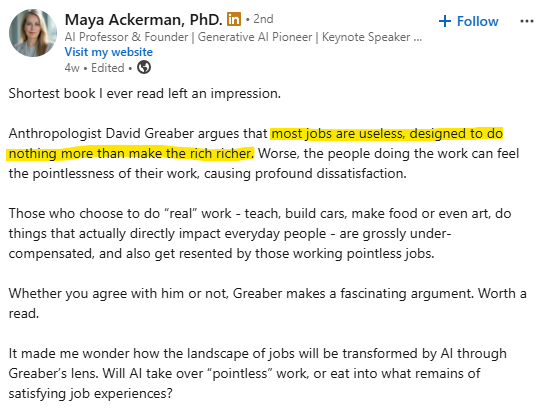
But that interpretation isn’t actually an argument Graeber makes to that degree. For example, he does argue that some roles directly serve financial interests: lobbying for favorable rules, extracting fees, or protecting corporate advantages. This falls under the corporatism we discussed before. It also doesn’t take long in the study of capitalist economics to realize that this is the opposite of free market principles and is opposed by the likes of Friedrich Hayek, Murray Rothbard, and Ludwig von Mises of the Austrian School of Economics.
But there’s another twist to the ‘rich getting richer’ in that Elon Musk, the richest man on the planet, is notorious for shredding bullshit jobs. When he bought Twitter, he eliminated roughly 80% of its staff, reducing the company from nearly 8,000 employees down to about 1,500. Even today, the entire platform is running with fewer than 2,000 employees, and no one has noticed a difference in performance or product. Clearly, there were a lot of bullshit jobs at Twitter, but he became richer by eliminating them, not keeping them.
To understand the underlying economics of these contradictions, I would actually like to recommend a book called Basic Economics by the brilliant Thomas Sowell. It’s an outstanding primer that helps anyone avoid these classic misinterpretations of the real waste we see in the workforce. He highlights so many fundamental elements that you’ll see both the source of the bullshit and how that bullshit is a feature for too many people.

All of this is great from the perspective of a book review and social media debates, but some of us are probably in a bullshit job that we would like to fix. Thankfully, there are steps you can take to improve that.
Fixing Bullshit Jobs:
If you’re ready to step out of the chaos and regain satisfaction in your work, there are a few key things to grab onto. The first is understanding Lean Six Sigma and its goal of eliminating a lot of the issues that drive the bullshit. Much has to do with activities collectively called Waste, which are categorized as:
D – Defects: Errors, scrap, or products requiring rework and the processes that cause them.
O – Overproduction: Making items earlier or in greater quantities than required. Also includes excess data entry/re-entry
T – Transportation: Unnecessary moving of materials, parts, or information.
W – Waiting: Idle time of workers, equipment, or parts waiting for the next step.
I – Inventory: Excess stock or materials waiting to be processed.
M – Motion: Unnecessary physical movement by employees during their work. This also extends into digital movements such as the number of clicks per task.
P – Processing inappropriately (or Overprocessing): Performing more work or using more complex tools than the customer actually requires.
The key here is that you have to understand the larger value chain to see how you integrate with the systems around you to properly assess waste. Lean execution is then all about eliminating these activities.
Critical to add here is the definition of Value Added when it comes to tasks. For this, the simple idea of the Three Cs helps: The task is Correct the first time, it Changes the product incrementally toward completion, and the customer Cares, meaning if the customer knew about the activity, would they want to be billed for it? If you can eliminate waste and ensure the tasks are centered on value added, then, by definition, it’s not bullshit.
The cool thing is that you don’t have to do this yourself, as almost every business has a Six Sigma or Operational Excellence department. Even better, you can find innumerable Six Sigma certification programs at your company or online that will teach you the process and empower you to run your own improvement projects.
I’ve also never met a company that didn’t appreciate employees identifying improvements and, if they don’t appreciate it, that might be an indication your skills are more valuable elsewhere. Also, as with most things we explore here, It’s always best to start with the work you do before trying to fix others’ work. Over time, you’ll naturally include them as the process improvements expand, but you’ll also find a lot of opportunities that are right at your fingertips that can help you do better.
The second element is also recognizing that you are more than your work. It’s a concept we explored in one of our first essays, “Yes, Do Quiet Quit,” where, sometimes, the lack of productive work can be a feature for you when you can find the eddy in the noise, stop reacting to the manufactured chaos, and find ways to avoid the bullshit. In quiet quitting, we found that:
By stepping back and quitting the problematic expectations of the corporate rat race, my teams, and I, have been able to achieve results on projects that other teams hadn’t been able to solve for years
The tactic was to not contribute to the bullshit and, since you can’t unilaterally stop it, you can only refuse to participate and repurpose that time to more productive ends. This is a key tactic I use to great success in my own professional roles.

Summary
Bullshit jobs do exist; however, they’re often a feature, not a bug, of corporate life. There’s rarely anything malicious or nefarious about the work, and the intent isn’t to suck people’s souls away. It’s just imperfect humans, imperfect systems, and imperfect incentives.
But this gives us hope, because imperfection is a perfect opportunity for continuous improvement, and we have entire disciplines dedicated to optimizing systems in the form of Lean Six Sigma and more. It just takes the wherewithal to stop accepting the bullshit and start taking the steps to eliminate it. When you do this, you’ll achieve meaning and satisfaction through that, let alone the overall improvement of your actual, formerly bullshit, job.
Do you, or have you worked a bullshit job in the past? What advice would you add?
Did you enjoy this post? If so, please hit the ❤️ button above or below. This will help more people discover Substacks like this one, which is great. Also, please share here or in your network to help us grow.
Polymathic Being is a reader-supported publication. Becoming a paid member keeps these essays open for everyone. Hurry and grab 20% off an annual subscription. That’s $24 a year or $2 a month. It’s just 50¢ an essay and makes a big difference.
Further Reading from Authors I Appreciate
I highly recommend the following Substacks for their great content and complementary explorations of topics that Polymathic Being shares.
Goatfury Writes All-around great daily essays
Cyborgs Writing Highly useful insights into using AI for writing
Educating AI Integrating AI into education
Mostly Harmless Ideas Computer Science for Everyone
The Shepard Scale - Kit Perez - Counter Intelligence Insights
My 2 Cents - Karina Schneidman MBA, MS-MFT