


Welcome to Polymathic Being, a place to explore counterintuitive insights across multiple domains. These essays take common topics and investigate them from different perspectives and disciplines to come up with unique insights and solutions.
Today's topic squares off on a long-touted platitude that leaders are trained, not born. Out of the gate, this makes logical sense; my Army officer training made me a much better leader. Also, no one just emerges from the womb as the next Martin Luther King. Yet is that training all there is to the equation? What risks or limitations exist that the simple platitude hides? We cover all that today in understanding leadership.

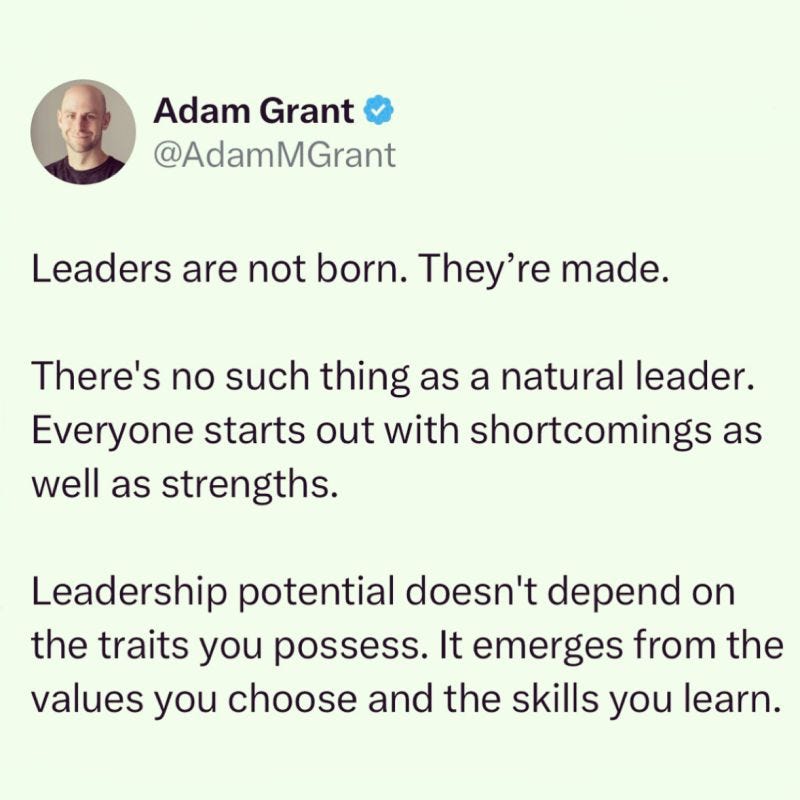
All the way back to when I was in the Reserve Officer Training Corps (ROTC) being trained to lead as an Officer in the Army I heard the mantra, “We can teach anyone to lead.” Similar conversations pop up in Leadership Development Programs (LDPs) at large businesses across the United States, and inspirational speakers like Adam Grant double down with memes like this:
There are two things here he said that are true.
Everyone starts out with shortcomings as well as strengths
Leadership emerges from the values you choose and the skills you learn.
These two are clearly logical. So why is it baked around the rest, which obfuscates the reality of the situation?
Natural Traits
Given that the two words that seem to be criticized here are Natural Traits. The conclusion appears to be that there are no natural traits in leadership, and this is what I’d contest. As we explore this, what traits make a good leader?
Openness?
Conscientiousness? (structure/order)
A balance of agreeable and yet disagreeable? (able to get along but not a pushover)
Low in anxiety and self-doubt?
Able to be outgoing and engaging?
If you agree that these are good traits for a leader, and almost everyone does, then we should pause and consider that these are literally natural traits of personality captured in the Big 5 personality profile of:
Openness (open or closed to new experiences)
Conscientiousness (being orderly or being disordered)
Extraversion (energized by people)
Agreeableness (willingness to go along, or willingness to disagree)
Neuroticism (anxiety, or lack thereof, regarding experiences)
We dove deep into this a year ago in Investigating Personality Proclivities, where I showed how these traits weave together, and these proclivities are founded on natural traits that we need to be aware of.

Does this mean that an introverted, less open, less orderly, highly agreeable, yet neurotic person can’t lead? That certainly wouldn’t be true. Yet this type of person is also going to have the deck stacked against them as they attempt to lead the vast majority of people who value the traits we introduced earlier.
They’re likely to be exhausted by the social engagement required of leaders engaging with their teams.
They’ll lack the structure or actively resist structures that build consistency
They won’t be open to new ideas, new ways of doing or thinking.
They’ll be highly agreeable when leaders need to form firm lines of accountability both up and down the hierarchy.
They’ll be anxious, nervous, and feel threatened by many things.
Now this is an extreme caricature of a leader, but it is a profile that does exist. Given that these people are out there, what Adam Grant says seems foolish on inspection.
My Own Experience
Back to ROTC with the leaders that everyone said could be trained:
None of us starts off as great leaders or even very good ones. Yet those who rose to the top, again and again, all had certain natural traits that amplified the training we received.
Those who didn’t have these natural traits could work through the eight steps of the Army Troop Leading Procedures, but lacked the nuance for more sophisticated actions. These leaders also suffered from an inability to understand how others achieved spectacular results under the same conditions.
My time at Ranger School brought this into clear focus. Known as the world’s most difficult leadership school, where they simulate the stress of combat to the point that you can hardly focus on a thought, Ranger School also identified the benefit of natural traits over training. Those with the traits were more flexible, could adapt under pressure, and didn’t turn everything into a checklist. Conversely, those without those natural traits ended up going ‘by the book’ to the point where I was asked to move two feet, putting me in a thorn bush, so that we could have a symmetrical security halt. (totally missing the point)
The bifurcation of natural talent also exists outside of the Military, and I’ve met more leaders without these natural traits in corporate America than in the Army. They frustrate the hell out of me. It’s an underlying thread in quite a few essay,s whether they are an industrious leader instead of a lazy one (and that’s not a bad thing):

Or whether they are Successfully Unsuccessful:

These trained leaders, without some of those natural traits we discussed earlier, often end up feeling like they should be as successful as any other leader while missing the skills that help them succeed.
A company’s Leadership Development Program (LDP) often exacerbates this because they don’t look for temperament. Instead, they often look for credentials when hiring. In fact, when I’m called in to fix a major problem in a big company, there’s a high probability that the leader in charge was a graduate of that company’s LDP.
Does this mean training leaders is wrong?
Far from it. We all get better with training, exposure, refinement, and learning. It’s the classic Learn, Unlearn, Relearn that underpins our own Polymathic mindset. Training is essential, but training doesn’t magically overcome your own natural traits.
Frankly, some personality traits make stepping into leadership roles easier,r and others add challenges. If the training is just teaching you steps, frameworks, or mantras, it won’t help you uncover, understand, and overcome those same limitations.
Leadership is more than you!
The crucial thing to understand here is that I’m not saying that those without certain natural traits can’t lead. I’m trying to articulate that they need to understand how to lead in a way that leverages their strengths.
A person who isn’t open needs to create ways to be exposed to new ideas in a psychologically safe way. You may need to embrace divergent thinkers whom you can trust.
Someone who is neurotic has to constantly remind themselves that they aren’t under attack. Or put a different way, when you’re a leader, you have to take the arrows and provide top cover for your teams.
If you are introverted, you can’t lead like an extrovert, but you also can’t treat everyone on your team like you (and yes, the same goes for an extrovert)
If you aren’t conscientious, you might need to establish more external structure to stabilize your team for confident and consistent execution.
If you are overly agreeable, you may need to avoid positions where you feel pressured to answer immediately lest you feed an echo chamber.
All of these natural traits can be managed, but as I’m sure you’re seeing by now, they do create challenges or enablers in the common zeitgeist of what we value as leaders. I’m more than willing to accept that we can change that zeitgeist but as it stands, what we value in leaders is ancient and consistent.
Conclusion
Yes, there are natural traits that make leading easier for some than others. Instead of placating everyone with simple, yet wrong, memes like Adam Grant, it requires a deeper dive into the personality implications of leadership.
We all have shortcomings and strengths and there are a lot of skills and values you can leverage to lead better no matter who you are. The key is to lose the ego of how good of a leader you think you are and to have the humility to surround yourself with those who will challenge and therefore grow, your leadership capabilities.
What tips, tricks, or experiences can you share on this topic to help others or even challenge the thesis of the topic?
Here are a few select topics from the archives capturing some counterintuitive skills and values that can help any leader become better:


Enjoyed this post? Hit the ❤️ button above or below because it helps more people discover Substacks like this one and that’s a great thing. Also please share here or in your network to help us grow.
Polymathic Being is a reader-supported publication. To receive new posts and support my work, consider becoming a free or paid subscriber.
Further Reading from Authors I really appreciate
I highly recommend the following Substacks for their great content and complementary explorations of topics that Polymathic Being shares.
Goatfury WritesAll-around great daily essays
Never Stop Learning Insightful Life Tips and Tricks
Cyborgs WritingHighly useful insights into using AI for writing
One Useful ThingPractical AI
These are good tips. I'm sure I've already asked you, but have you read "Endurance: Shackleton's Last Voyage" yet? I wanted to recommend it as an excellent tome that touches on all of these aspects, but indirectly, by way of an historical narrative. I really liked it.
Great piece.
I have been a corporate executive for over 40 years and have had my head in leadership theory and practice for all that time.
With exceptions, I think leaders can be trained to be reasonably effective, but just like a swimmer some that are trained will end up winners, and others will just participate. But there is enate wiring and personality traits that contribute to the role of leadership. Those with certain wiring and traits will find the role more natural and have a greater potential for success. Those with other wiring and traits will struggle more.
A good example of training for effectiveness is the Blanchard Situation Leadership Model. I have used this for my management teams to help them become more effective. It is a prescriptive model that helps overcome leader deficiencies derived from personality traits that would otherwise create some sub-optimized leadership behavior. It would help a challenged personality type limp along to reasonable effectiveness.
Effective leaders require strong emotional intelligence and strong emotional regulation capability. They must also have strong visualization capability... the capacity to visualize a future state even if abstract, and to set goals and lead an organization to achieve those goals.
Leadership includes management, but management is a subset. In many ways management can be anti-leadership. People that are risk-averse and have a scarcity mindset might manage their teams in a way that prevent forward progress... possibly blocking needed change and thus causing a snowball effect of increased problem from lack of problem-solving.
I have worked with smart and capable people that are so attracted to harmony and agreeableness, that conflict avoidance becomes the norm of the work-culture and thus problems are allowed to remain and fester for fear of upsetting stakeholders with change. I have also worked with smart and capable people that disregard stakeholder emotional reactions and create a sea of resentment that becomes a roadblock to progress. Effective leaders navigate this and strike a middle ground where they pursue solutions to problems and progress but also do well motivating their teams toward a shared vision and set of goals.
Just like every capability, some will be born with advantages that make it easier to achieve mastery. But I think those with wiring and personality traits that make it more difficult for them can still learn behaviors that allow them to be effective.